

Cabinet Pull Size by Drawer Width: Work in Center-to-Center
One third of the drawer front, read as hole spacing rather than overall length, then rounded to a size that is actually manufactured.

Set cabinet pull size for drawer width at about one third of the front, and read that third as center-to-center, the distance between the two screw holes. On a 15 in drawer that lands you on 5 in centers, on a 24 in drawer on 7-9/16 in (192 mm), and on a 30 in drawer on 10 in. Round to the nearest size that is actually manufactured, because pulls are made at fixed steps and nothing sits between them. The condition that changes the answer arrives at about 30 in, where the question stops being about proportion and starts being about leverage, and two pulls usually beat one long one.
Shop the picks from this guide
In stock at Knobs.co · Free shipping on hardware orders $99+ · 110% price match
-
 Amerock
Everyday Heritage 3'' cc Cabinet Pull BP865Polished Chrome
Amerock
Everyday Heritage 3'' cc Cabinet Pull BP865Polished Chrome
$1.92
$2.25 -
 Amerock
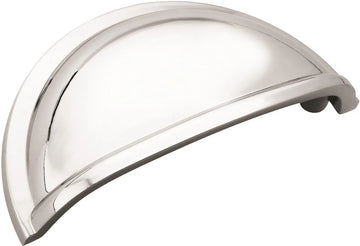
Cup Pulls 3'' cc Cabinet Cup Pull BP53010Polished Chrome
Amerock
Cup Pulls 3'' cc Cabinet Cup Pull BP53010Polished Chrome
$4.61
$5.42 -
 Amerock
Everyday Heritage 4'' cc Cabinet Pull BP76312Polished Chrome
Amerock
Everyday Heritage 4'' cc Cabinet Pull BP76312Polished Chrome
$2.28
$2.68 -
 Amerock
Edge Pull 5-1/16'' cc Cabinet Pull BP36575Polished Chrome
Amerock
Edge Pull 5-1/16'' cc Cabinet Pull BP36575Polished Chrome
$5.83
$6.85 -
 Amerock
Everyday Heritage 3-1/2'' cc Cabinet Pull BP867Brushed Chrome
Amerock
Everyday Heritage 3-1/2'' cc Cabinet Pull BP867Brushed Chrome
$2.03
$2.38 -
 Amerock
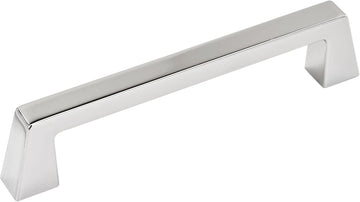
Blackrock 5-1/16'' cc Cabinet Pull BP55277Polished Chrome
Amerock
Blackrock 5-1/16'' cc Cabinet Pull BP55277Polished Chrome
$9.63
$11.32


Take the third in center-to-center, not in overall length
Nearly every page on this question tells you to apply the third to the overall length, tip to tip. I disagree, and it is not a small quarrel. Overall length is not a standardized number. Two pulls with identical 5 in centers can finish more than an inch apart tip to tip depending on how their ends are drawn: a squared-off bar with tight returns adds almost nothing past the holes, while a cup pull or a pull with swept feet adds a lot. So a rule expressed in a number the manufacturer decides on a whim is a rule you cannot shop with.
Center-to-center is the opposite. It is the measurement every listing leads with, it is the only one that has industry-standard steps behind it, and it is the number you have to mark on the drawer front anyway. Work in centers and the target you calculate is the target you can filter for. The cost of my version is that it runs a little tighter than the overall-length version, roughly one step smaller on a wide drawer, so the pull will look slightly more restrained than the charts elsewhere predict. On flat modern fronts I would take that trade every time; on a heavily framed traditional front, add a step back.
Centers by drawer front width, in sizes that exist
| Drawer front width | One third | Centers to buy |
|---|---|---|
| 12 in (305 mm) | 4 in | 3-3/4 in (96 mm) or 4 in (102 mm) |
| 15 in (381 mm) | 5 in | 5 in (127 mm) or 5-1/16 in (128 mm) |
| 18 in (457 mm) | 6 in | 6 in (152 mm) or 6-5/16 in (160 mm) |
| 24 in (610 mm) | 8 in | 7-9/16 in (192 mm) or 8 in (203 mm) |
| 30 in (762 mm) | 10 in | 10 in (254 mm), or two pulls |
Two entries in that table look like typographical errors and are not. Five inch and 128 mm are separate sizes about a sixteenth of an inch apart, and so are 6 in and 160 mm, because one lineage is imperial and the other is the European 32 mm system. Retailers and installers both say "five inch" for either. On a new drill that difference disappears into the clearance around the screw. Matching a pair of holes that are already bored is a different matter, and there I measure rather than assume.
When the target falls between two steps, go longer
A 21 in drawer wants 7 in centers, and 7 in is not a size. The choice is 6-5/16 in (160 mm) or 7-9/16 in (192 mm), and I take the longer one on flat slab and shaker fronts. A pull slightly over the third reads deliberate; a pull slightly under reads like it was on sale. Longer also grips better, and grip is the half of this decision that the proportion charts never price in.
The exception is a front with a raised or recessed panel. There, the eye measures the pull against the inner panel, not against the full width of the drawer, because the frame around the panel is read as edge rather than as field. On a 21 in shaker front with wide rails the panel might only be 16 in across, which pulls the target back down toward 5 in centers. Measure the panel, apply the third to that, and the hardware will sit inside the frame instead of appearing to burst out of it.
Use two or three lengths across a whole kitchen, not seven
Applied drawer by drawer, the rule generates a different length for nearly every cabinet, and a run of fronts with six slightly different pulls on them looks restless in a way nobody can name when they are standing in the room. Cabinet runs are read left to right as one line. Small differences along that line register as error rather than as proportion.
So I take the rule as a sorter rather than a calculator. Group the drawers into two or three families by width, pick one size per family, and accept that a few fronts carry a pull an inch off their ideal. In most kitchens that comes out as a short size for spice and utensil drawers, a middle size that covers the bulk of the base cabinets, and one long size for the pan drawers and the island. That is also the version of the rule that survives contact with a budget and with a reorder two years later, when you need four more of something and want to remember what it was.
Past 30 inches the question becomes leverage, not proportion
A 36 in drawer loaded with cast iron does not open straight when you pull it from one point in the middle. It skews, the slides bind at one corner, and over a few years that shows up as a drawer that needs a shove at the end of its travel. Two pulls fix the mechanics as well as the look, because a hand on each one squares the front as it comes out. Halve the drawer width, apply the third to each half, and you have your size: on a 36 in front, two 6 in pulls.
Place them by centering one pull in each half of the front, which puts their midpoints at the quarter points. Pushing them further toward the ends improves the leverage and starts to make one drawer look like two, so the quarter points are where I stop. If the client wants a single sweep instead, bar pulls are made long enough, and a 12 in center pull holds a 36 in front without argument. It is a fair choice; it just asks one hand to do work that two hands would share, and it draws a strong horizontal line that some kitchens do not want. Our guide to pull length for extra-wide drawer fronts runs further into that case.
Appliance panels are the one place I stop doing arithmetic. A panel-ready fridge or dishwasher is gripped against a door seal that resists, so the hardware is chosen for the force it takes rather than for the width it covers, which is why appliance pulls run far longer than a third of anything. Match the appliance run to the kitchen's longest drawer size rather than to its own width.
Two pull types that ignore the rule
Cup pulls are sold in a narrow band of centers and are meant to look small against their drawer, so scaling one up to a third of a wide front produces something that reads as a trough. On drawers past about 24 in, run two cup pulls or switch that run to bar pulls rather than hunting for an oversized cup. Knobs sidestep the rule entirely, since a knob has no length to proportion; on a drawer wide enough to want two knobs, set them where two pulls would go.
Measure so the number you order is the number you drill
Measure the drawer front itself, edge to edge, not the cabinet opening and not the box behind it. On a stack of drawers inside one base cabinet the fronts are all the same width, so one size covers the stack even though the bottom drawer is four times as deep as the top one. Depth changes nothing about the size decision. Then measure your existing pull, if there is one, from the center of one hole to the center of the other, not from end to end and not from the inside edges of the holes.
Before ordering for a whole kitchen, tape a paper cutout of the pull at its true centers onto the widest drawer and the narrowest one, and stand where you usually stand. Sizes that look convincing on a screen at arm's length behave differently at eight feet. If a run has odd widths and you want a second opinion on how to group them, that is exactly what our free design consultation is for.
Shop Cabinet Pulls & Handles
-
 Amwell Bar Pull 11 11/32'' Honey Bronze M2605
$22.59
Amwell Bar Pull 11 11/32'' Honey Bronze M2605
$22.59
-
 Retail Pack Hardware 3'' cc Bar Pull 400SN-R
$43.51
Retail Pack Hardware 3'' cc Bar Pull 400SN-R
$43.51
-
 Tahoe 128 mm cc Bar Pull 602-128SIM
$26.12
Tahoe 128 mm cc Bar Pull 602-128SIM
$26.12
-
 Additions Tab Pull 3'' TK103ORB2 Oil Rubbed Bronze
$12.06
Additions Tab Pull 3'' TK103ORB2 Oil Rubbed Bronze
$12.06
-
 Lafayette 128 mm cc Bar Pull 317-128SN
$19.91
Lafayette 128 mm cc Bar Pull 317-128SN
$19.91
-
 Barrington Brookline Knob 1 1/8'' Honey Bronze TK762HB
$10.13
Barrington Brookline Knob 1 1/8'' Honey Bronze TK762HB
$10.13
-
 Lafayette 96 mm cc Bar Pull 317-96SN
$17.90
Lafayette 96 mm cc Bar Pull 317-96SN
$17.90
-
 Zane 128 mm cc Bar Pull 293-128BNBDL
$17.57
Zane 128 mm cc Bar Pull 293-128BNBDL
$17.57


Browse all 8382 in Pulls & Handles → Cabinet knobs Cabinet pulls & handles