

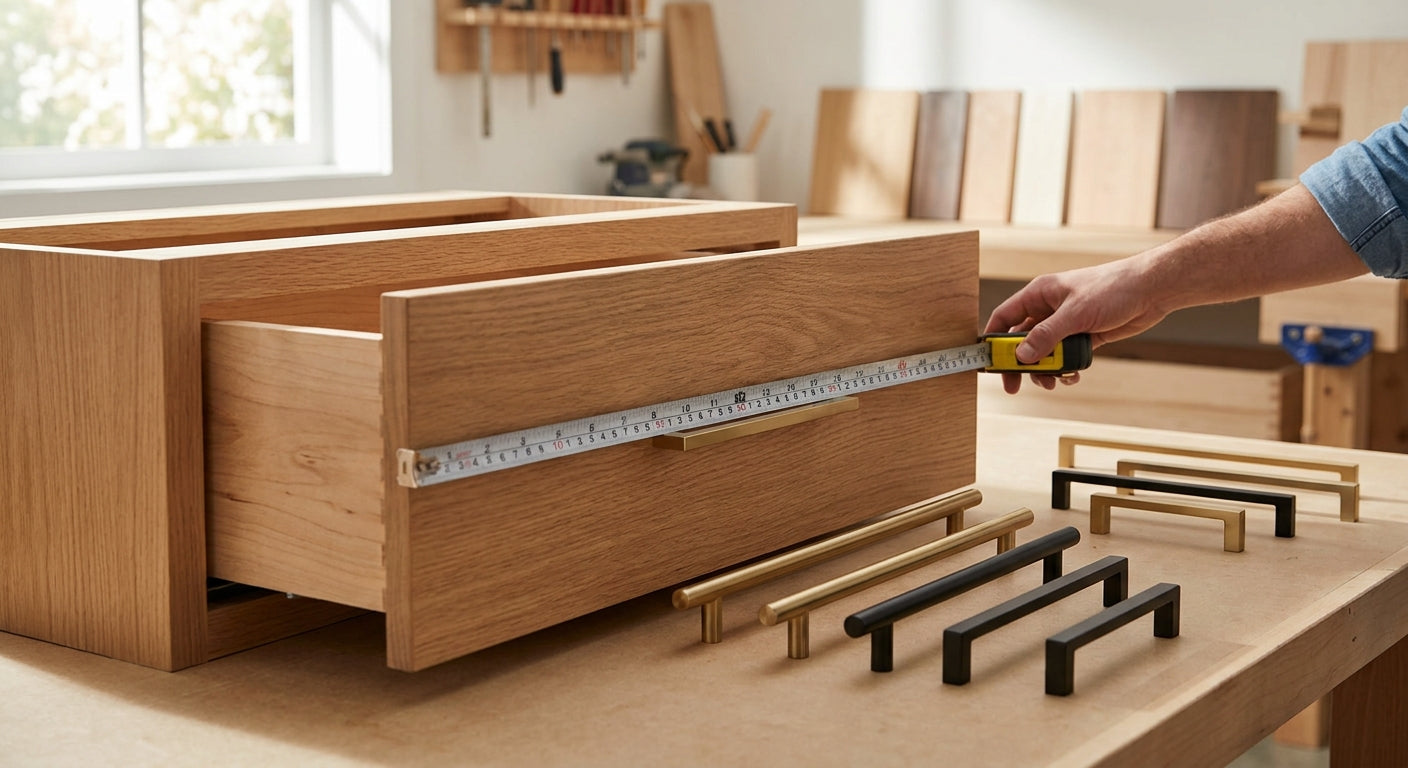
Extra-wide drawer fronts — anything past 30 inches, like island drawers, pull-out pantries, and file cabinets — make a standard 3-inch or 5-inch pull disappear into the slab like an afterthought. Getting pull length right for wide drawer fronts is a math problem with a design payoff, and it's one of the most common mistakes Knobs.co sees in cabinet hardware orders in 2026.
- Pull length for wide drawer fronts should run 1/3 to 1/2 of the front's width — a 30-inch front needs an 8 to 12-inch cc pull.
- Drawer fronts over 36 inches call for two pulls or a single 18 to 24-inch pull, never one short pull centered alone.
- Keep pulls at least 2 inches from each edge; tighter clearance reads as cramped on 2026-style flat-front cabinetry.
- Amerock's Winsome 12-inch appliance pull and Jeffrey Alexander's Belcastel 160mm bar pull both scale correctly for wide fronts — Buy.
Why this matters
Wide drawer fronts have gotten more common in 2026 kitchen layouts — island storage drawers, apron-front sink cabinets, and oversized pantry pull-outs regularly run 30 to 48 inches across. A pull sized for a 15-inch cabinet door looks stranded on a front that size; it reads as a design mistake, not a finish choice.
The fix isn't guesswork. Cabinet hardware scales to width using a simple ratio, and getting the pull size for a kitchen island right is the same math you'll apply to any oversized front. Get the length wrong in either direction — too short or too long — and the hardware fights the cabinetry instead of finishing it.
What you'll need
- A tape measure and a pencil
- The actual drawer front width, measured face to face (not the cabinet box opening)
- Painter's tape to mock up placement before drilling
- A cabinet hardware jig if you're installing more than a handful of fronts
- A drill bit sized to the pull's screw diameter
- A shortlist of cc lengths that fit your width — see the table below
The steps
1. Measure the actual drawer front, not the opening
Pull out the drawer and measure the wood front itself, edge to edge. Cabinet openings and overlay reveals throw this number off by half an inch or more, which matters once you're centering a 12-inch or 18-inch pull. Write the number down before you shop — a 34-inch front and a 30-inch front land in different length brackets. Common mistake: measuring the cabinet box instead of the actual drawer face, which shifts your centerline.
2. Apply the one-third to one-half rule
Pull length for wide drawer fronts should span roughly a third to half of the front's width. A 30-inch front looks proportionate with an 8-inch to 12-inch center-to-center (cc) pull; a 24-inch front wants something closer to 6 to 9 inches cc. The Jeffrey Alexander Belcastel bar pull at 160mm cc (about 6.3 inches) sits right in that range for a 24-to-27-inch front — Buy for mid-width drawers that don't quite qualify as extra-wide. Undersize this ratio and the pull looks like a placeholder; oversize it and it competes with the drawer's proportions instead of framing them.
3. Separate cc length from overall pull length
Cc measures the distance between the two screw holes — it's the number that has to match your pre-drilled holes or new drilling layout. Overall pull length is longer once you add end caps or ornamental finials, sometimes by an inch or more on decorative styles. Order by cc first, then confirm the overall length fits your clearance math from step 4. Skipping this step is the single most common return reason on long pulls in 2026 — the cc was right, but the finial made the piece 2 inches longer than expected.
4. Set edge clearance before you center anything
Keep at least 2 inches of bare wood between the end of the pull and the edge of the drawer front; extra-wide fronts read better with 3 inches of breathing room on each side. This clearance is what keeps a long pull from looking like it's spilling off the drawer. Tape the pull's actual footprint to the front and step back 6 feet before committing to a drill mark.
5. Decide between one long pull and two pulls
Once a drawer front crosses 36 inches, a single pull almost never looks right, no matter how long you order. Cabinetmakers switch to two pulls spaced at roughly the quarter points of the width, or step up to an 18-to-24-inch single pull for fronts in the 36-to-42-inch range. The Amerock Winsome 12-inch cc appliance pull works well as one half of a two-pull layout on a 40-inch front — Buy for that specific use, Skip it as a lone centered pull on anything over 36 inches; it will look too small by itself.
6. Confirm hole spacing against the drawer box before drilling
Check that your chosen cc length lands on solid wood, not over a drawer box joint or slide bracket. Extra-wide fronts sometimes have center rails or reinforcement blocks that a long pull's screws can hit. Dry-fit with tape and a scrap screw before you commit to a hole in the finished front. Common mistake: drilling a beautiful 18-inch pull into position only to discover the right-hand screw lands on a drawer box corner brace.
When length alone isn't the whole story
On statement pieces — a media console, a formal dining sideboard, a wide file drawer in a home office — pull length is only part of the read. Ornamental long pulls with finials scale the same way structurally but carry more visual weight per inch, so the one-third rule can flex toward the lower end of the range.


Verdict comparison
| Drawer front width | Recommended pull length (cc) | Layout |
|---|---|---|
| 24-27 in | 6-9 in | Single centered pull |
| 28-33 in | 8-12 in | Single centered pull |
| 34-40 in | 12-18 in | Single pull or two pulls |
| 40 in+ | 18-24 in or two pulls | Two pulls at quarter points recommended |
Troubleshooting
- Pull looks too short and floating on a wide front. Recalculate against the one-third rule — you likely undersized the cc length for the actual measured width, not the cabinet opening.
- Pull ends touch the drawer edge. You've violated the 2-inch minimum clearance. Size down the cc length or shift to a two-pull layout instead of forcing one long pull.
- Two-pull spacing looks uneven. Measure from the true edges of the drawer front, not the visible reveal, and split the width at the quarter points rather than eyeballing it.
- Ordered the wrong overall length. You confused cc with overall pull length — decorative finials on styles like the Versailles long pull add length beyond the screw-hole measurement, so always check both numbers before drilling.
- Hardware finish clashes across drawer sizes. Wide-front pulls and narrower cabinet pulls should share a finish family even when lengths differ; mixing polished nickel with honey bronze on adjacent cabinetry reads as inconsistent, not eclectic.
Tools and resources
- Tape measure, pencil, and painter's tape for the mockup stage
- A cabinet hardware jig for repeat installs across multiple wide fronts
- The measuring cabinet pull hole spacing guide for getting cc numbers right before you order
- A shortlist of cc options in the 8-to-24-inch range, sourced from Knobs.co's cabinet hardware catalog
What to do next
Once you've locked pull length, the next variable is finish and style consistency across a room with mixed drawer widths — narrow vanity drawers next to a wide island drawer need a plan that ties them together rather than treating each cabinet in isolation.
FAQ
What is the best pull length for a 36-inch drawer front?
A 36-inch drawer front works best with an 18-to-24-inch cc pull or two shorter pulls set at the quarter points in 2026 layouts. Anything under 12 inches looks undersized once the front crosses this width.
Is one long pull better than two pulls on a wide drawer?
Below 36 inches, one centered pull usually reads cleaner; above 36 inches, two pulls balance the width better than a single very long pull. The choice comes down to the drawer's actual measured width, not personal preference alone.
How much clearance should a pull have from the drawer edge?
Keep at least 2 inches of clearance between the pull's end and the drawer edge, and bump that to 3 inches on extra-wide fronts. Tighter spacing makes the hardware look crowded against the panel.
Does cc length include the pull's finial or end caps?
No, cc length only measures the distance between the two screw holes. Decorative pulls with finials, like Carpe Diem Hardware's Versailles line, add length beyond the cc number, so check overall length separately before ordering.
How wide does a drawer front need to be for two pulls?
Most cabinetmakers switch to two pulls once a drawer front passes 36 to 40 inches. Below that range, a single 12-to-18-inch cc pull still reads proportionate.
What pull length works for a kitchen island drawer?
Kitchen island drawers commonly run 30 to 36 inches wide and pair well with an 8-to-18-inch cc pull depending on the exact measurement. Wider island drawers over 36 inches often move to a two-pull layout instead.
Can I use the same pull length across different drawer widths?
No — pull length should scale to each drawer's actual width using the one-third to one-half ratio. A pull sized for a 24-inch drawer will look undersized on a 40-inch drawer even if the finish matches.
“If the pull looks like an afterthought, it's too short for the drawer.”
One last thing
The number that trips up most orders isn't cc length — it's the gap between cc and overall length on ornamental pulls. A 12-inch cc pull with a decorative finial can measure 13.5 inches end to end, and on a 30-inch front that extra inch and a half is the difference between correct clearance and a pull that crowds the edge. Check both numbers before you drill, every time, in 2026 and beyond.