

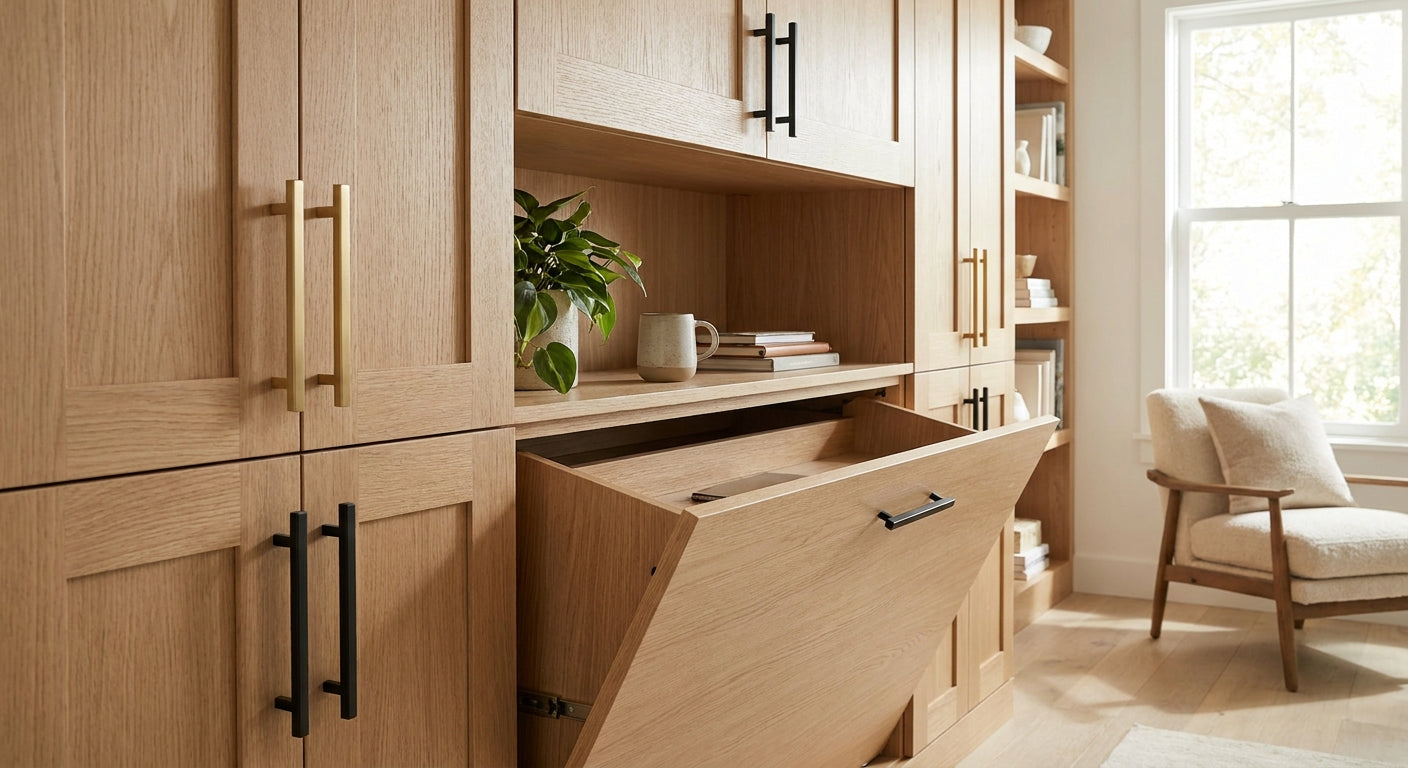
Fold-down Murphy desk cabinets ask more of a cabinet pull than a kitchen drawer ever will: the same hardware you grab to open the cabinet becomes part of the surface you write on once the door drops flat. Projection, grip angle, and mounting depth matter more here than finish or style, and picking the wrong pull means catching your knee on it every single day.
- The Curved Push-Pull Set 2-3/4 x 13 is the buy for cabinet pulls for Murphy desk cabinets in 2026.
- Top Knobs TK320HB Chareau Reeded Knob holds projection under 1-1/4 inches, safe for fold-down clearance.
- Skip bar pulls past 6.5 inches on Murphy desk doors; they catch knees when the panel drops flat.
- Mount hardware at least 2 inches from the hinge edge so the fold mechanism never binds.
Shop the picks from this guide
In stock at Knobs.co · Free shipping on hardware orders $99+ · 110% price match
-
 Alno
Alno A1032 1'' Brass Cabinet KnobPolished Brass
Alno
Alno A1032 1'' Brass Cabinet KnobPolished Brass
$13.46
$14.95 -
 Alno
Alno A726 Charlie's 3 1/2'' CC Cabinet PullAntique English / 3''
Alno
Alno A726 Charlie's 3 1/2'' CC Cabinet PullAntique English / 3''
$24.26
$26.95 -
 Alno
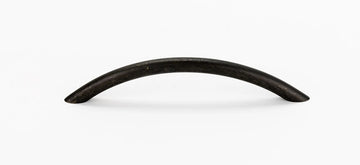
Alno A1298 128mm 5'' CC Brass Cabinet PullBarcelona
Alno
Alno A1298 128mm 5'' CC Brass Cabinet PullBarcelona
$19.76
$21.95 -
 Alno
Alno A1033 1 1/8'' Brass Cabinet KnobPolished Brass
Alno
Alno A1033 1 1/8'' Brass Cabinet KnobPolished Brass
$18.86
$20.95 -
 Alno
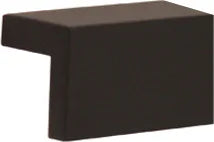
Alno A960 Tab 1 1/2'' CC Brass Cabinet PullBronze / 3/4''
Alno
Alno A960 Tab 1 1/2'' CC Brass Cabinet PullBronze / 3/4''
$16.16
$17.95 -
 Alno
Alno A1145 1 1/4'' Brass Cabinet KnobBarcelona
Alno
Alno A1145 1 1/4'' Brass Cabinet KnobBarcelona
$17.96
$19.95


Why this matters
A Murphy desk cabinet door does double duty. Closed, it's a vertical panel. Open, it's a horizontal desk surface holding a laptop, a lamp, maybe a stack of mail. Any pull mounted on that panel has to survive being pulled hundreds of times a year and then sit flush enough that it doesn't dig into your forearm while you type.
Most cabinet hardware guides treat pulls as a style decision. On a fold-down desk, pull choice is a mechanical decision first. Browse the full cabinet hardware range at Knobs and you'll notice the pulls that work best for this application share three traits: low projection, a rounded grip edge, and solid metal construction that won't loosen after repeated stress. Get those three right in 2026 and the rest — finish, brand, price — is preference.
Who this is for
This guide is for anyone converting a closet, built-in, or dedicated cabinet into a fold-down home office: DIYers building a Murphy desk from a kit, cabinetmakers fabricating custom millwork, and homeowners retrofitting an existing Murphy bed cabinet with a companion desk unit. If you're shopping cabinet pulls for a Murphy desk and the door needs to double as your worktop, the criteria below apply directly to you.
What to look for in cabinet pulls for a Murphy desk
Projection depth
Projection is the distance the pull sticks out from the door face. On a Murphy desk, anything over 1-1/2 inches of projection becomes an obstacle once the panel is horizontal — it sits right where your wrist rests. Pulls in the 3/4 to 1-1/4 inch range clear that problem without disappearing entirely.
Knob, pull, or push-latch mechanism
A standard bar pull works fine on a kitchen cabinet you open once a day. On a Murphy desk you're opening and closing the same panel constantly, so a recessed cup pull or push-latch mechanism that sits flush when closed reduces the number of things you can snag on while working. Knobs are the middle ground: low profile, easy to grip, but they do protrude a fixed amount no matter what.
Grip clearance for fingers
You need enough gap behind the pull to get two fingers in comfortably, even with the desk fully loaded. Pulls with a tight radius or sharp inside edge look fine in a photo and feel bad every time you use them for real.
Mounting hole spacing and screw length
Murphy desk fold-down fronts are often 3/4-inch MDF or plywood, thinner than a standard face-frame cabinet door. Standard screws that work on a 1-inch door can strip out or poke through a thinner panel. Confirm screw length before you order, especially if the pull's stock screws are sized for a thicker substrate.
Finish durability under repeated contact
This pull gets touched every time the desk opens or closes. Plated finishes with a thin top coat wear faster under that kind of daily contact than solid brass, bronze, or stainless steel. Budget hardware finishes fine in a guest bathroom; they show wear inside 18 months on a daily-use desk pull.
Placement relative to the fold hinge
Mount the pull too close to the hinge edge and it interferes with the fold mechanism at full extension. Keep at least 2 inches of clearance between the pull's inside edge and the hinge line so nothing binds when the panel swings down.
Top picks for cabinet pulls for a Murphy desk
Curved Push-Pull Set 2-3/4" x 13" — the safe pick. This is a recessed cup-style pull with a 2-3/4 inch projection depth, which is about as low-profile as cabinet hardware gets while still giving you a real finger grip. No protruding knob, no sharp edge catching your sleeve when the desk is open. Buy.
Top Knobs TK3265HB Garrison 7.9" — the wildcard. A longer bar pull gives you a full-hand grip for lifting a heavier fold-down panel, and at just under 8 inches it distributes force better than a small knob on a wide door. It's the pick if your Murphy desk panel is solid wood and heavier than average, but check that 7.9 inches doesn't land in your knee zone before you drill. Consider.
Top Knobs TK320HB Chareau Reeded Knob 1-1/4" — the compact grip. A 1-1/4 inch diameter knob keeps projection tight and works well on desks where the pull needs to sit near the top edge without dominating the panel visually. It's a smaller target to grab than a pull, which matters less once you've used it a few weeks. Buy.
Schaub and Company 704-PN Traditional Round Knob Polished Nickel 1-1/2" — the budget classic. A 1-1/2 inch round knob in polished nickel, priced like a standard cabinet knob because it is one — no Murphy-specific engineering, just a solid, low-projection option that does the job without ceremony. Consider.
Britannia Victoria Knob 1-1/4" Pewter Antique — looks right, grips wrong. The ornate backplate and antique pewter finish photograph beautifully on a traditional kitchen door, but the raised detailing on the backplate is exactly the kind of texture that catches a sleeve on a panel you're opening several times a day. Skip for this application specifically.
What to avoid
- Bar pulls over 8 inches. They look proportional on a wide Murphy desk face but the extra length puts more of the pull directly in your lap zone once the panel folds flat.
- Heavily textured or hammered finishes. Attractive on a stationary cabinet door, uncomfortable under repeated hand contact and prone to catching fabric.
- Lightweight pot-metal hardware. It's fine for low-traffic cabinets. On a pull that flexes under daily use, cheap castings loosen and rattle within a year — read more on hardware built for constant-use doors in the guide to cabinet hardware for Murphy bed cabinet doors.
Verdict comparison
| Pick | Projection | Best for | Verdict |
|---|---|---|---|
| Curved Push-Pull Set 2-3/4" x 13" | 2-3/4 in | Daily fold-down use, minimal snag risk | Buy |
| Top Knobs TK3265HB Garrison 7.9" | Standard bar pull length | Heavier solid-wood panels | Consider |
| Top Knobs TK320HB Chareau Reeded Knob | 1-1/4 in diameter | Compact desks, top-edge mounting | Buy |
| Schaub 704-PN Traditional Round Knob | 1-1/2 in diameter | Budget-conscious builds | Consider |
| Britannia Victoria Knob | 1-1/4 in diameter | Stationary doors only, not fold-down | Skip |
FAQ
What's the best cabinet pull for a fold-down Murphy desk?
A recessed cup-style push-pull with under 3 inches of projection, like the Curved Push-Pull Set 2-3/4 x 13, works best because it stays flush enough to avoid snagging when the panel is horizontal.
Should I use a knob or a pull on a Murphy desk cabinet?
Knobs generally work better than long bar pulls on Murphy desk doors because they protrude less and don't sit across your working surface. A compact knob under 1-1/2 inches in diameter is the safer default for 2026 builds.
How much clearance do I need behind a Murphy desk pull?
Leave at least 2 inches of clearance between the pull and the hinge edge so the fold mechanism doesn't bind, and enough room behind the grip for two fingers even with the desk loaded.
Can I use a bar pull on a fold-down desk cabinet?
Yes, but keep it under 6.5 to 7 inches and mount it away from where your knees or forearms rest once the panel is open. Longer bar pulls increase the chance of catching on clothing during daily use.
What screw length works for Murphy desk hardware?
Check panel thickness before ordering; many Murphy desk fold-down fronts run 3/4-inch MDF or plywood, thinner than standard cabinet doors, and stock screws sized for a 1-inch door can strip out.
Is a finger pull better than a knob for flush Murphy cabinets?
A finger pull or edge pull works well on frameless, handleless designs where you want zero visible hardware, but it requires more precise routing than a surface-mounted knob or pull.
How do I keep the pull from catching on my knees when the desk is open?
Choose a pull with a projection under 1-1/4 inches and mount it near the top edge of the panel rather than centered, keeping it away from where your legs sit once the desk is down.
One last thing
The detail most people miss: a cup-style push-pull like the Curved Push-Pull Set has essentially zero projection when the Murphy desk is closed, but the curved lip still gives you a real finger hold when it's time to open it. That's the trade-off that makes it the buy for this specific application in 2026 — you get a grip when you need one and a flush surface the rest of the time.


