

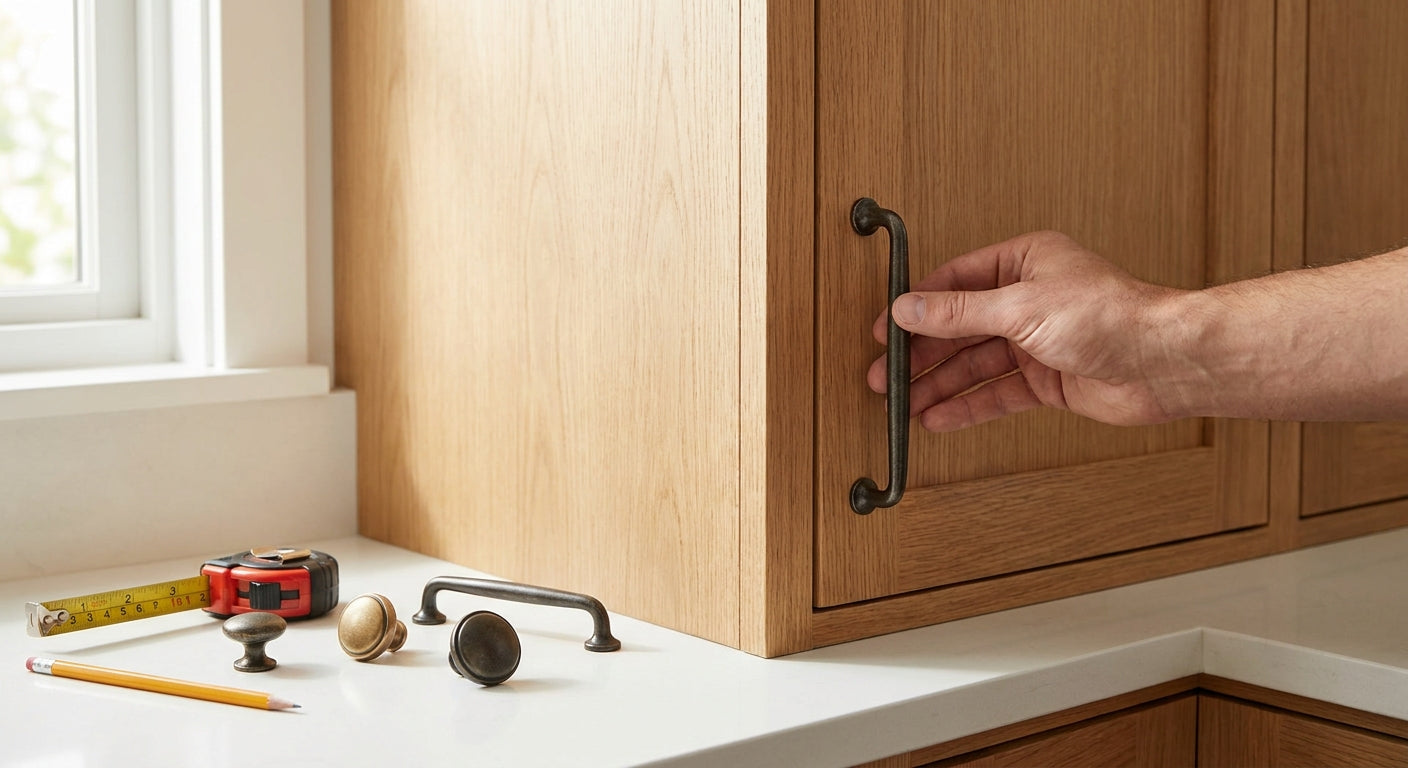
Corner cabinets confuse even people who've hung a hundred drawer pulls, because the rules for flat doors don't hold once you're dealing with a blind panel, a lazy susan, or a diagonal corner unit. Get the placement wrong and you end up with a pull that looks stranded on an angled stile or a knob that collides with the adjacent cabinet door every time you open it.
Shop the finish
Every oil-rubbed bronze knob and pull we carry, in one place — filter by size, style, and brand.
Browse Oil-Rubbed Bronze Cabinet Hardware →- Cabinet hardware placement for corner cabinets follows standard reveal rules on flat doors but shifts on blind, diagonal, and lazy susan units — center on the visible stile, not the box.
- Use 2 1/2 to 3 inches from the top corner for upper cabinet knobs and 2 1/2 to 3 inches from the bottom corner for base cabinet knobs in 2026 kitchens.
- Diagonal corner doors need pulls mounted vertically near the hinge-side edge so the door clears the neighboring cabinet when swung open.
- A cabinet hardware jig removes the guesswork on angled stiles — buy one before you drill a single corner door in 2026.
- Blind corner cabinets with swingout hardware need pull placement that clears the mechanism's travel path, not just the door face.
Shop the picks from this guide
In stock at Knobs.co · Free shipping on hardware orders $99+ · 110% price match
-
 Amerock
Edona 1-1/4'' diam Cabinet Knob BP53005Polished Chrome
Amerock
Edona 1-1/4'' diam Cabinet Knob BP53005Polished Chrome
$3.21
$3.77 -
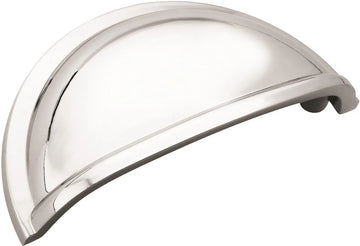 Amerock
Cup Pulls 3'' cc Cabinet Cup Pull BP53010Polished Chrome
Amerock
Cup Pulls 3'' cc Cabinet Cup Pull BP53010Polished Chrome
$4.61
$5.42 -
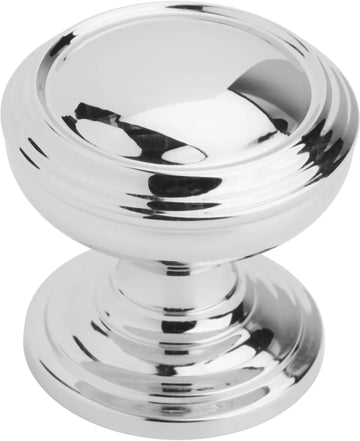 Amerock
Revitalize 1-1/4'' diam Cabinet Knob BP55342Polished Chrome
Amerock
Revitalize 1-1/4'' diam Cabinet Knob BP55342Polished Chrome
$6.42
$7.55 -
 Amerock
Edge Pull 5-1/16'' cc Cabinet Pull BP36575Polished Chrome
Amerock
Edge Pull 5-1/16'' cc Cabinet Pull BP36575Polished Chrome
$5.83
$6.85 -
 Amerock
Ravino 1-1/4'' diam Cabinet Knob BP53012Polished Chrome
Amerock
Ravino 1-1/4'' diam Cabinet Knob BP53012Polished Chrome
$2.79
$3.28 -
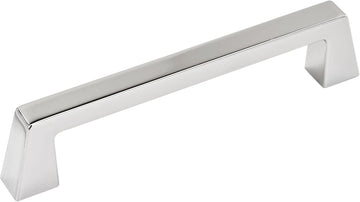 Amerock
Blackrock 5-1/16'' cc Cabinet Pull BP55277Polished Chrome
Amerock
Blackrock 5-1/16'' cc Cabinet Pull BP55277Polished Chrome
$9.63
$11.32


Why this matters
A corner cabinet isn't a smaller version of a flat cabinet — it's a different geometry problem. Diagonal doors have an angled stile instead of a straight one, blind corners hide half the cabinet behind the neighboring unit, and lazy susans rotate, which means the door swing radius has to clear the pull without smacking the counter or the adjacent cabinet box.
Get corner hardware placement wrong and the mistake is visible every time someone opens that cabinet — a knob that's off-center on an angled door reads as a mistake even to guests who couldn't tell you why it looks off. Knobs.co has spent two decades fielding exactly this question from homeowners and installers, and the fix is almost always the same: measure the visible face, not the theoretical centerline. Cabinet hardware placement done right on corner units also affects how your lazy susan operates day to day — see the lazy susan installation guide for how the hardware and the rotating shelf interact.
What you'll need
- Tape measure (metal, at least 10 feet)
- Painter's tape for marking hole locations before drilling
- A center-finding cabinet hardware jig, or a paper template if you're working freehand
- Drill with 3/16-inch and 1/8-inch bits (bit size depends on the screw supplied with your hardware)
- Level, small (4 to 6 inches)
- Pencil with a fine point — not a marker, which smears on painted doors
- The actual pulls or knobs you're installing, not a substitute — spacing and backplate size change the math
- 30 to 45 minutes per corner cabinet, longer if you're retrofitting over old holes
The steps
1. Identify which type of corner cabinet you have
This determines everything downstream. A diagonal corner base cabinet has a single angled door on the front corner. A blind corner cabinet has a full-size door on one side and a hidden, unusable void behind the neighboring cabinet. An upper corner cabinet is usually diagonal with a lazy susan or a two-door Susan-style configuration.
Misidentifying the type is the single biggest reason placement goes wrong — the diagonal-door math doesn't apply to a blind corner door, and vice versa. Take a photo of the open cabinet before you measure anything.
2. Measure the visible door face, not the cabinet box
On a diagonal door, the visible face is a trapezoid, not a rectangle. Measure the width of the door at the point where you plan to place the pull or knob, not the widest point of the door.
For a knob, standard placement on any door in 2026 remains 2 1/2 to 3 inches diagonally from the corner nearest the opening edge. On a diagonal corner door, use the same 2 1/2 to 3 inch offset from the top corner on uppers and the bottom corner on base cabinets, measured from the point where the door actually opens away from the frame.
Common mistake: measuring from the geometric center of the door instead of the opening-side corner. On an angled door this puts the knob visually closer to the hinge side, which looks backward every time the door swings open.
3. Mount pulls vertically on diagonal doors, not horizontally
Horizontal pulls on a flat cabinet face look standard. On a diagonal corner door, a horizontal pull reads as crooked because the door edge itself is angled relative to the room.
Mount pulls vertically, centered top-to-bottom on the door stile nearest the opening edge, roughly 2 1/2 inches in from that edge. This keeps the sightline straight regardless of the door's angle. A 6 1/2-inch pull like the Atlas Homewares Tustin pull works well here because the length gives your hand clearance without extending past the narrow stile width common on diagonal doors.
4. Account for the swing radius on blind corner cabinets
Blind corner cabinets often carry swingout hardware that rotates shelving out of the hidden void. That mechanism has a travel path, and your pull placement has to clear it when the door is fully open, not just when it's closed.
Open the door fully and manually cycle the swingout mechanism (if installed) before marking your final hole locations. If the pull sits where the swingout arm passes, you'll hear a scrape or a jam within the first few weeks of use.
Common mistake: placing the pull based on the closed-door position only, then discovering the swingout mechanism clips it on the first full rotation.
5. Use a jig for angled stiles — freehand measuring fails more often here
Standard flat-door pull placement forgives a little drift because the door is a rectangle and your eye doesn't catch a 1/8-inch offset easily. Angled doors are less forgiving — any drift shows up against the diagonal line of the door edge.
A cabinet hardware jig with an adjustable center-finder removes this risk. Clamp it to the stile, set the offset, and drill through the template rather than eyeballing a pencil mark. If you're outfitting more than two or three corner cabinets in the same kitchen, the jig pays for itself in avoided redrills.
6. Check clearance against the adjacent cabinet before drilling
Corner cabinets sit next to another cabinet box by definition, and that neighboring unit limits how far out a pull can sit. Open the corner door fully and measure the gap between your planned pull location and the face of the adjacent cabinet.
You need at least 1/2 inch of clearance between the outermost point of the pull and the neighboring cabinet face when the door is fully open. Less than that, and the pull will scuff the neighbor's finish every time the cabinet opens.
7. Drill a test hole in scrap or an inconspicuous spot first
Before committing to the finished door, drill your pilot hole pattern into a scrap piece of the same material, or into the inside face of the door if it's not visible when open. This confirms bit size matches the screw thread and that your jig offset is correct.
Skipping this step is the most common reason installers end up with an oversized hole they have to patch and refinish.


“On a diagonal corner door, measure from the opening-side corner, not the geometric center — that single habit fixes most corner hardware complaints.”
Troubleshooting
- The pull looks off-center once the door is open. You likely measured from the wide point of the diagonal door instead of the opening-side edge. Remeasure from the corner where the door swings away from the frame.
- The knob collides with the countertop edge. Base cabinet corner doors sometimes run closer to the counter than flat doors. Drop your knob placement 1/2 inch lower than standard 2026 spec to clear granite or quartz overhangs.
- The swingout mechanism catches the pull. Cycle the mechanism through a full rotation before final drilling — see step 4. If it's already installed, you may need to relocate the pull toward the hinge side by an inch or two.
- Old screw holes don't line up with new hardware. Corner cabinets rarely share hole spacing across brands. Fill and refinish the old holes rather than forcing a mismatched pull into place.
- The pull looks fine closed but hits the adjacent cabinet when open. Recheck clearance per step 6 — a 1/2-inch gap standard on flat doors often isn't enough on a corner unit where the door swings toward the neighbor.
- The jig won't sit flush on the angled stile. Some jigs are built for 90-degree edges only. Confirm the jig has an adjustable angle setting before buying it for corner cabinet work.
Tools and resources
- A cabinet hardware jig with adjustable center-finding, covered in more detail in the jig guide for perfect placement
- A tape measure and a small level for the reveal checks in steps 2 and 6
- Reference photos of your specific cabinet type (diagonal, blind, or lazy susan) taken before you start
- Knobs.co stocks pulls sized for narrow diagonal stiles alongside blind corner swingout hardware, so you're not stuck retrofitting mismatched brands mid-project
What to do next
Once corner cabinet hardware is placed correctly, the next failure point is usually hole spacing on the rest of the kitchen's pulls — a 3-inch spacing pull looks wrong next to a 5-inch spacing pull even if both are centered correctly. Confirm your spacing is consistent across the whole run before you drill the last cabinet.
FAQ
What's the best cabinet hardware placement for corner cabinets?
Center the pull or knob on the visible door stile nearest the opening edge, using a 2 1/2 to 3 inch offset from the corner, rather than measuring from the geometric center of an angled door. This keeps the hardware visually straight even on a diagonal face.
Is vertical or horizontal pull placement better on a diagonal corner door?
Vertical placement is better on diagonal corner doors because a horizontal pull reads as crooked against the angled door edge. Mount the pull vertically near the opening-side stile, centered top-to-bottom.
How much clearance do I need between a corner cabinet pull and the next cabinet?
Leave at least 1/2 inch between the outermost point of the pull and the neighboring cabinet face when the corner door is fully open. Less clearance causes the pull to scuff the adjacent finish over time.
Do blind corner cabinets need different hardware placement than diagonal cabinets?
Yes. Blind corner cabinets have a full-size door on the accessible side and hidden swingout hardware, so pull placement has to clear the swingout's travel path, not just the closed-door position.
Should I use a jig for corner cabinet hardware placement?
A jig is worth using on any diagonal or angled door because freehand measuring drifts more visibly against an angled edge than on a flat rectangular door. It pays off fastest when you're doing more than two or three corner cabinets.
How do I fix a corner cabinet knob that's already off-center?
Fill the old hole with wood filler matched to the door finish, sand smooth, and redrill using the opening-side corner as your reference point rather than the door's visual center.
What size pull works best on a narrow diagonal corner stile?
A pull in the 5 to 6 1/2 inch range typically fits narrow diagonal stiles without extending past the usable door width. Measure your specific stile before ordering since diagonal doors vary more in width than flat doors.
Does lazy susan hardware change where I place the door pull?
Lazy susan doors still take standard knob or pull placement on the door face, but you need to confirm the rotating shelf's swing radius doesn't strike the pull when the unit spins, especially on tightly packed upper corner cabinets.
One last thing
The detail installers miss most in 2026 isn't the math — it's checking the door swing with the cabinet fully loaded, not empty. A corner door that clears fine when empty can catch on a full lazy susan shelf or a loaded swingout tray, so do your final clearance check after the cabinet has its actual contents in place, not before.


