

Closet Cabinet Hardware: Choose It for Clothes, Not Kitchens
Projection, front thickness and rod profile decide a closet's hardware long before finish does, and closets break the kitchen rules anyway.

Buy closet cabinet hardware for how far it stands off the door, not for how it looks against the front. Clothes move past this hardware every day, and a pull with a deep grip catches knits, belt loops and the shoulder of whatever hangs in front of it. Low projection first, then size it to fronts narrower than any kitchen drawer, then check what the drawer boxes are actually made of before you buy a single screw. One thing changes that order. If the closet doors are visible from the bedroom, they are furniture, and the finish has to answer to the room rather than to the clothes.
Shop the finish
Every black knob and pull we carry, in one place — filter by size, style, and brand.
Browse Black Cabinet Hardware →Shop the picks from this guide
In stock at Knobs.co · Free shipping on hardware orders $99+ · 110% price match
-
 Amerock
Everyday Heritage 3'' cc Cabinet Pull BP865Polished Chrome
Amerock
Everyday Heritage 3'' cc Cabinet Pull BP865Polished Chrome
$1.92
$2.25 -
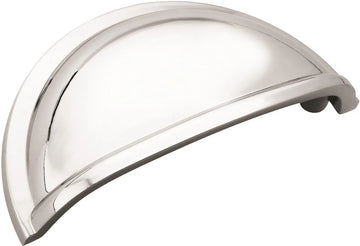 Amerock
Cup Pulls 3'' cc Cabinet Cup Pull BP53010Polished Chrome
Amerock
Cup Pulls 3'' cc Cabinet Cup Pull BP53010Polished Chrome
$4.61
$5.42 -
 Amerock
Everyday Heritage 4'' cc Cabinet Pull BP76312Polished Chrome
Amerock
Everyday Heritage 4'' cc Cabinet Pull BP76312Polished Chrome
$2.28
$2.68 -
 Amerock
Edge Pull 5-1/16'' cc Cabinet Pull BP36575Polished Chrome
Amerock
Edge Pull 5-1/16'' cc Cabinet Pull BP36575Polished Chrome
$5.83
$6.85 -
 Amerock
Everyday Heritage 3-1/2'' cc Cabinet Pull BP867Brushed Chrome
Amerock
Everyday Heritage 3-1/2'' cc Cabinet Pull BP867Brushed Chrome
$2.03
$2.38 -
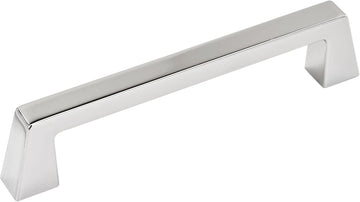 Amerock
Blackrock 5-1/16'' cc Cabinet Pull BP55277Polished Chrome
Amerock
Blackrock 5-1/16'' cc Cabinet Pull BP55277Polished Chrome
$9.63
$11.32


Projection is the spec nobody lists, and the one that bites in a closet
Projection is how far the grip sits out from the door face. In a kitchen it is invisible. In a closet the clothes come to the hardware instead of the other way round, so it governs everything. A wardrobe door that swings past a hanging section rakes its pull across sleeves on every open, and a drawer bank under a rail sits beneath a row of garments reaching down toward it. Tab and edge pulls were made for this problem. They stay close to the plane of the front, or fold over its top edge, so fabric has nothing to hook.
The cost of that choice is grip. A low-profile pull is harder to catch with cold hands, or with a hand already holding something, and an edge pull needs a free edge to fold over, which rules it out on inset fronts and on any drawer running tight under a fixed shelf. Where a drawer bank faces open floor with nothing hanging above it, I take the deeper grip and put bar pulls on that run. Before anyone orders, I ask them to walk the closet with everything open and look at what passes within a hand's width of each front. That two-minute check sorts the hardware into two piles better than any style rule.
Closet fronts are thinner than kitchen doors, so the screw comes before the style
Closets get built out of sheet goods far more often than kitchens do. Melamine and veneered panel fronts, particularly on component systems, are routinely thinner than the three-quarter-inch door that hardware is packed for. Cabinet screws are 8-32 thread, and the one-inch screw in the bag suits three-quarter stock. Send it through a thinner front and it stands proud on the inside face, where it snags folded cotton and scores the back of a shirt box. On closet work I ask for break-away screws, the kind scored so you can snap them shorter, and the problem goes away before it starts.
The other habit worth breaking is treating a particle core like wood. A stripped hole in melamine does not heal. You get one pass, so drill the pilot, start the screw by hand and stop the moment it seats. When a hole is already spun, the repair is not more torque, it is a backplate with different centers than the ruined pair, so the new screws bite sound material while the plate covers what went wrong. The mistake I see most often in closets is someone snugging up a loose knob every few weeks for a year instead of moving it half an inch.
What your hands are carrying decides knob against pull
At a kitchen cabinet you usually arrive with one hand free. At a closet you arrive holding an armload, and that single difference does more work than any door-style guide. A knob asks for a pinch between thumb and finger, which is the grip you lose first when your arms are loaded. A pull takes a hooked finger, which you keep. So I put pulls on everything opened while carrying, and knobs where opening is deliberate: a shallow accessory drawer, a small door at eye level, a jewelry bank you stand still in front of.
Hooks belong in the same conversation and get left out of it. The hardest-working piece of hardware in most closets is the one holding tomorrow's shirt, and a single hook inside a door earns its place faster than a matched set of pulls. I buy it in the same family as the pulls so it reads as part of the scheme.
Rod brackets are four different parts, and the wrong one arrives more often than not
In twenty years of this, the bracket is the part I have watched people order wrong most often. A closed socket flange caps the end of a rod and holds it captive, so the rod cannot be lifted out once the run is up. An open flange, sometimes sold as a saddle, is a cradle the rod drops into, which is what you want when a rod must come out for painting or when the run is long enough to need flexing into place. A shelf-and-rod bracket carries the shelf above and the rod below on one piece of steel, and it is the part a closet with a full-length shelf actually needs. A center support is a mid-span piece only, screwed up into the underside of the shelf.
Match the bracket to the rod profile before the finish, because oval and round rods take differently shaped saddles and will not swap. Round rods sell in two common diameters, and the smaller one is what people mean when they search for a one-inch bracket, so measure the rod you have rather than trusting the number in your head. Span is the other decision: most makers call for a center support once the run passes about four feet, and a loaded six-foot rod without one shows a bow inside a year. Our closet rod hardware guide for wardrobes goes deeper on load and mounting if the rods are the main event.
Behind a closet door the usual finish rules come off
A kitchen pull has to live with the faucet, the appliances and the counter. A closet pull mostly has to live with itself. That freedom is the best reason to do something here you would not do in the kitchen, and crystal and glass knobs are where I watch most people spend it: on a dressing room drawer bank they read as jewelry, they stay cool to the touch, and nothing about them fights a wall of folded color.
Unlacquered brass behaves differently in here too. It patinas with handling, and closet handling is lopsided. The two drawers you open daily will darken while the seasonal ones stay bright, so a closet run in bare brass ends up reading as a gradient rather than a set. I happen to like that, and it is the honest reason to choose it; if you want the bank to stay uniform, buy a lacquered or PVD version instead.
One warning about ordering across categories. Rod flanges, hooks and decorative pulls usually come from different makers, and finish names are not standardized between them, so one company's satin nickel is another's brushed nickel. Where those parts will be seen together, order a sample of each first; the cost is refunded with your full order.
Spec a whole closet in one pass
- Measure the widest drawer front and the narrowest. Closet drawers cluster well below kitchen widths, so a pull length that looks modest in a kitchen showroom can overwhelm them.
- Measure the thickness of a front and write it down. That number decides screw length, and it is the one measurement nobody takes.
- Note which fronts have clothes hanging in front of them or above them. Those get the low-projection hardware. Everything else is free.
- Measure each rod run wall to wall and count how many need a mid-span support.
- Decide whether the closet doors are seen from the bedroom. If yes, the finish is a bedroom decision; if no, it is yours alone.
- Hold two finish samples against a front under the closet's own light before you commit the whole room.
Center support for closet rod
A center support is a small bracket that screws into the underside of the shelf and cradles the rod partway along its run, and it is what stops a long rod bowing under a season of coats. The usual threshold is a span past roughly four feet, sooner if the run carries heavy outerwear. Fix it to a stud or into solid blocking rather than shelf material alone, since the point of the part is to move load upward, and check that its cradle matches your rod profile: an oval rod will not sit properly in a round support.
Black closet rod bracket
Black brackets are the easiest closet hardware to get right, because black reads as a shadow line against a white melamine interior rather than as a piece of metal. They are usually powder coated, which hides fingerprints well and shows dust, and a thin coating wears through at the edges first, so lift the rod in and out of an open saddle gently. If the closet also has black pulls, expect a small difference in tone between a powder-coated bracket and a plated pull, and accept it. Inside a closet, nobody reads two blacks as a mismatch the way they would across a kitchen island.
Shop Cabinet Pulls & Handles
-
 Amwell Bar Pull 11 11/32'' Honey Bronze M2605
$22.59
Amwell Bar Pull 11 11/32'' Honey Bronze M2605
$22.59
-
 Retail Pack Hardware 3'' cc Bar Pull 400SN-R
$43.51
Retail Pack Hardware 3'' cc Bar Pull 400SN-R
$43.51
-
 Tahoe 128 mm cc Bar Pull 602-128SIM
$26.12
Tahoe 128 mm cc Bar Pull 602-128SIM
$26.12
-
 Additions Tab Pull 3'' TK103ORB2 Oil Rubbed Bronze
$12.06
Additions Tab Pull 3'' TK103ORB2 Oil Rubbed Bronze
$12.06
-
 Lafayette 128 mm cc Bar Pull 317-128SN
$19.91
Lafayette 128 mm cc Bar Pull 317-128SN
$19.91
-
 Barrington Brookline Knob 1 1/8'' Honey Bronze TK762HB
$10.13
Barrington Brookline Knob 1 1/8'' Honey Bronze TK762HB
$10.13
-
 Lafayette 96 mm cc Bar Pull 317-96SN
$17.90
Lafayette 96 mm cc Bar Pull 317-96SN
$17.90
-
 Zane 128 mm cc Bar Pull 293-128BNBDL
$17.57
Zane 128 mm cc Bar Pull 293-128BNBDL
$17.57


Browse all 8382 in Pulls & Handles → Cabinet knobs Cabinet pulls & handles