

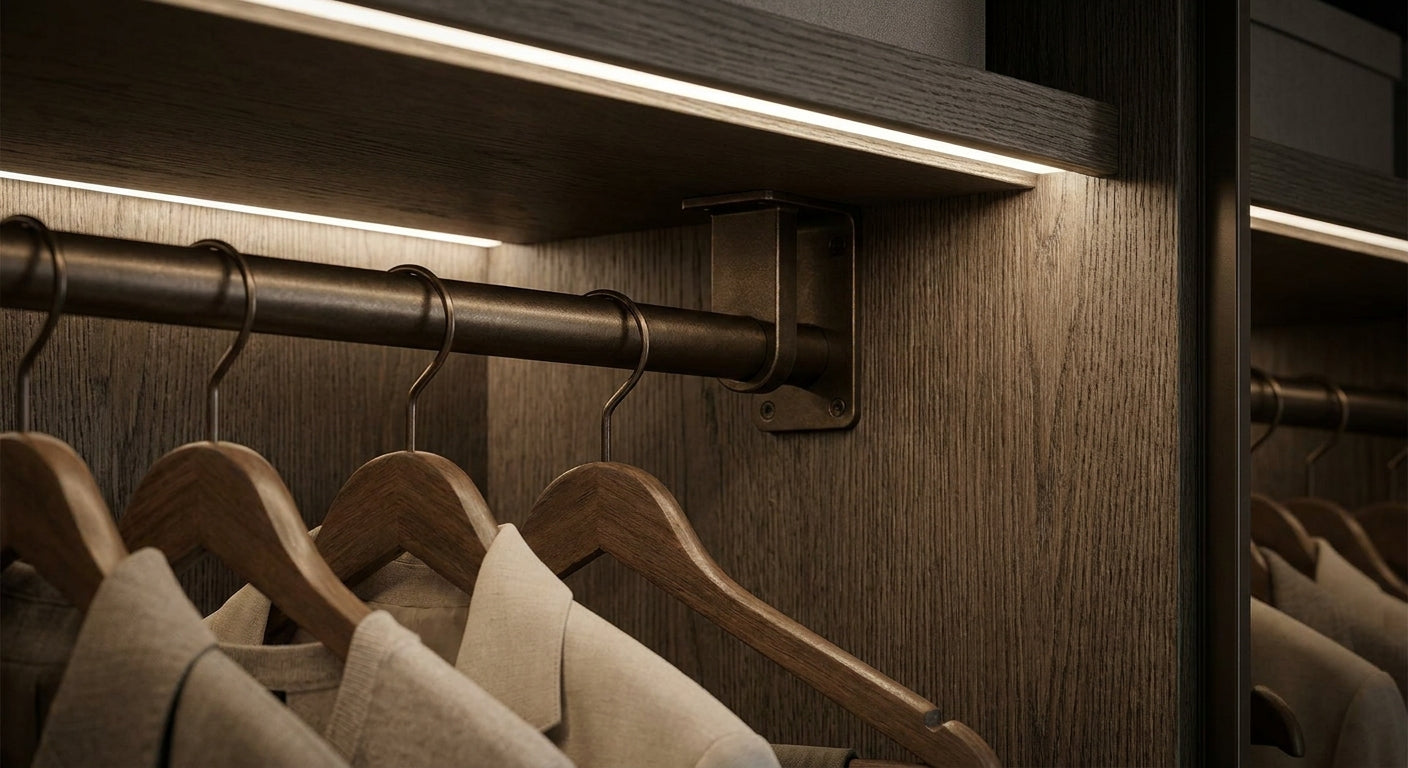
Wardrobe cabinets take more daily handling than almost any other cabinet in the house, and the rod, brackets, hinges, pulls and slides you choose decide whether the doors sag and the rod bows by year three or hold up past 2026 without a service call.
- Closet rod hardware for wardrobes needs 20-30 lbs of load capacity per linear foot; undersized brackets sag first.
- Atlas Homewares Tustin stainless pull handles daily wardrobe traffic without showing smudges: Buy.
- Schaub and Company polished nickel knob at 1-1/2 inches fits traditional wardrobe doors cleanly: Buy.
- Top Knobs Garrison honey bronze bar pull suits oversized wardrobe doors but costs more per opening: Consider.
Shop the picks from this guide
In stock at Knobs.co · Free shipping on hardware orders $99+ · 110% price match
-
 Alno
Alno A1032 1'' Brass Cabinet KnobPolished Brass
Alno
Alno A1032 1'' Brass Cabinet KnobPolished Brass
$13.46
$14.95 -
 Alno
Alno A726 Charlie's 3 1/2'' CC Cabinet PullAntique English / 3''
Alno
Alno A726 Charlie's 3 1/2'' CC Cabinet PullAntique English / 3''
$24.26
$26.95 -
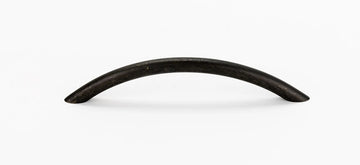 Alno
Alno A1298 128mm 5'' CC Brass Cabinet PullBarcelona
Alno
Alno A1298 128mm 5'' CC Brass Cabinet PullBarcelona
$19.76
$21.95 -
 Alno
Alno A1033 1 1/8'' Brass Cabinet KnobPolished Brass
Alno
Alno A1033 1 1/8'' Brass Cabinet KnobPolished Brass
$18.86
$20.95 -
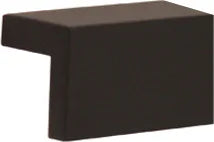 Alno
Alno A960 Tab 1 1/2'' CC Brass Cabinet PullBronze / 3/4''
Alno
Alno A960 Tab 1 1/2'' CC Brass Cabinet PullBronze / 3/4''
$16.16
$17.95 -
 Alno
Alno A1145 1 1/4'' Brass Cabinet KnobBarcelona
Alno
Alno A1145 1 1/4'' Brass Cabinet KnobBarcelona
$17.96
$19.95


Why this matters
A kitchen cabinet door opens a handful of times a day. A wardrobe door opens twice a day per person who uses it, every day of the year, and the rod inside carries 15 to 20 garments on hangers that shift weight every time someone pulls a shirt free. Hardware rated for light kitchen duty wears out faster under that pattern.
That's why cabinet pulls for closet built-ins and wardrobes exists as its own category instead of getting lumped in with kitchen hardware. Wardrobe traffic is different, and the hardware needs to match that traffic, not the paint color.
Who this is for
This guide is for homeowners finishing a reach-in or walk-in wardrobe cabinet, contractors specifying hardware for a closet built-in, and interior designers pulling finish samples for a client's wardrobe wall. If you're outfitting a single closet door, the stakes are lower. If you're speccing hardware across a whole-house remodel with 8 to 12 wardrobe units, one wrong bracket spec multiplies fast.
What to look for in closet rod hardware for wardrobes
Rod diameter and load rating
A standard round closet rod runs 1-5/16 inches in diameter and holds roughly 20 to 30 lbs per linear foot when properly supported. Go thinner and the rod flexes visibly under a full load of coats; go with an oval profile and you get more resistance to bowing over a 48-inch span.
Bracket spacing and mounting points
Center support brackets belong every 32 to 48 inches on any rod longer than that span. Skip the center bracket on a 6-foot closet rod and the middle sags within a year, even with a rod rated for the full load.
Hinge weight rating for the door size
A hinge rated for a 15 lb door will fail early on a 20 lb wardrobe door with a mirror or panel insert. Match the hinge rating to the actual door weight, not the average cabinet door weight, because wardrobe doors run heavier than kitchen doors more often than not.
Pull and knob finish consistency
Wardrobe cabinets usually sit in a bedroom or hallway where hardware finish is more visible than it is in a kitchen full of appliances. Matching the pull, knob, and hinge finish across every door in the same wardrobe wall reads as intentional; mixing finishes across the same run reads as an afterthought.
Drawer slide type for wardrobe drawers
Wardrobe drawers hold folded clothes, which means repeated full-extension pulls loaded with weight. A slide rated for smooth full-extension travel outlasts a basic side-mount slide under that kind of daily use.
Adjustable shelf hardware
Wardrobe storage needs change as a household changes. Shelf pins that let you reposition shelving without redrilling the cabinet interior save a full re-install later.
Top picks for wardrobe hardware
The daily-use workhorse: Atlas Homewares A972-MG Stainless Tustin Pull. Stainless steel resists fingerprint smudging better than most plated finishes, which matters on a pull that gets touched twice a day per person. At roughly 6.5 inches center-to-center, it fits standard wardrobe door widths without crowding a knob-and-pull pairing. Buy for any wardrobe door that gets heavy daily traffic.
The safe traditional pick: Schaub and Company 704-PN Traditional Round Knob, Polished Nickel, 1-1/2 inch diameter. This is the pick for a wardrobe cabinet built into a traditional bedroom or hallway, where a bar pull would look out of place. Polished nickel holds up to fingerprint contact without showing wear as fast as brushed finishes on high-touch surfaces. Buy for classic wardrobe styling.
The statement upgrade: Top Knobs TK3265HB Garrison Bar Pull, Honey Bronze. At close to 7-9/16 inches, this pull suits larger wardrobe doors where a small knob would look undersized against the panel. Honey bronze reads warmer than oil-rubbed bronze and pairs well with walnut or white oak wardrobe fronts. Consider it for a single statement wardrobe wall before committing it across a whole house of closets.
The smaller alternative: Schaub and Company 711-PN Traditional Knob Round, Polished Nickel, 1-1/4 inch diameter. A quarter-inch smaller than the 704-PN, this fits narrower wardrobe stiles where the larger knob would sit too close to the door edge. Consider it specifically for narrow-frame wardrobe cabinets, and skip it if your door stiles are already wide enough for the 1-1/2 inch version.


What to avoid
- Decorative rod finishes that don't match the door hardware. A brushed brass rod against polished nickel pulls looks like two separate purchases, not one finished wardrobe.
- Non-soft-close hinges on a daily-use wardrobe door. A wardrobe door slams harder over time than a kitchen cabinet door because it's opened with more force by someone reaching for a hanger, not carefully with both hands.
- Standard side-mount slides on deep wardrobe drawers. They bind under a full load of folded sweaters where a full-extension slide won't.
“If a hinge is rated for 15 lbs and your wardrobe door weighs 20, it fails in the first six months, not the tenth.”
Verdict comparison
| Pick | Finish | Size | Best for | Verdict |
|---|---|---|---|---|
| Atlas Homewares Tustin Pull | Stainless | ~6.5 in cc | Daily-use wardrobe doors | Buy |
| Schaub and Company 704-PN Knob | Polished Nickel | 1-1/2 in dia | Traditional wardrobe styling | Buy |
| Top Knobs Garrison Bar Pull | Honey Bronze | ~7-9/16 in cc | Large statement doors | Consider |
| Schaub and Company 711-PN Knob | Polished Nickel | 1-1/4 in dia | Narrow door stiles | Consider |
FAQ
What's the best rod diameter for a wardrobe closet?
A 1-5/16 inch round rod is standard and holds 20 to 30 lbs per linear foot with proper bracket support. Oval profiles resist bowing better on spans over 48 inches.
How far apart should closet rod brackets be spaced?
Space center support brackets every 32 to 48 inches on any rod longer than that. Skipping the center bracket on a 6-foot rod causes visible sagging within a year.
Is a wood rod or metal rod better for a wardrobe cabinet?
Metal rods handle heavier daily loads without flexing, while wood rods match certain traditional cabinet interiors better. For a high-traffic wardrobe in 2026, metal is the more durable choice.
How much weight can a closet rod hold?
A properly supported closet rod holds 20 to 30 lbs per linear foot, roughly 15 to 20 garments on hangers. Weight capacity drops fast without a center bracket on longer spans.
What hinge is best for wardrobe cabinet doors?
Match the hinge weight rating to the actual door weight, since wardrobe doors with mirror or panel inserts often run heavier than standard kitchen cabinet doors. A soft-close hinge also holds up better under daily wardrobe traffic.
Should wardrobe drawers use soft-close slides?
Yes, full-extension soft-close slides handle the repeated, loaded pulls of folded clothing storage better than basic side-mount slides. They also prevent slamming from daily use.
How do you match rod hardware finish to cabinet knobs and pulls?
Pick one finish family, such as polished nickel or honey bronze, and carry it across the rod brackets, hinges, and pulls in the same wardrobe wall. Mixing finishes in one visible run reads as unfinished.
How much does cabinet hardware for a wardrobe cost in 2026?
Individual pulls and knobs typically range from a few dollars to around twenty dollars each depending on finish and brand, while brackets and hinges run a similar range per piece. Total cost depends on door and drawer count across the wardrobe.
One last thing
The detail that gets skipped most often on wardrobe builds isn't the rod or the pull, it's the center bracket. Homeowners buy a rated rod and matching hardware in every finish, then leave a 6-foot span unsupported in the middle because the bracket wasn't in the box. That single missing bracket is the most common callback reason on wardrobe installs going into 2026 remodel season.


