

Drawer Pull Placement: Center the Shallow Fronts, Align the Deep Ones
Centered side to side on every drawer. Centered top to bottom only on shallow fronts; on deep ones, hold one constant distance from the top edge.

Drawer pull placement has two halves, and only one of them is settled. Side to side, center the pull on the drawer front. Top to bottom, center it on shallow fronts up to about 8 inches, and on anything deeper hold a constant distance down from the top edge, 2-1/2 to 3 inches, rather than centering it. The condition that changes this: if every front in a bank is the same height, center them all and the question never comes up. The reason to break from centering is that a kitchen shows you several cabinets at once, and pulls that are each centered on fronts of different heights do not agree with one another.
Shop the picks from this guide
In stock at Knobs.co · Free shipping on hardware orders $99+ · 110% price match
-
 Amerock
Everyday Heritage 3'' cc Cabinet Pull BP865Polished Chrome
Amerock
Everyday Heritage 3'' cc Cabinet Pull BP865Polished Chrome
$1.92
$2.25 -
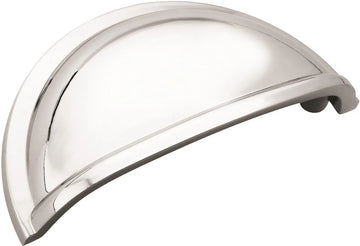 Amerock
Cup Pulls 3'' cc Cabinet Cup Pull BP53010Polished Chrome
Amerock
Cup Pulls 3'' cc Cabinet Cup Pull BP53010Polished Chrome
$4.61
$5.42 -
 Amerock
Everyday Heritage 4'' cc Cabinet Pull BP76312Polished Chrome
Amerock
Everyday Heritage 4'' cc Cabinet Pull BP76312Polished Chrome
$2.28
$2.68 -
 Amerock
Edge Pull 5-1/16'' cc Cabinet Pull BP36575Polished Chrome
Amerock
Edge Pull 5-1/16'' cc Cabinet Pull BP36575Polished Chrome
$5.83
$6.85 -
 Amerock
Everyday Heritage 3-1/2'' cc Cabinet Pull BP867Brushed Chrome
Amerock
Everyday Heritage 3-1/2'' cc Cabinet Pull BP867Brushed Chrome
$2.03
$2.38 -
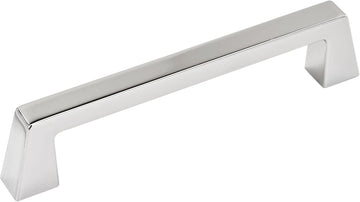 Amerock
Blackrock 5-1/16'' cc Cabinet Pull BP55277Polished Chrome
Amerock
Blackrock 5-1/16'' cc Cabinet Pull BP55277Polished Chrome
$9.63
$11.32


Drawer pull placement side to side: center on the front, not the opening
The horizontal answer is centered, and it holds for almost every drawer in a kitchen. What I watch people get wrong is centering on the wrong thing. Take the width of the front alone, from edge to edge, and halve it. A front beside a filler strip, or a false front under a sink, is often not centered on its own opening, so the opening is the wrong thing to work from. Mark the vertical centerline in pencil, then step out half the pull's center-to-center spacing in each direction. A pull sold as 5 in (128 mm) centers on an 18 in front puts its holes at 6-1/2 in and 11-1/2 in from the left edge.
Two cases sit outside the rule. Tab and edge pulls mount at the top edge of the front and are placed by eye or by run, not by a centerline, and some are meant to sit off-center deliberately. And on a pair of appliance panels the pulls line up with each other rather than with their own fronts, because the eye reads the pair.
The real decision: do the pulls line up with the drawer, or with the kitchen
Take a common base cabinet: a 6 in drawer front over two 12 in fronts. Center a pull on each and they land 3 in, 6 in and 6 in down from their own top edges. Each drawer looks balanced alone. But the gap from the first pull to the second is about 9 in and from the second to the third is 12 in, and the bank reads as slightly off without most people being able to say why.
Now hold 3 in from the top of every front. The shallow drawer is still centered, because 3 in is its middle. The spacing between pulls is still uneven, because the fronts are uneven and no placement fixes that. What you gain is that every pull sits the same distance below the top of whatever it is mounted on, so a bank of graduated drawers agrees with the bank of equal drawers three cabinets down.
There is a second argument I find more persuasive than the visual one. Knobs on base cabinet doors go 2-1/2 to 3 in down from the top corner of the door. If the deep drawer pulls hold the same offset, the drawer pulls and the door knobs land on one line across the whole lower run. Center the drawer pulls instead and that line breaks at every drawer bank.
The tradeoff is real and it shows up on the deepest fronts. On a 15 or 18 in pot drawer, a pull 3 in from the top leaves a large empty field of door below it, and the front can look top-heavy, especially in a flat slab kitchen where there is no rail or panel to break the space. That is the case where I would center instead, or split the difference and take the pull to the upper third rather than the top few inches. Decide it once and apply the same answer to every deep front in the house.
Height off the floor is part of the answer
The bottom drawer is the one I ask people to test before drilling. Its top edge sits around knee height, and a centered pull on a 12 in front puts your hand another 6 in lower, which is the difference between opening it standing and squatting to it. The logic runs the other way on a tall pantry: above eye level, a pull near the top edge is the one you cannot see to grab, and centering is kinder.
Tape a pull to the lowest drawer and the highest one and open each twice. Placement rules get written by people looking at elevations, and elevations are drawn at eye level.
Pull length by drawer width, and where 3 in centers still belong
Center-to-center describes the distance between the two screw holes. A pull's outside length is a separate and larger number, so a 5 in pull and a 5 in center-to-center are not the same object. Size it by the front: pull centers at about a third of the width, rounded to the nearest spacing that exists.
| Drawer front width | Center-to-center, single pull |
|---|---|
| Up to 12 in | 3 in (76 mm) or 3-3/4 in (96 mm) |
| 12 to 18 in | 5 in (128 mm) |
| 18 to 24 in | 6-5/16 in (160 mm) to 7-9/16 in (192 mm) |
| 24 to 30 in | 8-13/16 in (224 mm) to 10 in |
| 30 in and wider | 12 in (305 mm), or two pulls |
The rule bends on slab fronts, where a longer pull reads better than the proportion suggests, and in a kitchen where the doors wear knobs, since a shorter pull keeps the two families the same visual weight. Vanity and desk drawers are where 2-1/2 in and 3 in centers still earn their keep, and on a narrow drawer under 9 in I would use a knob rather than a pull that spans the front.
Where the second pull goes, if you use one
Past about 30 in, one pull sized by the one-third rule stops being available in most styles, and the choice is a long pull or a pair. The pair goes at the quarter points. Mark the centerline, split each half again, and drill each pull centered on its own half: on a 36 in front that puts the two pull centers 9 in either side of the middle, with 9 in of front outboard of each.
Hold the same vertical offset you set for every other deep drawer, because a pair drilled to its own height is twice as visible as a single pull in the wrong place. The pair also costs you something at the slides, since people grab one of the two and load a heavy drawer off-center, which a full-extension undermount shrugs off and an older side-mount roller slide does not. I use the pair when the kitchen is traditional enough that one long bar looks out of place, and a single centered pull nearly every other time. Our guide to pull length for wide drawer fronts carries the proportion argument further.
Measure the material where the screw lands, not the thickest part of the front
This is the step that turns a good layout into a returned order. Cabinet hardware screws are 8-32 thread, and the 1 in screw in the box is sized for a 3/4 in front. Two things on a drawer break that assumption in opposite directions.
- Five-piece fronts. A shaker-style front has a 3/4 in frame around a panel that is often 1/4 in and floating in a groove. If the pull lands on the panel rather than the rail, a 1 in screw stands almost 3/4 in proud inside the drawer, where it catches whatever you store. Measure the panel, not the frame, and take a shorter screw.
- Applied fronts. Many drawers have a decorative front screwed onto the front of the drawer box, so the pull is drilling through two layers, 3/4 in plus another 1/2 to 5/8 in. The stock screw will not reach, and it is the reason I see more installs stop halfway through than any other.
Check one drawer of each type while you are still ordering. Longer screws and break-away screws both solve it, but only if you know which you need before the box arrives.
Consistency beats correctness
A kitchen where every pull is an eighth of an inch low looks fine. A kitchen where one pull is an eighth of an inch low looks wrong, and it is the one your eye returns to for years. I care less about which offset someone picks than about whether they hold it, and the way to hold it is to stop measuring.
- Cut a scrap of wood to the offset you picked and use it as a story stick on every front. Numbers on a tape get misread; a stick does not.
- Mark holes with an awl, not a pencil dot, so the bit cannot wander at the start.
- Drill from the face with a brad-point bit and clamp a block of scrap behind the front to catch the exit, or the inside face splinters.
- Do one drawer, mount the pull, and stand back before you drill the other fifteen.
- Keep the stick in the drawer under the sink. The next phase of the kitchen, or the next owner, will want the same line.
Shop Cabinet Pulls & Handles
-
 Amwell Bar Pull 11 11/32'' Honey Bronze M2605
$22.59
Amwell Bar Pull 11 11/32'' Honey Bronze M2605
$22.59
-
 Retail Pack Hardware 3'' cc Bar Pull 400SN-R
$43.51
Retail Pack Hardware 3'' cc Bar Pull 400SN-R
$43.51
-
 Tahoe 128 mm cc Bar Pull 602-128SIM
$26.12
Tahoe 128 mm cc Bar Pull 602-128SIM
$26.12
-
 Additions Tab Pull 3'' TK103ORB2 Oil Rubbed Bronze
$12.06
Additions Tab Pull 3'' TK103ORB2 Oil Rubbed Bronze
$12.06
-
 Lafayette 128 mm cc Bar Pull 317-128SN
$19.91
Lafayette 128 mm cc Bar Pull 317-128SN
$19.91
-
 Barrington Brookline Knob 1 1/8'' Honey Bronze TK762HB
$10.13
Barrington Brookline Knob 1 1/8'' Honey Bronze TK762HB
$10.13
-
 Lafayette 96 mm cc Bar Pull 317-96SN
$17.90
Lafayette 96 mm cc Bar Pull 317-96SN
$17.90
-
 Zane 128 mm cc Bar Pull 293-128BNBDL
$17.57
Zane 128 mm cc Bar Pull 293-128BNBDL
$17.57


Browse all 8382 in Pulls & Handles → Cabinet knobs Cabinet pulls & handles