

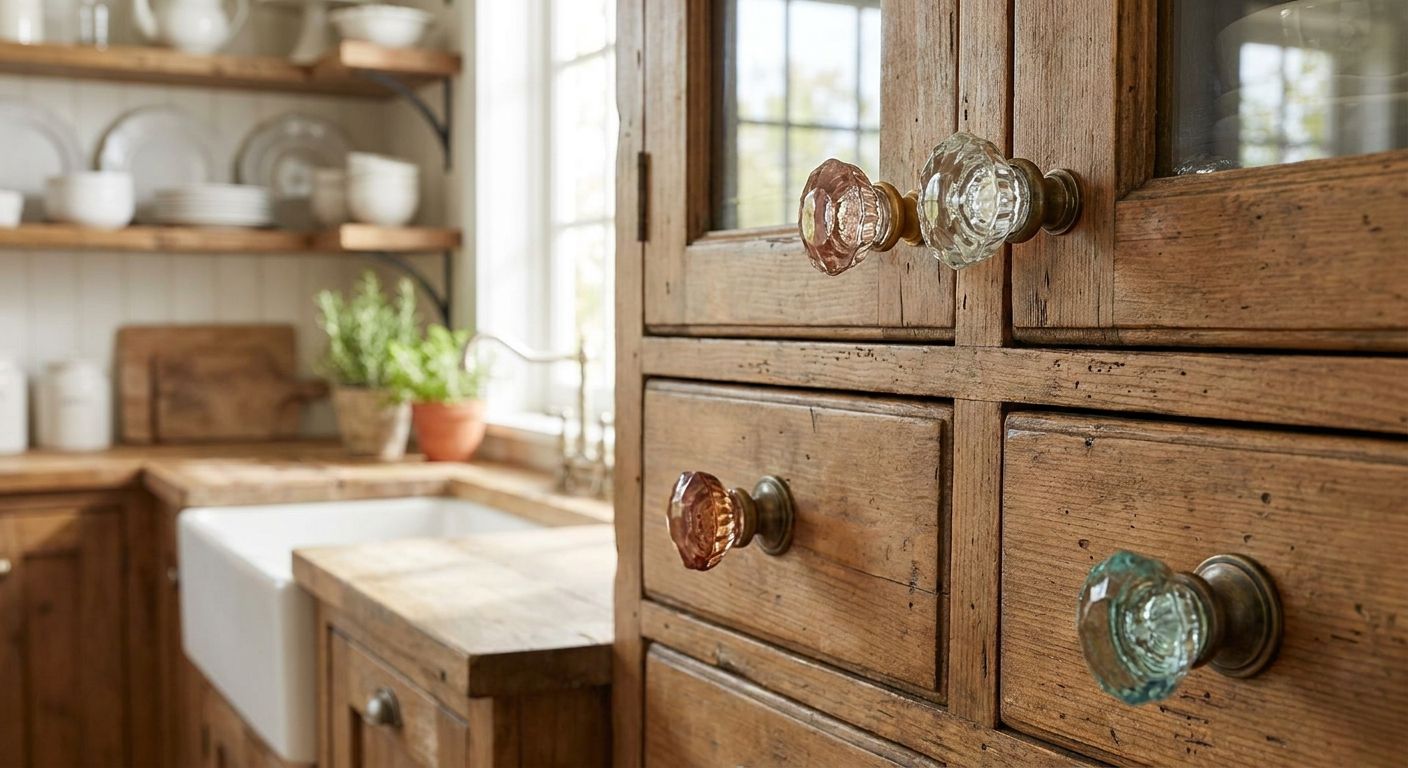
Glass cabinet knobs are the fastest way to give a kitchen that pre-1950s farmhouse or Victorian character without gutting the cabinets themselves — but picking the wrong finish base or glass style can make a fresh remodel look like a costume instead of a period-accurate room.
- Crystal Palace glass knobs with a satin nickel or chrome base suit most vintage-inspired kitchens in 2026 — Buy.
- Skip clear acrylic-look glass on painted shaker cabinets; it reads modern, not antique.
- Pair glass cabinet knobs with a pewter or antique-brass pull on longer drawers for period balance.
- Oil-rubbed bronze bases on glass knobs work best in farmhouse and cottage kitchens, not sleek transitional ones.
Why this matters
Vintage-inspired kitchens live or die on hardware detail. Cabinet fronts, paint color, and even the sink can be reproductions, but a knob that's the wrong glass tone or the wrong metal base breaks the illusion instantly. If you're planning a full-kitchen hardware swap this year, glass cabinet knobs are one of the few hardware categories where the material itself — not just the finish — carries the period signal, similar to the effect art glass knobs for statement kitchens create in eclectic builds.
Glass has been used on cabinetry since the late 1800s, first as pressed or faceted knobs on Victorian furniture, later as Depression-era glass pulls on 1930s kitchens. That history is exactly why glass reads as "vintage" to most buyers in 2026 — it's a material choice tied to a specific era, not a trend cycle.
Who this is for
This guide is for homeowners restoring a pre-1960s house, anyone doing a farmhouse or cottage-style remodel, and renovators matching new cabinets to an older home's existing character. It's also useful for interior designers sourcing period-appropriate hardware for a client who wants "old house" charm without actual old-house wiring problems.
If your kitchen is modern flat-front or minimalist, this isn't your guide — glass cabinet knobs will fight the cabinet style rather than complement it.
What to look for in glass cabinet knobs for vintage kitchens
Faceted vs. smooth glass
Faceted glass — cut with visible angles, like the Crystal Palace line — throws light the way antique pressed glass did, and it's the more historically accurate choice for Victorian and Edwardian kitchens. Smooth, rounded glass knobs read closer to mid-century or coastal styling, so match the cut to the era you're chasing.
Metal base finish
The base is what most people notice first, even though it's the smaller visual element. Satin nickel and chrome bases suit Victorian and Edwardian kitchens; oil-rubbed bronze bases suit farmhouse and cottage kitchens. Mixing eras — chrome base with a rustic farmhouse door — undercuts the whole look.
Glass clarity and tone
Clear glass reads more contemporary; translucent white or slightly frosted glass reads older and softer, closer to how milk glass and pressed glass aged over a century. If your cabinets are painted white or cream, a translucent white glass knob blends rather than contrasts, which is usually the vintage-correct choice.
Knob diameter for cabinet door size
Glass knobs in the 1-1/4" to 1-3/8" range suit standard kitchen cabinet doors. Anything smaller looks fussy on a full-size door; anything larger starts competing visually with the faceting detail that makes glass knobs distinctive in the first place.
Backplate use
A lot of original Victorian glass knobs sat on a small brass or pewter backplate to protect the wood finish and add a second metal accent. If your cabinets are stained wood rather than painted, a backplate under the glass knob adds period depth that a bare knob on wood doesn't.
Hardware pairing on drawers
Knobs work on cabinet doors, but long kitchen drawers usually need a pull, not a knob. For 2026 remodels mixing glass knobs on doors with a metal pull on drawers, keep the metal base finish identical across both pieces so the room doesn't end up with three competing metal tones.


Top picks for glass cabinet knobs in vintage kitchens
The safe pick — Crystal Palace Knob, satin nickel (HH075852-GLSN). Faceted glass, 1-1/4" x 3/4" overall, priced at $23.20. This is the closest match to original Victorian pressed-glass hardware and works on painted or stained cabinets alike. Buy.
The budget pick — Crystal Palace Knob, chrome (HH075854-GLCH). Same faceted glass shape at $12.80, cheaper because of the chrome base rather than satin nickel. It suits Edwardian and cottage kitchens with existing chrome fixtures. Buy.
The wildcard — Serene Clarity Round Knob, oil-rubbed bronze (TK842ORB). Clear glass on a dark bronze base at $50.99, better suited to farmhouse-vintage than Victorian-vintage kitchens. It reads more rustic than glam, so use it only if your cabinets lean toward reclaimed wood or dark stain. Consider.
The traditionalist companion pull — Britannia Victoria Knob, pewter antique, 1-1/4" with backplate. Not glass, but a period-correct pewter piece for kitchens mixing glass door knobs with metal drawer hardware. The antique pewter finish and small backplate mirror the same era glass knobs come from, so it's a natural pairing rather than a competing look. See the Britannia Victoria knob for drawer runs where glass isn't practical. Buy.
The transitional option — Portobello Road Knob, plain finish. A simpler, unfaceted profile for kitchens that want a hint of vintage without full Victorian ornamentation. Works better in cottage or modern-farmhouse kitchens than in strict period restorations. Check the Portobello Road knob if faceted glass feels like too much detail for your cabinet style. Consider.
What to avoid
- Bright clear acrylic-look glass on painted shaker cabinets. It photographs like plastic under kitchen lighting and undercuts the whole vintage effort — the faceting and slight translucency matter more than clarity.
- Mixed metal bases across the same run of cabinets. A satin nickel glass knob next to a brushed gold pull three doors down reads as an unfinished remodel, not an intentional mix.
- Oversized glass knobs on small cabinet doors. Glass knobs over 1-3/8" on a narrow door frame look like they were sized for a different kitchen; stick to the 1-1/4" to 1-3/8" range for standard doors.
Verdict comparison
| Pick | Glass Style | Base Finish | Price | Best For | Verdict |
|---|---|---|---|---|---|
| Crystal Palace Knob HH075852-GLSN | Faceted | Satin nickel | $23.20 | Victorian, Edwardian | Buy |
| Crystal Palace Knob HH075854-GLCH | Faceted | Chrome | $12.80 | Edwardian, cottage | Buy |
| Serene Clarity Knob TK842ORB | Smooth clear | Oil-rubbed bronze | $50.99 | Farmhouse | Consider |
| Britannia Victoria Knob | N/A (pewter) | Antique pewter | Check site | Drawer pairing | Buy |
| Portobello Road Knob, plain | N/A (metal) | Plain | Check site | Transitional | Consider |
FAQ
What's the best glass cabinet knob for a vintage-inspired kitchen?
The Crystal Palace faceted glass knob with a satin nickel base is the closest match to original Victorian pressed-glass hardware in 2026. It suits both painted and stained cabinets and pairs cleanly with pewter or brass drawer pulls.
Are glass cabinet knobs durable enough for daily kitchen use?
Glass cabinet knobs with a solid metal base and mounting post hold up to normal daily door and drawer use. The glass itself is the wear point, so avoid slamming cabinet doors shut on faceted glass edges.
Should glass knobs match my cabinet pulls?
The metal base finish should match across knobs and pulls, but the material doesn't have to. A glass knob on doors and a pewter or nickel pull on drawers is a standard vintage-kitchen pairing as long as the base metal tone is consistent.
Is clear or frosted glass better for a farmhouse kitchen?
Frosted or translucent white glass reads softer and older, closer to milk glass, which suits farmhouse and cottage kitchens better than bright clear glass. Clear glass leans more toward Victorian glam styling.
How much do glass cabinet knobs cost in 2026?
Glass cabinet knobs typically run from around $10 to $50 depending on the base metal finish, with chrome bases usually cheaper than oil-rubbed bronze or satin nickel options.
What size glass knob fits a standard kitchen cabinet door?
A 1-1/4 inch to 1-3/8 inch glass knob fits standard cabinet doors without overwhelming the panel. Larger diameters work only on oversized pantry or island doors.
Can glass cabinet knobs work on modern kitchens too?
Smooth clear glass knobs on a chrome or nickel base can work in transitional kitchens, but faceted Victorian-style glass generally looks out of place on flat-front modern cabinetry.
One last thing
The detail most people miss: glass knobs with a pewter or nickel backplate protect painted cabinet finishes from the twisting motion that bare glass knobs put directly on paint over years of use — worth the extra piece if your cabinets are freshly painted rather than stained wood.