

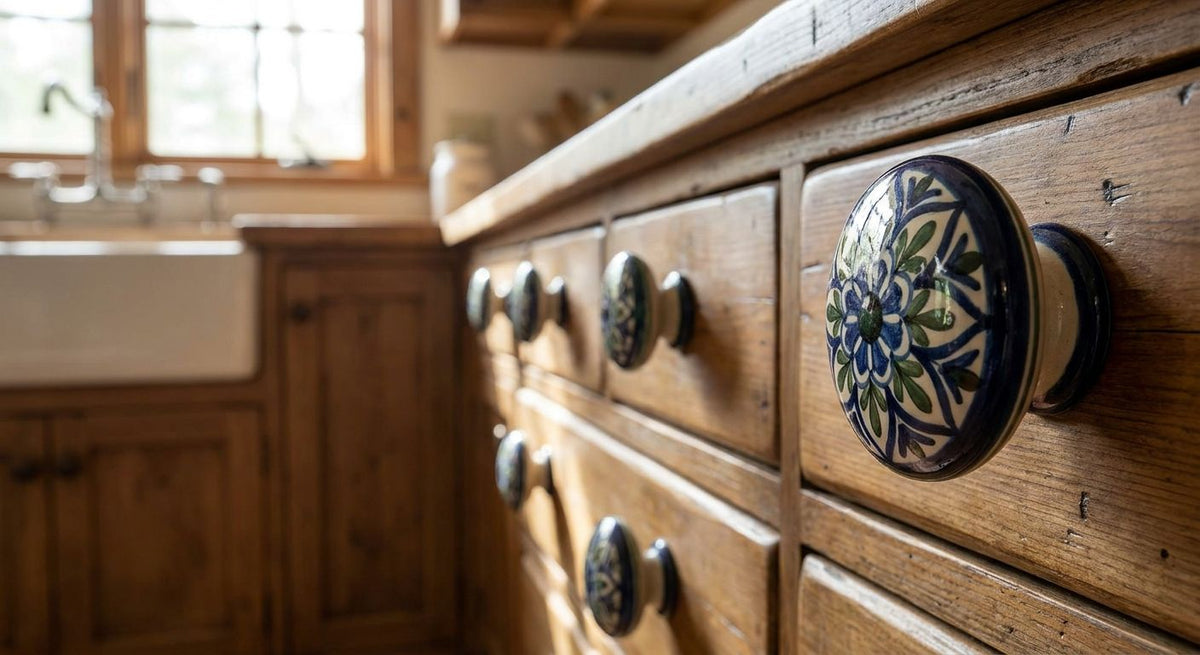
Hand-painted cabinet knobs for custom kitchens are hardware pieces finished by hand with paint, glaze, or patina instead of a factory-uniform coating, built for kitchens where no catalog finish name matches the actual cabinet color. If your cabinets are a custom-mixed paint, not a stock white or a standard oil-rubbed bronze, hand-finished hardware is the only reliable way to get a true color match in 2026.
- Hand painted cabinet knobs work best on custom kitchens with a one-off cabinet color — order samples before committing to a full set.
- Ceramic and glazed knobs hold color longest; hand-applied metal patinas shift with handling, and that's normal, not a defect.
- Standard cabinet knobs run 1-1/4 to 1-5/8 inches in diameter — measure your door stiles before ordering in 2026.
- Knobs.co stocks decorative, novelty, and traditional knob collections across a 50,000+ SKU catalog for custom-kitchen color matching.
- Skip hand-painted finishes on high-traffic drawer pulls that get grabbed daily — paint wears faster there than plated metal.
Why hand-painted cabinet knobs matter for custom kitchens
Custom kitchens exist because a homeowner or designer rejected the stock palette. That decision has a hardware consequence: none of the standard finish names (satin nickel, oil-rubbed bronze, matte black) are painted to match anything — they're plated or powder-coated to a fixed, repeatable color. A custom-mixed cabinet paint has no fixed hardware counterpart on the shelf.
Hand-painted, hand-glazed, or hand-finished knobs solve that gap because the color is applied to the piece, not baked into a factory recipe. That's why ceramic cabinet knobs and glazed pulls show up disproportionately often on kitchens with unusual paint colors, two-tone islands, or historic-reproduction cabinetry — a factory finish simply can't chase a custom color the way a hand-applied one can.
“If a hand-painted knob doesn't match your door color at 3pm under daylight, it won't match at 8pm under a pendant light either — test both before you order the full set.”
How to choose hand-painted cabinet knobs for a custom kitchen
Confirm your cabinet color code before you shop
Don't shop hardware by memory or a photo on your phone. Bring the actual paint reference to the table.
- Write down the exact paint brand, color name, and sheen (matte, eggshell, satin)
- Note the undertone — a "white" with a warm undertone reads differently against a cool-toned painted knob
- If cabinets are freshly painted, wait for the topcoat to fully cure before final color judgment; sheen shifts in the first few weeks
- Bring a physical door sample or paint chip, not a screen photo, to any in-person comparison
- Check the color match under two light sources: daylight near a window and the kitchen's actual overhead fixture
Choose the base material for the painted or glazed finish
The material the paint sits on determines how long the color lasts and how it fails.
- Ceramic/porcelain: glaze is fired into the surface, giving the most colorfast result over years of use
- Glass: often reverse-painted on the back side, which protects the pigment from direct handling — a fit for glass cabinet knobs in glossy or glam custom kitchens
- Metal with a hand-applied patina: not technically paint, but hand-worked finishes (like a hand-polished traditional collection) shift tone with handling the way painted surfaces do
- Resin or composite: the least durable painted surface — pigment sits closest to the grip point and chips first
Order samples before you commit to a full set
The manual route: request paint swatches from your painter, then physically hold hardware finish photos up against them in daylight — free, slow, and only as accurate as your monitor's color rendering.
The faster path is to order actual hardware samples rather than judging from photos. Knobs.co runs a program built for exactly this — you can order hardware samples instead of guessing from a product image.
- Order 2-3 finish options in the material you're leaning toward
- Test the sample on an inconspicuous cabinet, not the most visible door in the kitchen
- Compare the knob against both the painted door and any exposed wood trim nearby
- Wait at least 48 hours before final judgment — some hand-finished pieces shift slightly once handled and oxidized by air
Measure and count before ordering the full set
A custom kitchen order that comes up short mid-install is the most common and most avoidable failure point.
- Count every door and drawer that needs hardware, not just the visible run
- Measure door stile width to confirm a 1-1/4 to 1-5/8 inch knob clears the panel edge without crowding
- Decide upfront whether each piece gets a bare knob or a backplate underneath it
- Order 5-10% extra stock for breakage or a future single-door repair
- Confirm screw length against door thickness — standard 8-32 screws typically come in 1 inch and 1-1/4 inch lengths, and a thicker custom door needs the longer one
Match placement to your kitchen's existing hardware pattern
Hand-painted knobs draw the eye more than a uniform plated finish, so placement inconsistency is more visible, not less.
- Keep knob height identical across every door in the run
- If mixing knobs on doors with pulls on drawers, align the two hardware types on a shared horizontal line
- Use a hardware jig for repeat spacing rather than measuring each door by hand
- Check corner cabinet clearance carefully — an oversized hand-painted knob can hit the adjacent door when both are open
Plan for care and color touch-up
Hand-finished surfaces need gentler handling than a factory powder coat.
- Avoid abrasive cleaners or scouring pads on any painted or glazed knob
- Wipe with a soft microfiber cloth and mild soap only
- Keep any touch-up paint or glaze the maker provided, if offered, for small chips
- Expect metal patina finishes to darken or shift tone with years of handling — that's the finish working as designed, not a failure
Comparison: hand-painted knob options for custom kitchens
| Option | Best for | Key limitation |
|---|---|---|
| Ceramic/glazed hand-painted knobs | Bold or historic custom colors | Glaze can chip on hard impact; exact color rarely reproducible years later |
| Reverse-painted glass knobs | Glossy or glam custom kitchens | Limited color depth; shows fingerprints more than matte finishes |
| Hand-applied metal patina finishes | Traditional or period-style custom kitchens | Not a true paint match; tone shifts with handling over time |
| Powder-coated color-match knobs | Contractors needing bulk color-matched runs | Factory turnaround; not a genuinely hand-finished piece |
Verdict: ceramic and glazed hand-painted knobs are the strongest match for a genuinely custom kitchen color in 2026 — buy those first and test before ordering the full run. Powder-coated color-match hardware is the practical fallback for large contractor jobs where hand-finished consistency across dozens of units isn't realistic.
Common mistakes custom kitchens make with hand-painted knobs
- Ordering before the cabinet paint fully cures. Sheen and undertone shift in the first 30 days, and hardware bought too early gets returned once the true color settles.
- Judging finish from a screen photo instead of a daylight sample. Monitor color rendering is not reliable enough for a custom color match.
- Mixing hand-painted knobs with plated pulls on one continuous run without a transition point. An island-versus-perimeter split works; a random mix on the same wall doesn't.
- Ignoring screw length on thicker custom door stock. A 3/4 inch panel and a 7/8 inch panel need different screw lengths, and the wrong one leaves a gap or strips the hole.
- Skipping the extra-stock order. Hand-finished batches vary slightly, and a single replacement knob ordered a year later almost never matches the original run exactly.
FAQ
Are hand-painted cabinet knobs durable enough for daily kitchen use?
Ceramic and glazed hand-painted knobs hold up well on doors and low-traffic drawers, but painted surfaces on constantly-gripped pulls wear faster than plated metal finishes. Reserve hand-painted pieces for knobs rather than the drawer pulls that get grabbed multiple times a day.
What's the difference between hand-painted and glazed ceramic knobs?
Glazed ceramic knobs have the color fired into the surface during production, making it the most colorfast option. Hand-painted refers more broadly to any piece where pigment or patina is applied by hand after the base material is formed, which can wear differently depending on the material.
How do I match hand-painted cabinet knobs to a custom cabinet color?
Bring the exact paint code and a physical door sample, then compare hardware options under both daylight and your kitchen's actual light fixture before ordering. Ordering samples first avoids a full-set mismatch.
Can hand-painted knobs be used in bathrooms or humid areas?
Ceramic and glass hand-painted knobs tolerate bathroom humidity better than porous or composite painted pieces. Wipe them dry after use and avoid prolonged standing water around the mounting screw.
How much do hand-painted cabinet knobs cost in 2026?
Pricing varies by material, size, and finish complexity, so check current listings for the specific piece you're considering rather than assuming a flat rate across styles.
What screw size do cabinet knobs use?
Most cabinet knobs use a standard 8-32 machine screw, typically supplied in 1 inch or 1-1/4 inch lengths depending on door thickness. Confirm your door panel thickness before ordering replacement screws separately.
Is ceramic or glass better for hand-painted cabinet finishes?
Ceramic holds color longer because the glaze is fired into the surface, while glass is usually reverse-painted, which protects the pigment from direct contact. Choose ceramic for daily-use doors and glass for a glossier custom kitchen look.
How many cabinet knobs does a custom kitchen typically need?
Count every door and drawer in the kitchen individually rather than estimating, since custom layouts vary widely in door count. Order 5 to 10 percent extra to cover breakage or a future single-door repair.
One last thing
The knob that matches your paint swatch perfectly in the sample box can still look slightly off once it's mounted, because the light hitting a corner cabinet near a window is not the light hitting the island under a pendant fixture. Order two extra of whichever finish you're least confident about before the full set ships in 2026 — it's cheaper than a second shipping run once the kitchen is installed.