

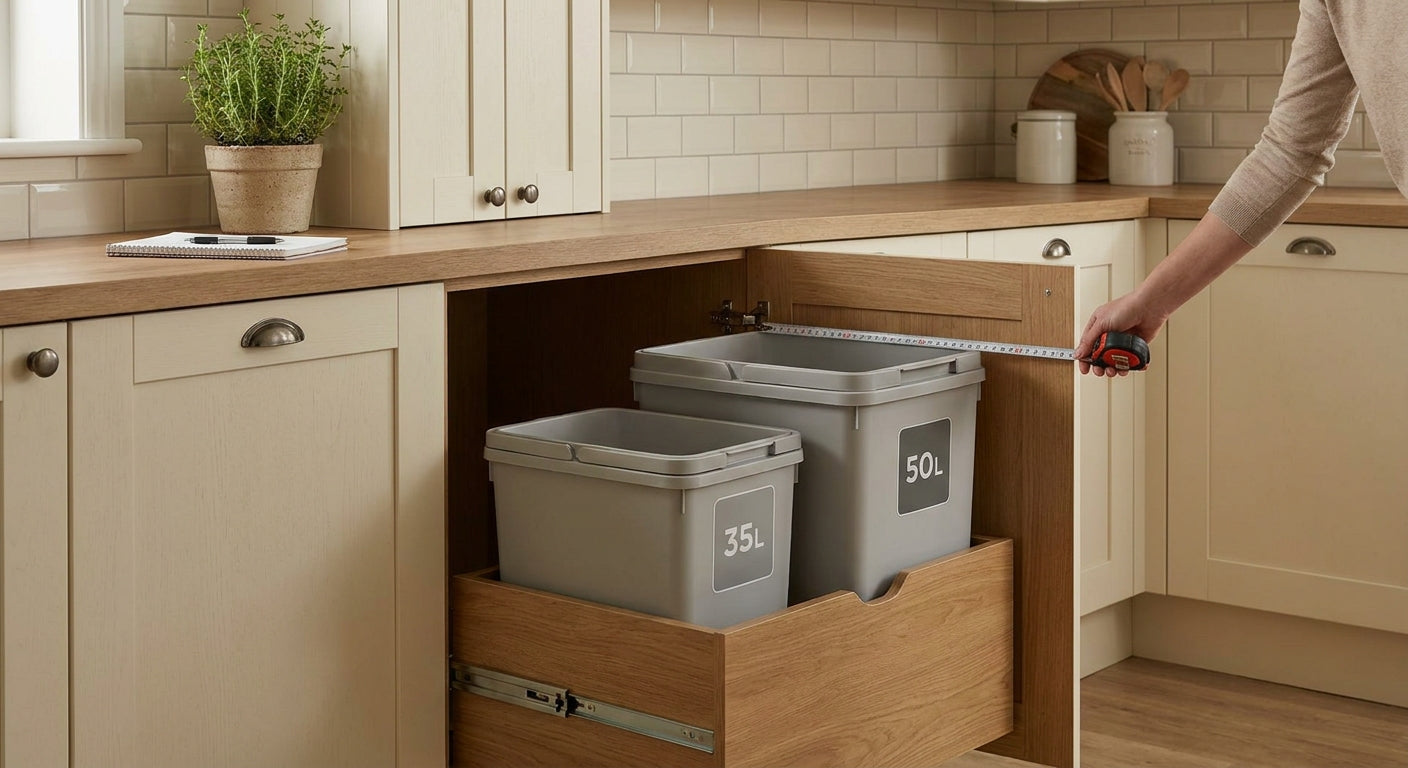
Cabinet trash can size depends on three measurements — interior cabinet width, interior depth, and door swing clearance — not the size printed on the box at the hardware store. This guide walks through measuring your cabinet opening, matching it to standard pull-out bin capacities, and picking hardware that keeps the whole system running smoothly for years.
Shop trash pull-outs
Every pull-out trash and waste solution we carry — filter by size and configuration.
Browse Pull-Out Trash Can Hardware →TL;DR
Cabinet trash can size comes down to matching bin capacity to your cabinet's interior width. A 15-inch base cabinet fits one 35-quart pull-out bin — Buy that configuration for a standard single-door setup. An 18-inch cabinet handles either a double 27-quart system or a single 50-quart bin — Buy if you generate more trash and recycling volume. Anything under 12 inches of interior width should Skip a built-in pull-out entirely and stick with a freestanding can. Full-extension slides and a soft-close hinge on the door are what separate a bin you forget about from one you fight with daily in 2026.
Why this matters
Buy the wrong size and you'll spend years wrestling a bin that won't fully extend, catches on the face frame, or tips over when the door swings open. Most kitchen cabinet lines built in 2026 still ship pull-out trash cabinets in five standard widths — 12, 15, 18, 21, and 24 inches — and a pull-out trash system has to nest inside one of those without touching the sidewalls.
Get the interior measurement wrong by even half an inch and the bin either rattles against the cabinet sides or won't clear the door on its way out. The hardware on that door matters just as much as the bin itself — a pull-out trash can hardware setup needs a pull and hinge rated for repeated daily cycling, not the lightest-duty knob in the catalog.
Pull-out trash cabinet size: width, bin capacity and clear opening
Cabinet trash can size starts with the cabinet's nominal width, but the bin only cares about the clear interior opening once the face frame is subtracted. Standard pull-out trash and waste systems are built for five nominal cabinet widths: 12, 15, 18, 21 and 24 inches. Each width maps to a bin count and capacity range, so match your cabinet to the table below before you shop for a bin.
| Cabinet width (nominal) | Bins and capacity | Minimum clear opening |
|---|---|---|
| 12 inches | Single bin, 27 to 35 quarts | About 9 to 10.5 inches wide |
| 15 inches | Single bin, up to 50 quarts | About 11.5 to 13.5 inches wide |
| 18 inches | Double bin, two 27 to 30 quart bins (the most common double-bin width) | About 15 inches wide, 21 to 22 inches deep |
| 21 inches | Double bin, larger capacity | About 18 inches wide, 21 to 22 inches deep |
| 24 inches | Double bin, largest capacity, up to 35 quarts per bin | About 21 inches wide, 21 to 22 inches deep |
Eighteen inches is the single most common double-bin width in cabinet lines, running two bins side by side in the 27 to 30 quart range. Twenty-one and 24-inch cabinets use the same double-bin layout with larger bins. The clear-opening figures above are measured inside the face frame or cabinet box, not across the door opening, and a face frame typically takes 1.5 to 3 inches off the nominal width. That means a 15-inch cabinet with a heavy face frame can behave like a 12-inch cabinet once a bin actually has to slide through it.
How to measure your cabinet for a pull-out trash can
The clear opening is the only number that decides fit. Open the cabinet door fully and measure straight across the inside of the cabinet box, from the innermost point on each side, not the door itself and not the outside of the cabinet. On a face-frame cabinet, measure at the frame, since that is the narrowest point the bin has to pass through. Frameless cabinets have no frame lip, so the interior width sits close to the nominal cabinet width, while face-frame cabinets usually lose 1.5 to 3 inches per opening.
Height and depth matter as much as width. Most pull-out systems need roughly 19 to 20 inches of clear height from the cabinet floor to the underside of the top shelf or countertop support. A double bottom-mount bin needs about 21 to 22 inches of depth to clear the door at full extension. Measure width, height and depth before checking bin specs, since a cabinet can pass on width and still fail on depth or height.
Door and hinge clearance is the last check. Open the door to its full stop and confirm the bin frame clears the door edge at full extension; anything under about 90 degrees of swing usually blocks the bin from coming out fully. The drawer slides carrying the bin frame need a load rating that matches the bin at capacity, not empty, since a full 50-quart bin loaded with wet trash weighs more than it does in the showroom.
What you'll need
- A tape measure (metal, not cloth — cloth tapes sag and throw off narrow-cabinet readings)
- The cabinet's interior width, depth, and height — never the door face dimensions
- A notepad or phone to record three numbers before you shop
- 15 to 20 minutes, uninterrupted
- The replacement pull-out hardware if you're upgrading an existing cabinet, not just buying a new bin
The steps
1. Measure the interior width, not the door
Open the cabinet door fully and measure the distance between the two side panels, at the narrowest point — usually right where hinge hardware or a face frame lip intrudes into the opening. This is the number that decides everything else. A cabinet with an 18-inch door can easily have only 16.5 inches of usable interior width once you account for face-frame stiles, so measure inside, not the door itself.
Common mistake: measuring the door width and assuming the interior matches. Face-frame cabinets routinely lose 1 to 1.5 inches to the frame on each side.
2. Measure interior depth and height
Most base cabinets run 22 to 24 inches deep and 24 to 30 inches tall to the underside of the countertop. A 50-quart bin typically needs at least 22 inches of depth to clear the door when fully extended; anything shallower forces you into a shorter, wider bin instead.
Expected outcome: you now have three numbers — width, depth, height — that rule out roughly 80% of trash can options on sight.
3. Check door swing and hinge clearance
Swing the door open to its full 100-110 degree stop (typical for soft-close hinges) and check whether the bin frame clears the door edge at full extension. If the door only opens to 90 degrees because of an adjacent cabinet or wall return, you need a bin system that fully extends before the door reaches that limit.
Common mistake: ignoring adjacent obstacles like a dishwasher handle or an island edge that stops the door short of full swing.
4. Match width to a standard bin capacity
Use this rough conversion, based on standard pull-out trash cabinet widths and typical bin capacities:
| Interior cabinet width | Typical bin configuration | Capacity |
|---|---|---|
| 9-11 inches | Single slim bin | 15-20 quarts |
| 12-14 inches | Single bin | 27-35 quarts |
| 15-17 inches | Single bin | 35-50 quarts |
| 18-21 inches | Double bin or single large | 2x27 qt or 1x50 qt |
| 24+ inches | Double large bin | 2x35-50 qt |
Verdict: for anything narrower than 12 inches, Skip the built-in route — freestanding is more practical and cheaper.
5. Decide single-bin vs. double-bin
Double-bin systems separate trash from recycling but need at least 18 inches of interior width to hold two bins side by side without binding. Single large bins maximize capacity in a narrow cabinet but mix everything into one stream.
Common mistake: choosing a double-bin system for an 18-inch cabinet without checking that the center divider doesn't eat into each bin's usable capacity — expect roughly 10% less volume per bin than the rated total suggests.
6. Choose door hardware built for daily cycling
A trash pull-out door opens and closes more times per day than almost any other cabinet in the kitchen, so the pull and hinge need to handle that load. A full-height bar pull gives better leverage on a heavier loaded bin than a small knob, and a properly rated soft-close hinge prevents the door from slamming shut under the bin's own weight when full.
Expected outcome: a door that opens with one hand even when the bin is at capacity, and closes without a bang.
7. Test-fit before you commit to hardware
Slide the empty bin into the cabinet, close the door, then load it to roughly two-thirds capacity and test the full open-close cycle again. Weight changes how the slides behave and how much the door needs to swing to clear the frame.
Common mistake: testing only with an empty bin, then discovering at week two that a full 50-quart bin needs another half-inch of clearance you didn't measure for.
Troubleshooting
- Bin won't fully extend: the interior width is likely tighter than measured, or a hinge is protruding into the cabinet opening — remeasure at the hinge line, not just at the front edge.
- Door won't close over the bin: the bin's frame is too tall for the cabinet height; look for a shorter-profile bin or lower the slide mounting position by an inch.
- Bin rattles side to side: you sized down too far — a 15-inch bin in an 18-inch cabinet needs a filler kit or a wider-frame model to stop the movement.
- Door sags after six months of daily use: the hinge is under-rated for the door and bin combined weight — upgrade to a heavier-duty hinge rated for repeated cycling.
- Bin tips forward when pulled out: the slide isn't full-extension, or the bin sits too far forward on the frame — check that the slide rating matches the loaded bin weight, not just the empty weight.
- Double-bin lids collide when both are open: the center divider is too narrow for the lid swing radius — measure lid diameter before buying a double system, not just bin width.
Tools and resources
- Metal tape measure for interior cabinet dimensions
- Cabinet hinge selection guide for matching hinge weight rating to a loaded pull-out door
- Small kitchen drawer organizer options if the cabinet you're measuring turns out too narrow for a trash pull-out and works better as storage
- Knobs.co's full cabinet hardware catalog for pulls and hinges rated for daily-use cabinets like trash pull-outs
What to do next
Once the bin fits and cycles cleanly, the hardware on the door is the last variable that determines whether the setup holds up. Knobs.co's pull and hinge selection covers this kind of high-cycle cabinet door, and getting that piece right the first time saves a hardware swap later.
FAQ
What's the best cabinet trash can size for a kitchen island? For most kitchen islands, an 18-inch interior width fits a double 27-quart system comfortably, giving separate trash and recycling streams without crowding the cabinet.
Is a single 50-quart bin better than a double 27-quart setup? A single 50-quart bin maximizes total capacity in the same footprint, but a double 27-quart setup wins if you need trash and recycling kept separate — there's no universal winner, it depends on your sort habits.
How much clearance does a trash pull-out door need to swing? Most pull-out trash systems need 100 to 110 degrees of door swing to clear the bin at full extension; anything less than 90 degrees usually blocks the bin from coming out fully.
Can I fit a trash pull-out in a 12-inch cabinet? Yes, but only with a slim single bin in the 27 to 35-quart range — 12 inches is close to the minimum practical width for a built-in system.
Does cabinet depth matter as much as width for trash can size? Yes — a bin needs 22 to 24 inches of interior depth to clear the door at full extension, and a shallower cabinet forces a shorter, wider bin regardless of available width.
How do I know if my cabinet hinge can handle a loaded trash pull-out door? Check the hinge's weight rating against the combined weight of the door, bin frame, and a full bin — most standard hinges are rated for lighter cyclical loads than a daily trash door demands.
What cabinet hardware works best on a trash pull-out door? A full-height bar pull gives better leverage than a small knob on a heavier loaded door, paired with a soft-close hinge rated for high-cycle daily use.
Should I measure the door or the cabinet interior for trash can size? Always measure the interior — face-frame cabinets can lose over an inch of usable width per side compared to the door opening.
One last thing
Most people size the bin first and the hardware last — flip that order. A cabinet trash can size that fits perfectly on day one still fails in six months if the hinge isn't rated for the weight of a full bin cycling multiple times a day, and that's a hardware problem, not a bin problem.


