

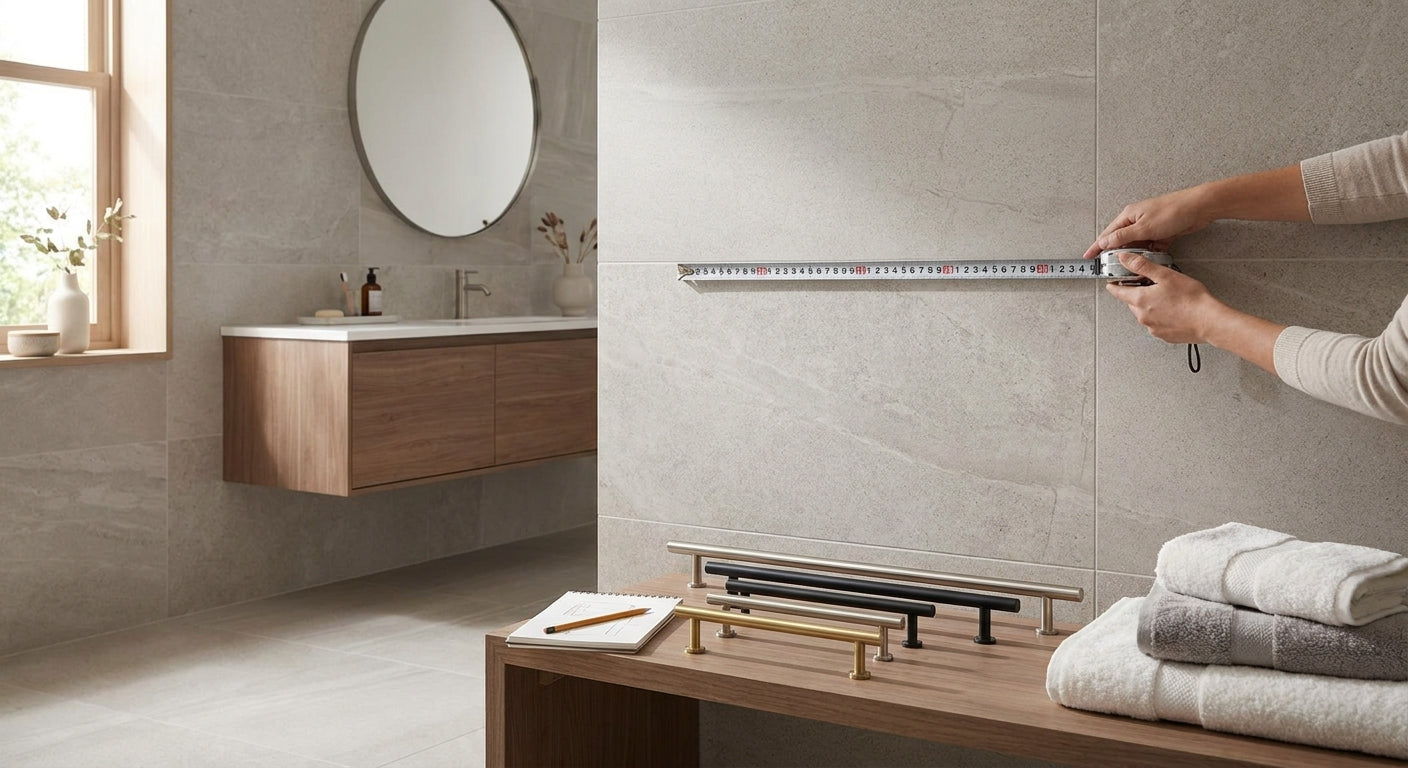
A towel bar that's too short crowds a folded towel against the wall mount; one that's too long looks like it's floating in empty tile. This towel bar length guide walks through the exact measurements, spacing rules, and mounting checks that get the size right on the first try in 2026.
Shop towel bars
Every towel bar we carry, in one place — filter by length, finish, and brand.
Browse Towel Bars →TL;DR
Most single towel bars run 18 inches or 24 inches, and the right pick depends on wall space and towel count, not just what looks biggest. For a single bath towel, an 18-inch bar is the standard; for two towels or a wider wall, step up to a 24-inch bar. Tight powder rooms or shared vanities do better with a 24-inch double bar that doubles capacity without adding wall length. Verdict: measure your wall and towel width before you shop, not after. The standard mounting height for a towel bar is 48 inches from the floor to the center of the bar, with 42 to 48 inches as the acceptable range.
Why this matters
Cabinet hardware and bath hardware get returned for the same reason more than any other: the buyer picked a finish first and a size second. A towel bar is a fixed-length fixture screwed into studs or anchors, so a wrong-size order means patching drywall, not just swapping a part.
Getting towel bar length right in 2026 also affects daily use. A bar that's 4 inches too short forces towels to overlap and stay damp longer, which is exactly the kind of small friction that makes a bathroom feel cheaper than it is.
What you'll need
- Tape measure (steel, not fabric, for an accurate wall reading)
- Painter's tape to mark bracket positions before drilling
- Stud finder or wall anchors rated for the bar's mounting weight
- Level (4-inch torpedo level works for most bars)
- Pencil and a drill with the correct bit size for the mounting screws
- The towel bar itself — Knobs.co stocks single bars in 18-inch and 24-inch lengths plus 24-inch double bars for higher-traffic bathrooms
The steps
1. Measure the available wall space
Measure the clear wall run where the bar will hang, from the edge of the vanity or door casing to the nearest obstruction. Most residential walls beside a vanity give you 18 to 30 inches of usable space. Write down the number before you look at any product page — it's the single constraint that rules out half the options.
Common mistake: measuring wall-to-wall instead of leaving 2-3 inches of clearance on each side for hand and towel movement.
2. Match length to towel count and width
A standard bath towel measures roughly 25 to 30 inches wide when folded in half over a bar, so an 18-inch bar comfortably holds one towel without bunching. If two people share the bathroom or you want a hand towel and a bath towel side by side, a 24-inch bar or a double-bar configuration handles it without stacking.
The Emma bath towel bar in 24-inch single is a reasonable default for a shared full bath in 2026 — it's long enough for two folded towels without overwhelming a standard 30-inch vanity wall.
Common mistake: buying based on the vanity's total width rather than the towel's folded width, which leads to a bar that looks proportional but functions too small.
3. Check mounting height and rough-in spacing
Mark the bar center at 48 inches above the finished floor, the standard height for a towel bar. A range of 42 to 48 inches works in most bathrooms, depending on the users and the fixtures nearby. Above a vanity, hold the bar at least 18 inches above the countertop so wet towels clear the surface. Before drilling, confirm the rough-in spacing: the mounting spread between screw holes typically runs 1 to 2 inches less than the bar's nominal length, so a 24-inch bar often has a 22- or 23-inch spread. Common mistake: measuring from the ceiling instead of the floor, which throws off the height in rooms with non-standard ceilings.
Common mistake: confusing the bar's total length with its mounting spread; a 24-inch bar typically mounts on brackets spaced 22 to 23 inches apart, not exactly 24.
4. Decide between a single bar, double bar, or ring
A double bar like the Gratitude 24-inch double towel bar stacks two hanging rails in the same wall footprint as a single bar, which solves capacity problems in bathrooms too narrow for a second full-length bar. A towel ring, by contrast, is built for a hand towel near a sink, not a full bath towel — it's a companion piece, not a substitute.
Common mistake: installing a double bar in a spot where reaching the bottom rail requires bending past the vanity edge; test the reach before finalizing placement.
5. Confirm finish and hardware match existing fixtures
Towel bar length matters more once the size is locked, but finish consistency is what makes the fixture read as intentional rather than mismatched. If your vanity already runs polished nickel or brushed nickel cabinet pulls, matching the towel bar's finish keeps sightlines clean across the room.
6. Dry-fit before you drill
Hold the bar (or its bracket template, often included in packaging) against the wall at the marked height, use painter's tape to outline the screw points, and step back to check it against the vanity, mirror, and door swing. A five-minute dry-fit catches a bar that's technically the right length but visually wrong for the room.
7. Anchor for the wall type you have
Drill into studs when possible; when studs don't line up with your marked spot, use anchors rated for at least 20-25 lbs of pull-out weight, since a wet towel adds real load over time. Tile walls need a masonry bit and, in most cases, a slower pilot hole to avoid cracking the glaze.
Common mistake: using plastic anchors meant for picture frames on a towel bar that will carry damp weight daily — they loosen within months.
How high to hang a towel bar
The standard height for a towel bar is 48 inches from the floor to the center of the bar. This height lines up with a comfortable reach for most adults and keeps a folded towel from dragging on the floor. Most installers work within a range of 42 to 48 inches, adjusting for ceiling height, door swing, and who uses the bathroom. Above a vanity, keep the bar at least 18 inches above the countertop so a hanging towel does not brush wet surfaces below. In a bathroom built for children, drop the bar to 36 to 40 inches so the reach is comfortable. ADA guidelines cap operable parts at 48 inches, and accessible bathrooms commonly mount bars at 33 to 36 inches for wheelchair users.
Use this quick reference for common situations:
| Situation | Height to bar center |
|---|---|
| Standard bathroom | 48 inches |
| Above a vanity countertop | 18 inches above the counter |
| Children's bathroom | 36 to 40 inches |
| ADA-accessible bathroom | 33 to 36 inches |
Height and length work together. A 48-inch mounting height paired with a 27-inch towel leaves the hem about 21 inches off the floor, clear of a typical vanity top or trash can. For towel rings and robe hooks, which mount at different heights, see our towel bar and hook height guide.
Towel bar sizes: what the numbers mean
When people search for towel bar width, they usually mean length. The two terms describe the same measurement: the distance the bar spans, end to end. Towel bars are sold by nominal length, most commonly 18, 24, 30, and 36 inches. Manufacturers print the nominal length on the box and the spread measurement in the install sheet, so measure your studs against the spread, not the box number. The mounting spread, meaning the distance between the screw-hole centers on the wall brackets, usually runs 1 to 2 inches shorter than the nominal length, so check the spec sheet before drilling.
An 18-inch bar suits hand towels, a small guest bath, or one bath towel folded in half. A 24-inch bar is the most common single-bar size and holds one folded bath towel with room to spare. A 30- to 36-inch bar fits two towels side by side, or one bath towel hung open by its long edge, since a standard bath towel runs about 27 to 30 inches wide.
Troubleshooting
- Bar looks too short for the wall: step up one size, from 18 inches to 24 inches, rather than trying to center a short bar in a wide space.
- Towels overlap and stay damp: switch to a double bar or add a second single bar rather than forcing more towels onto one rail.
- Bracket screws won't bite: you likely hit tile grout or drywall without an anchor; reposition 1-2 inches and re-anchor properly.
- Bar sits crooked after mounting: recheck with a level before final tightening — brackets installed even slightly off-level show clearly on a horizontal bar.
- Finish doesn't match other bathroom hardware: cross-reference the exact finish name (polished nickel vs. brushed nickel vs. venetian bronze) rather than relying on photos, since lighting shifts how metals photograph.
- Double bar feels crowded to reach: confirm mounting height puts the lower rail at least 20 inches off the floor for comfortable access.
Tools and resources
- Emma bath towel bar, 18-inch single, polished nickel — the standard single-towel size for most vanities
- Emma bath towel bar, 24-inch single, brushed nickel — the step-up size for shared bathrooms
- Gratitude 24-inch double towel bar, brushed nickel — doubles capacity in a fixed wall footprint
- Emma bath towel ring, brushed nickel — the companion piece for hand towels near a sink
- Stud finder, level, and a rated wall anchor kit for tile or drywall mounting
What to do next
Once the towel bar is sized and mounted, the next fixture most homeowners tackle is the grab bar — especially in bathrooms being updated for long-term accessibility. The guide to choosing the right grab bar for a bathroom covers load ratings and mounting rules that carry over directly from towel bar installation.
FAQ
What's the standard towel bar length for a bathroom? An 18-inch single bar is the most common size for one bath towel, while 24 inches is standard when a bathroom is shared or the wall space allows it.
Is a 24-inch towel bar too big for a small bathroom? Not if the wall run is at least 26-28 inches with clearance; the issue isn't the bar's length alone but whether 2-3 inches of buffer remain on each side.
How much wall space do I need for a double towel bar? A 24-inch double bar needs the same wall footprint as a 24-inch single bar — it adds a second rail rather than extra width.
Should towel bar height match across bathrooms in the same house?
Not necessarily. Use 48 inches as the reference height in every bathroom, then adjust for the fixtures in that room. A bar above a vanity may sit slightly lower to clear the counter, and a children's bathroom can run several inches lower for easier reach.
Can I mount a towel bar on tile without hitting a stud? Yes, with a masonry-rated anchor and a pilot hole sized to the anchor, though studs behind tile are still the stronger long-term option when available.
Do towel rings replace towel bars? No, a towel ring is sized for a hand towel, not a full bath towel; most bathrooms use a bar for bath towels and a ring near the sink for hand towels.
What finish should a new towel bar match? Match it to the room's existing cabinet or faucet finish — polished nickel, brushed nickel, and venetian bronze are the most common pairings in bathroom hardware for 2026.
How do I know if my towel bar's mounting spread will fit my marked studs? Check the rough-in spec listed on the product page; it's typically 1-2 inches shorter than the bar's total length and rarely lines up perfectly with stud spacing, which is why anchors matter.
One last thing
The detail most people skip: measure the folded width of the actual towels you own, not a generic average, before picking a length. A household running oversized bath sheets needs the next size up from what a standard towel chart recommends, and that's the kind of mismatch that shows up as overlap within the first week of use.


