

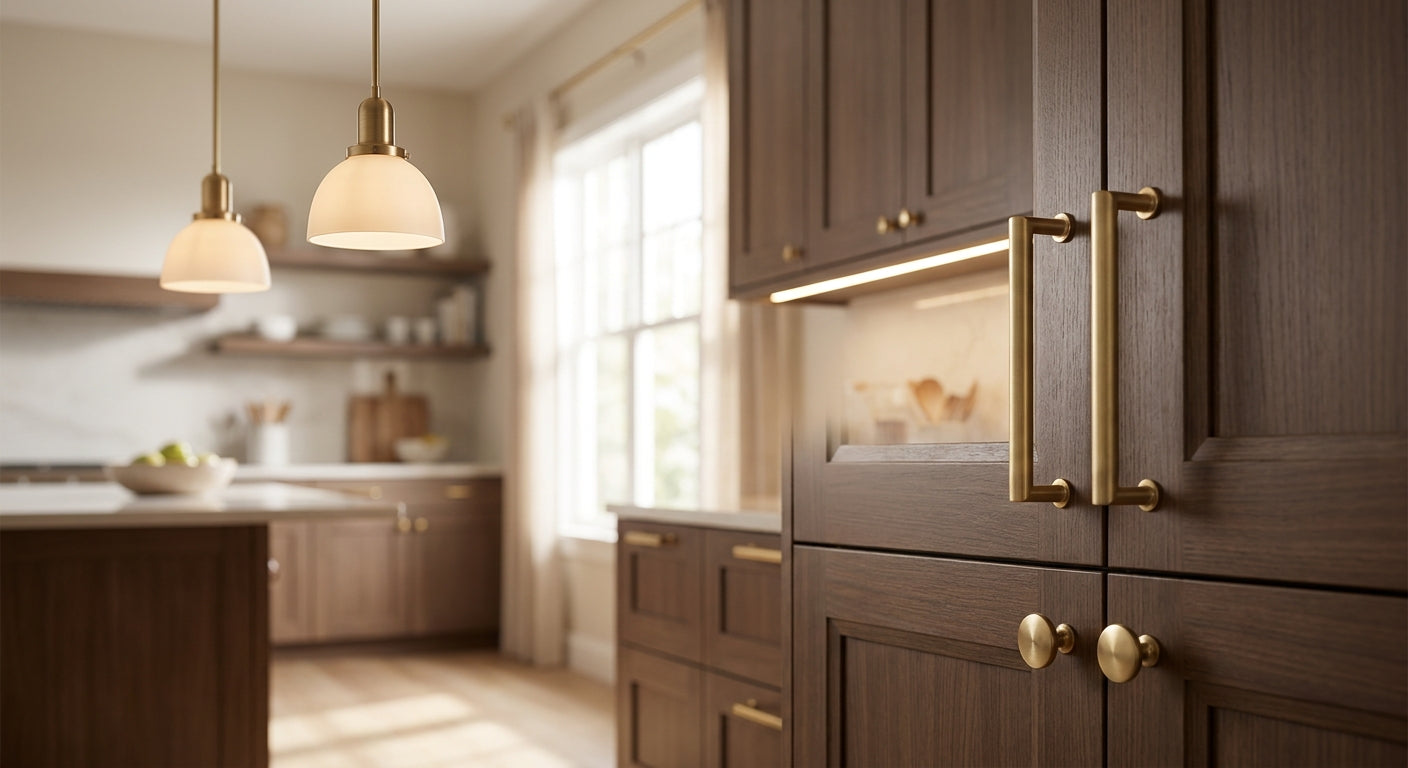
Coordinating cabinet hardware with kitchen lighting fixtures comes down to matching metal tones and finish sheen across pendants, under-cabinet lights, and knobs or pulls so the room reads as one decision instead of three separate purchases.
Shop the finish
Every bronze knob and pull we carry, in one place — filter by size, style, and brand.
Browse Bronze Cabinet Hardware →TL;DR
Match the undertone first, the sheen second: warm metals (brass, bronze, gold) pair with warm-toned fixtures, cool metals (nickel, chrome, stainless) pair with cool-toned fixtures, and mixing the two families only works when one finish clearly dominates. For a 2026 kitchen remodel, Top Knobs' Amwell Bar Pull in honey bronze is a safe anchor piece because it reads warm without going full brass, and it plays well under amber-toned pendant glass. Verdict: match undertone across at least 70% of your metal touchpoints, then let one accent finish break the rule on purpose. This guide covers cabinet hardware and lighting pairing step by step, with fixes for the most common mismatches.
Why this matters
A kitchen has more metal surfaces than people account for: faucet, cabinet hardware, lighting, appliance trim, even outlet covers. When those finishes fight each other, the room looks unfinished even with a $40,000 remodel behind it. Lighting is the worst offender because it's picked early (often before cabinets are even installed) and hardware gets picked last, as an afterthought. That order is backwards. Getting cabinet hardware and faucets wrong is annoying. Getting cabinet hardware and lighting wrong is more visible, because pendant lights and hardware sit at eye level together, in the same sightline, all day.
What you'll need
- A photo of your kitchen lighting fixtures (or the spec sheet finish name) taken in daylight, not under warm bulbs
- A metal swatch or two hardware samples in candidate finishes
- A tape measure for pull sizing against your cabinet stiles
- One drawer or cabinet door you can test hardware against before ordering the full set
- A list of every metal surface already committed: faucet, appliance handles, plumbing fixtures
The steps
1. Identify your lighting's true undertone
Most fixture finishes aren't as neutral as their name suggests. "Brushed nickel" pendants can lean warm-gray or cool-blue depending on the manufacturer, and "bronze" ranges from near-black to almost copper. Hold the fixture (or its box photo) next to a plain white sheet of paper in daylight and squint: if it warms the paper, it's a warm finish; if it cools it, it's a cool finish. Skipping this step is the single biggest reason people order the wrong hardware finish twice.
Common mistake: judging finish under LED kitchen bulbs, which shift everything toward blue-white and make warm bronze look cooler than it is.
2. Decide which finish leads the room
Pick the fixture with the largest visual footprint, usually the island pendants, and let that finish set the direction for hardware. If your pendants are aged bronze, hardware in a matching bronze or a close warm-metal cousin (honey bronze, champagne bronze) reads intentional. Trying to average two competing warm tones into a third "neutral" finish almost always looks like an accident instead of a choice.
Common mistake: choosing hardware finish based on the cabinet color instead of the lighting, which ignores the fixture that's actually closest to eye level.
3. Match sheen, not just color family
A polished brass fixture and a satin brass pull are technically the same metal family, but the sheen mismatch (mirror-shine versus matte) reads as clashing under kitchen lighting. Fixtures with high-gloss glass shades pull toward polished or bright hardware finishes; fixtures with fabric shades or matte metal read better against satin, honey bronze, or brushed finishes. Sheen mismatches are subtler than color mismatches but just as noticeable once you've seen it pointed out.
4. Pull one hardware sample and hold it under the actual fixture
Order or hold a physical sample and stand under the pendant or under-cabinet light at the counter height where hands actually touch hardware. Screen colors and even daylight photos distort finish more than people expect; a finish that looks perfect on a laptop can read two shades warmer or cooler in person. This is the step people skip to save a week, and it's the step that prevents a full-set return.
Common mistake: approving finish from a supplier's product photo alone, without a sample under your own bulbs.
5. Choose a bar pull or bin pull silhouette that echoes your fixture's lines
Linear pendant fixtures and rectangular island lights pair naturally with bar pulls, which carry the same straight horizontal line down onto the cabinets. Rounded schoolhouse or globe fixtures pair better with rounder knobs or arched pulls. The Top Knobs Amwell Bar Pull, 8-13/16 inch, for example, has a clean straight bar that echoes a linear pendant run without competing with it, and it's available in a honey bronze finish that matches warm-toned glass shades.
6. Confirm cross-room consistency before ordering the full set
If your kitchen lighting matches your dining or living room fixtures (an open-concept layout), check that your hardware finish choice doesn't create a jarring transition at the sightline between rooms. This matters more in 2026 open-plan builds than it did a decade ago, since kitchens now visually bleed into adjacent living spaces on nearly every new construction floor plan.
Common mistake: treating the kitchen as an isolated room when it's visually continuous with another space.
7. Order the full quantity only after the sample step is approved
Once the finish and silhouette are confirmed against the actual fixture, place the full hardware order. Buying in one batch from one finish run avoids the slight lot-to-lot variation that can happen when you order five now and fifteen later.
Troubleshooting
- Pendant lights look brassy but hardware samples look too yellow next to them: try a champagne bronze or honey bronze finish instead of straight brass; it splits the difference and reads warm without the high-shine yellow cast.
- Under-cabinet lighting washes out hardware finish entirely: switch to a warmer-temperature LED strip (2700K-3000K) rather than changing hardware, since cool 4000K+ strips flatten warm metal tones.
- Old brass fixtures don't match anything currently sold: don't chase an exact vintage match; pick a close contemporary warm finish and let the slight difference read as intentional layering rather than a mistake.
- Nickel pendant, but existing hardware is oil-rubbed bronze: rather than replacing everything, use the bronze as an accent finish only on a kitchen island or a single wall of cabinets, and match nickel hardware everywhere else.
- Hardware finish name doesn't match what you see in person: finish names aren't standardized across brands, so always trust the physical sample over the label.
- Budget doesn't allow full lighting replacement: hardware is the cheaper lever to pull; changing 20-30 knobs and pulls costs far less than replacing fixtures, and it does most of the visual work.
Tools and resources
- Top Knobs Amwell Bar Pull, 8-13/16 inch for a warm, linear finish anchor
- How to match cabinet hardware to faucets for the plumbing side of the same undertone problem
- How to style champagne bronze hardware in a kitchen if your lighting leans warm-neutral
- A physical hardware sample held under your actual fixtures, not a screen comparison
- Knobs.co for finish families across dozens of brands when you're still narrowing the direction
What to do next
Once hardware and lighting finishes are locked, the next mismatch to check is metal finishes across the whole house, not just the kitchen. How to mix metal finishes in a kitchen covers how many finish families a single kitchen can carry before it starts to look uncoordinated, and it's worth reading before you finalize a full hardware order.
FAQ
What's the best cabinet hardware finish to match brass kitchen lighting? A warm finish in the same family works best: honey bronze, champagne bronze, or unlacquered brass all pair well with brass fixtures without needing an exact metal match.
Is it OK to mix nickel hardware with bronze lighting? Yes, as long as one finish clearly dominates the room (roughly 70% or more of visible metal), with the second finish used only as a deliberate accent, not split evenly.
Does cabinet hardware need to match pendant lights exactly? No, matching undertone (warm versus cool) matters more than an exact finish match; a honey bronze pull next to an aged bronze pendant reads as coordinated even though the finishes aren't identical.
How many metal finishes can one kitchen have? Most coordinated kitchens in 2026 use two finish families at most: one dominant and one accent, with a third reserved only for small fixtures like a doorbell or robe hook.
Should I pick lighting or cabinet hardware first? Pick lighting first if it's already fixed (a design decision made early in a remodel), then choose hardware to match it; hardware is far easier and cheaper to change later than fixtures.
What finish works with cool-toned LED under-cabinet lighting? Brushed nickel, chrome, or brushed stainless hardware holds its color best under cool 4000K+ LED strips, while warm bronze finishes can look muddy under that light temperature.
Can I test a hardware finish before buying the whole set? Yes, ordering one or two samples and holding them under your actual fixtures at counter height is the single most reliable step before committing to a full hardware order.
Is champagne bronze a safe universal finish for mixed lighting? It's one of the more forgiving warm finishes for 2026 kitchens because it splits the difference between brass and bronze, which is why it shows up as an accent option across nickel, brass, and matte black lighting schemes alike.
One last thing
The fixture people forget to check is the doorbell. It sits at the front door, not the kitchen, but it's often the same finish family as the kitchen hardware in an open-concept entry, and a mismatched doorbell finish is a small detail that trained eyes notice before anything else in the house.


