

Black Cabinet Hardware on White Cabinets (2026)
How to style black cabinet hardware on white cabinets in 2026: finish choice, sizing rules, drill tips, and the one detail most installs get wrong.

Black cabinet hardware on white cabinets is one of the most searched, most second-guessed decisions in a kitchen or bathroom renovation — and it comes down to five choices you make before the first screw goes in.
TL;DR: Black cabinet hardware on white cabinets works in 2026 because the contrast is sharp, the finish hides fingerprints better than polished chrome, and the style range runs from farmhouse to sleek contemporary. The non-negotiable rules: match your black finish across every fitting in the room, size pulls to drawer width (roughly 1/3 the drawer face), and commit — mixing matte black with satin black reads as a mistake, not a design choice. Browse the full matte black finish collection before you finalize your hardware list.
Shop the picks from this guide
In stock at Knobs.co · Free shipping on hardware orders $99+ · 110% price match
-
 Amerock
Edona 1-1/4'' diam Cabinet Knob BP53005Matte Black
Amerock
Edona 1-1/4'' diam Cabinet Knob BP53005Matte Black
$3.21
$3.77 -
 Amerock
Cup Pulls 3'' cc Cabinet Cup Pull BP53010Matte Black
Amerock
Cup Pulls 3'' cc Cabinet Cup Pull BP53010Matte Black
$4.61
$5.42 -
 Amerock
Revitalize 1-1/4'' diam Cabinet Knob BP55342Black Bronze
Amerock
Revitalize 1-1/4'' diam Cabinet Knob BP55342Black Bronze
$6.42
$7.55 -
 Amerock
Edge Pull 5-1/16'' cc Cabinet Pull BP36575Matte Black
Amerock
Edge Pull 5-1/16'' cc Cabinet Pull BP36575Matte Black
$5.83
$6.85 -
 Amerock
Ravino 1-1/4'' diam Cabinet Knob BP53012Matte Black
Amerock
Ravino 1-1/4'' diam Cabinet Knob BP53012Matte Black
$2.79
$3.28 -
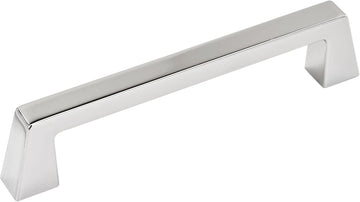 Amerock
Blackrock 5-1/16'' cc Cabinet Pull BP55277Polished Chrome
Amerock
Blackrock 5-1/16'' cc Cabinet Pull BP55277Polished Chrome
$9.63
$11.32


Why this pairing works in 2026
White cabinet paint reflects light and reads as neutral. Black hardware creates a defined edge on every door and drawer face — the eye lands on the hardware and reads the cabinet as intentional, not builder-grade. Interior designers have leaned into this pairing since roughly 2019, but it hasn't peaked. In 2026, the look is established enough to hold resale value and specific enough to separate a renovated kitchen from a stock one.
The practical bonus: matte black conceals fingerprints and water spots far better than polished nickel or chrome. In a high-traffic kitchen with white cabinets — which shows every smudge on the doors — matte black hardware is the lower-maintenance finish choice.
What you'll need
- Cabinet hardware in matte black finish (knobs, pulls, or a mix — see sizing section below)
- A pull-size template or a measuring tape
- Drill with the correct bit for your cabinet material
- Screwdriver (manual or electric, low torque setting)
- Painter's tape for marking hole placement
- A level for drawer pulls that require two holes
- Touch-up paint in your cabinet color (white) for any pilot hole mistakes
- 45–90 minutes for a standard 20-cabinet kitchen
The steps
Step 1: Decide on knobs vs. pulls vs. both
This single decision shapes every other choice. Knobs suit upper cabinet doors where a single pull point is enough. Pulls suit lower drawers and larger cabinet doors because they distribute grip across a longer span and feel more natural on heavier doors.
A common 2026 approach: knobs on upper doors, bar pulls on lower drawers, and a longer bar pull (8 inches or more) on any drawer wider than 24 inches. Mixing knobs and pulls on the same white cabinet run is fine — mixing knob styles or pull profiles within the same room is not.
Common mistake: choosing pulls shorter than the drawer face calls for. A 3-inch pull on a 24-inch drawer looks undersized and cheapens the hardware.
Step 2: Choose your black finish — and commit to it
Matte black is the dominant choice for white cabinets in 2026. Flat, low-sheen, no variation across the surface. Oil-rubbed bronze reads as warmer and brownish under certain lighting — it is not a black finish, and it will fight white cabinets. Satin black has a slight sheen that reads as gray in some light. If you want pure black contrast against white paint, matte black is the only finish that delivers it consistently.
Once you pick matte black, every piece of hardware in the room — hinges, knobs, pulls, and any appliance pulls — must be in matte black. A single hinge in brushed nickel will catch the eye every time the door opens.
Expected outcome: a cabinet run with consistent matte black hardware looks intentional from 6 feet away. Mixed finishes look like a stocking error.
Step 3: Size your pulls to the cabinet
The industry standard rule is to size a pull at roughly one-third the width of the drawer face. A 12-inch drawer gets a 4-inch pull. A 36-inch wide drawer or pot-and-pan bank gets a 12-inch bar pull.
For upper cabinet doors, center placement (both horizontally and vertically) works for shaker-style doors. For inset or flat-panel doors, place the knob or pull at the rail intersection — that is, where the stile and rail meet at the corner closest to the door's opening edge.
Common mistake: placing all hardware at identical height across upper doors and lower drawers without adjusting for door height variation. Measure each piece individually.
Step 4: Mark and drill with precision
Use painter's tape on the cabinet face before marking hole locations. Mark the center point (for knobs) or both hole centers (for pulls) with a pencil on the tape. Drill through the tape — it protects the paint surface from the bit's entry and keeps tear-out visible on the tape rather than on the cabinet finish.
For pulls requiring two holes, confirm the hole spacing matches the hardware's bore distance before you drill. Standard bore distances are 3 inches, 3.75 inches, 5 inches, and 6.25 inches on center. The Top Knobs Amwell Bar Pull at 8-13/16 inches uses a specific bore — confirm the spec sheet before drilling.
Expected outcome: clean holes with zero paint chip. Remove the tape immediately after drilling, before it sets.
Common mistake: drilling freehand without a template or level line. Even a 2mm offset on a lower drawer pull is visible when 10 pulls are installed in a row.
Step 5: Install hardware and check alignment at room scale
Hand-tighten screws first so the hardware can still shift slightly, then stand back 6 feet and sight along the cabinet run. Minor misalignments show at distance before they're locked in. Tighten fully once the alignment looks right at room scale, not just at arm's length.
For hinges, matte black cup hinges on white overlay doors are common in 2026. Soft-close is worth the small price premium — the mechanism is built into the hinge body and doesn't require separate dampers.
Expected outcome: every pull is level, centered to its drawer, and the row of pulls tracks in a straight horizontal line when viewed from across the room.
Step 6: Style the surrounding room to support the hardware
Black cabinet hardware on white cabinets needs at least one other black or dark element in the room to read as designed rather than accidental. Options: black faucet, black light fixture, black cabinet legs, or dark grout lines in a subway tile backsplash.
Two or three black elements in addition to the hardware creates a cohesive palette. More than five starts to fight the white cabinet's job, which is to keep the room light.
Common mistake: pairing matte black hardware with polished black faucets. The sheen difference is obvious under task lighting. Match matte black hardware with matte black plumbing fixtures, or accept the visual break consciously.
Troubleshooting
Hardware looks gray, not black, in certain light. The finish is satin black, not matte. Return and reorder in a confirmed matte black finish. Satin and matte are not interchangeable on white cabinets.
Pulls feel loose after six months. The screw has backed out through use. Add a small nylon lock nut to the mounting screw. Do not over-tighten the original screw — it can crack MDF cabinet fronts.
The contrast looks harsh in person vs. inspiration photos. The room's natural light level is lower than the photographed kitchen. Add under-cabinet LED strips to increase ambient light — the contrast softens as overall brightness increases.
One pull is visibly off-center after installation. Fill the incorrect hole with wood filler tinted to match the cabinet color, let cure for 24 hours, sand flush, touch up with white paint, then re-drill in the correct location.
Hinges don't match the pulls in finish tone. This is the most common matte-black mistake. Order hinges and pulls from the same manufacturer's finish line, not just from the same color category across different brands. Matte black varies by brand.
Hardware scratches easily. Some matte black finishes use a softer PVD coating. For high-traffic kitchens, specify hardware with a lacquer-over-PVD topcoat — Top Knobs and similar brands list this in the finish spec.
Tools and resources
- Matte black hardware catalog: finish-matte-black collection — 50,000+ SKU depth across knobs, pulls, and hinges
- Appliance pulls: appliance pulls collection — necessary if your white kitchen has a refrigerator or dishwasher panel to match
- Style reference: matte black cabinet pulls for white kitchens — room-by-room styling guide for this specific pairing
- Pull template: any hardware retailer sells a $10–15 plastic template; it eliminates the manual measuring step on step 4
- Level app on a smartphone works for single-room installs; a physical torpedo level is faster across 20+ doors
FAQ
Does black hardware look good on white cabinets? Yes — matte black on white is the highest-contrast pairing available in cabinet hardware and reads as deliberate in any kitchen or bathroom style from farmhouse to contemporary in 2026.
What finish of black hardware is best for white cabinets? Matte black. It delivers consistent flat color with no sheen variation, conceals fingerprints better than any other black finish, and photographs cleanly against white paint.
How do I know what size pulls to buy for white cabinets? Size the pull to approximately one-third the drawer face width. A 12-inch drawer takes a 4-inch pull; a 36-inch wide drawer takes a 12-inch bar pull. For upper doors, a single knob or a 3–4 inch pull centered on the stile is standard.
Can I mix knobs and pulls on white cabinets? Yes — knobs on upper doors and pulls on lower drawers is the most common combination in 2026. What you cannot mix is finish: every piece must be the same matte black finish from the same or finish-matched manufacturer.
Is black hardware a trend that will look dated in five years? Black cabinet hardware has been in continuous production since the mid-2010s and shows no sign of cycling out. It appears in new construction spec sheets across multiple price tiers, which indicates broad market adoption rather than a short trend cycle.
How many knobs or pulls do I need for a typical kitchen? A 20-cabinet kitchen with 10 upper doors, 6 lower doors, and 4 drawers requires roughly 20 pieces — 16 knobs or pulls for doors and 4 bar pulls for drawers. Order 10% extra for mistakes and future replacements.
Will black hardware scratch or rust on white cabinets over time? Quality matte black hardware uses PVD or powder-coat finishes rated for interior use; neither rusts. PVD is harder and more scratch-resistant than powder coat. For heavy-use drawers, specify PVD-finished hardware and avoid abrasive cleaners.
What other black elements should I add to the room? At minimum, one other black fixture — a faucet, a light, or a range hood — anchors the hardware choice. Two to three black elements create a cohesive room; more than five competes with white cabinetry's role as the primary surface.
One last thing
The single detail that separates a polished result from an amateur install: the hinges. Most people obsess over pulls and forget that 10 exposed hinges in brushed nickel against matte black pulls will register as a mistake to every person who opens a cabinet door. Order the hinges first — confirm matte black is available in the hinge style your cabinet overlay requires — then select the pulls. Hardware is a system, not a collection of individual parts.
Related guides
- Matte black cabinet pulls for white kitchens
- Best matte black knobs for shaker cabinets
- Best brushed nickel knobs for white cabinets
Shop Black Cabinet Hardware
-
 Nouveau III Essex Knob 1 3/16'' M1123 Flat Black
$7.79
Nouveau III Essex Knob 1 3/16'' M1123 Flat Black
$7.79
-
 Tahoe 128 mm cc Bar Pull 602-128BLK
$26.12
Tahoe 128 mm cc Bar Pull 602-128BLK
$26.12
-
 Edona 1-1/4'' diam Cabinet Knob BP53005
$3.21
Edona 1-1/4'' diam Cabinet Knob BP53005
$3.21
-
 Cup Pulls 3'' cc Cabinet Cup Pull BP53010
$4.61
Cup Pulls 3'' cc Cabinet Cup Pull BP53010
$4.61
-
 Charlie's Appliance Pull D726
$130.46
Charlie's Appliance Pull D726
$130.46
-
 Alno A726 Charlie's 3 1/2'' CC Cabinet Pull
$24.26
Alno A726 Charlie's 3 1/2'' CC Cabinet Pull
$24.26
-
 Revitalize 1-1/4'' diam Cabinet Knob BP55342
$6.42
Revitalize 1-1/4'' diam Cabinet Knob BP55342
$6.42
-
 Blackrock 5-1/16'' cc Cabinet Pull BP55277
$9.63
Blackrock 5-1/16'' cc Cabinet Pull BP55277
$9.63


Browse all 5096 in Black Cabinet Hardware → Cabinet knobs Cabinet pulls & handles