

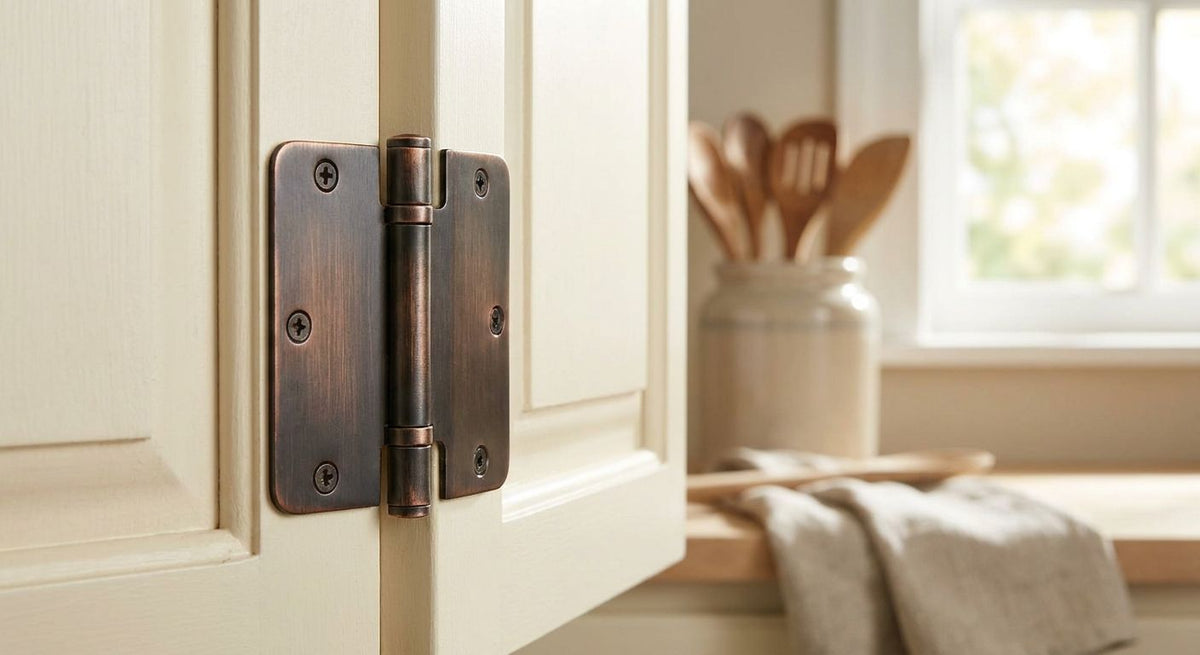
Oil rubbed bronze cabinet hinges are the finishing touch that keeps a traditional kitchen looking authentic instead of assembled from mismatched hardware bins. This guide breaks down which hinge styles actually belong on face-frame and raised-panel cabinets in 2026, and which ones just look right in a listing photo.
Shop the finish
Every oil rubbed bronze knob and pull we carry, in one place — filter by size, style, and brand.
Browse Oil Rubbed Bronze Cabinet Hardware →- Self-closing face-frame hinges in oil rubbed bronze are the safe pick for shaker and raised-panel traditional kitchens in 2026.
- European concealed hinges hide the hardware entirely — skip them if you want visible oil rubbed bronze detail.
- Match hinge finish to your knobs and pulls before ordering a full set; mismatched sheens are the most common traditional-kitchen error.
- Standard face-frame inset reveal runs about 3/8 inch; measure your doors before ordering oil rubbed bronze cabinet hinges.
Why This Matters
Traditional kitchens run on continuity: raised-panel doors, furniture-style toe kicks, and hardware that looks aged rather than sprayed. Oil rubbed bronze cabinet hinges reinforce that look because the finish is meant to show highlights and wear at the edges, the way a hand-forged strap hinge ages over decades. Swap in a bright chrome or unfinished hinge and the whole cabinet box reads modern, even when the doors themselves are true raised-panel.
Most homeowners get the knobs and pulls right and then grab whatever hinge shipped with the cabinet box. That mismatch is the single most common finish error in a traditional kitchen remodel — worse than picking the wrong door style. If you're already sourcing oil rubbed bronze cabinet knobs for the same kitchen, the hinges need to match in tone, not just in name.
Who This Is For
This guide is for homeowners and remodelers finishing a traditional kitchen — raised-panel or shaker-adjacent doors, furniture-leg islands, apron sinks — who need hinges that read as hand-finished rather than hardware-store generic. It's also useful for contractors specifying hardware for multiple traditional builds in 2026, where consistency across units matters more than any single decorative flourish.
What to Look For in Oil Rubbed Bronze Cabinet Hinges for Traditional Kitchens
Door Overlay and Mounting Style
Traditional face-frame cabinets typically use inset doors with roughly a 3/8-inch reveal, or partial-overlay doors that cover part of the frame. Order the wrong mounting style and the door sits proud of the frame or won't close flush, so measure your overlay before buying oil rubbed bronze cabinet hinges. How to choose the right cabinet hinge walks through the measurement if you're not sure which type your cabinets use.
Finish Depth and Highlight
Oil rubbed bronze isn't one shade — some lines run near-black with copper highlights, others sit lighter with a warm brown cast. Order a sample hinge alongside your knobs and pulls before committing to a full kitchen's worth. Finish batches vary even within the same manufacturer, and lighting changes how dark the finish reads.
Opening Angle and Function
European concealed hinges typically open 110 to 170 degrees depending on the model, while traditional butt hinges swing close to 180 degrees for full door clearance. A wider opening angle matters more on deep drawers and corner cabinets than on a standard swinging door.
Screw Hole Spacing and Hinge Size
Butt hinges for traditional cabinets commonly run 2 to 3.5 inches in leaf length. Match the existing screw pattern if you're replacing hinges rather than rehanging new doors, or you'll spend a weekend filling and redrilling holes.
Self-Closing vs Non-Self-Closing Action
Self-closing hinges pull the door shut over the last few degrees of swing, which cuts down on slamming in a busy kitchen. Non-self-closing hinges give more of a period-authentic feel but let doors swing free — some traditional-kitchen owners actually prefer that the hardware does less "work."
Hinge Styles to Consider for a Traditional Kitchen in 2026
The Safe Pick: Self-Closing Face-Frame Hinges
Self-closing semi-concealed hinges are the default for face-frame cabinets with inset or partial-overlay doors, matching the roughly 3/8-inch reveal common in raised-panel construction. They hide most of the mounting hardware while keeping a visible hinge barrel, which reads correctly on a traditional kitchen. Buy for most traditional remodels in 2026. See cabinet hinges for inset doors for mounting specifics on this hinge type.
The Period-Authentic Pick: Ball-Tip Butt Hinges
Decorative ball-tip or minaret-tip butt hinges show the full hinge leaf on the door face, the way hardware looked before concealed hinges existed. Leaf sizes commonly run 2 to 3.5 inches, and the visible barrel is the point of buying them. Buy if your doors are true inset with no partial overlay; Skip if your cabinets are frameless, since these hinges need a face-frame edge to mount to.
The Hidden Option: European Concealed Hinges
Concealed hinges disappear inside the cabinet box, with an opening range of roughly 110 to 170 degrees depending on the model. They work on frameless or full-overlay traditional-style cabinets, but they remove the visible oil rubbed bronze detail entirely — the finish only shows if the cup or mounting plate is visible from inside. Consider this only if your knobs and pulls already carry the finish statement and the hinges just need to function.
The Wildcard: Non-Self-Closing Minaret Hinges
Non-self-closing hinges with decorative tips skip the spring mechanism, so doors swing free and stay wherever you leave them. That's closer to how period cabinet hardware actually worked, which appeals to owners doing a strict restoration. Consider for a dedicated period build; Skip for a busy family kitchen where doors need to close themselves.
What Looks Right But Isn't: Full-Wrap Overlay Hinges
Full-wrap hinges are built for standard 3/4-inch overlay doors and wrap around both the door and frame edge for a cleaner, more contemporary look. They function fine mechanically on traditional cabinets, but the wrap-around leaf reads more transitional than traditional once installed. Skip if the rest of your kitchen is committed to a period look.


What to Avoid
- Hinges with a sealed lacquer topcoat marketed as "oil rubbed bronze." A fully sealed finish won't develop the soft highlight wear real ORB is known for, and it can look almost black-plastic under kitchen lighting.
- Ordering hinges before matching pulls and knobs. Finish names aren't standardized across manufacturers — one brand's oil rubbed bronze runs warmer than another's. Order a hinge and a knob sample together before buying a full set.
- Full-overlay decorative hinges on inset cabinets. They're built for a 3/4-inch overlay door and will sit wrong, or won't mount at all, on a true inset face-frame door.
Verdict Comparison Table
| Hinge Style | Best For | Key Spec | Verdict |
|---|---|---|---|
| Self-closing face-frame | Inset/partial-overlay traditional doors | 3/8 in reveal | Buy |
| Ball-tip butt hinge | Period-authentic, visible hardware | 2-3.5 in leaf | Buy |
| European concealed | Frameless or full-overlay cabinets | 110-170° opening | Consider |
| Non-self-closing minaret | Strict period restoration | 2 in joint size | Consider |
| Full-wrap overlay | Transitional, not traditional | 3/4 in door thickness | Skip |
FAQ
What's the best oil rubbed bronze cabinet hinge for a traditional kitchen in 2026?
Self-closing semi-concealed face-frame hinges are the best default for traditional kitchens in 2026 because they fit the common 3/8-inch inset reveal on raised-panel cabinets. Ball-tip butt hinges are the better choice if you want the full hinge leaf visible.
Is oil rubbed bronze still in style for kitchen hardware in 2026?
Yes, oil rubbed bronze remains a standard finish choice for traditional and transitional kitchens in 2026, particularly alongside raised-panel doors and warm wood tones. It pairs with matte black and warm brass trends without looking dated.
Do oil rubbed bronze hinges need to match oil rubbed bronze knobs and pulls?
They should match in tone even if not the exact same manufacturer batch, since finish depth varies between brands. Order a hinge and a knob sample side by side before buying a full kitchen's worth.
How much does it cost to replace cabinet hinges with oil rubbed bronze in 2026?
Cost depends on hinge style, brand, and how many doors need hardware, so check current listings for exact pricing. Decorative butt hinges typically cost more per unit than standard self-closing semi-concealed hinges.
Can I put European concealed hinges on a traditional face-frame kitchen?
Concealed hinges work on face-frame cabinets built for full overlay doors, but they hide the hardware entirely, removing the visible oil rubbed bronze detail. Choose them only if your knobs and pulls already carry the finish statement.
What's the difference between self-closing and non-self-closing cabinet hinges?
Self-closing hinges pull the door shut over the final few degrees of swing, reducing slamming in daily use. Non-self-closing hinges let the door swing free and stay wherever it's left, which some period restorations prefer.
Will oil rubbed bronze hinges tarnish or wear over time?
Oil rubbed bronze is designed to show wear at high-touch points, developing lighter highlights where fingers and cloths contact the metal most. That's the intended look, not a defect, though a sealed lacquer version will resist that change.
How do I know if my cabinets use inset or overlay doors?
Inset doors sit flush inside the face frame with a small reveal gap, typically around 3/8 inch, while overlay doors sit in front of the frame and cover it partially or fully. Check the door edge against the frame to tell which type you have.
One Last Thing
The fastest way to avoid a hardware mismatch: order one hinge, one knob, and one pull in the same finish line before buying anything else, then lay them side by side under your actual kitchen lighting, not store lighting. Oil rubbed bronze shifts more under warm versus cool bulbs than almost any other cabinet finish, and that difference doesn't show up in a product photo.


