

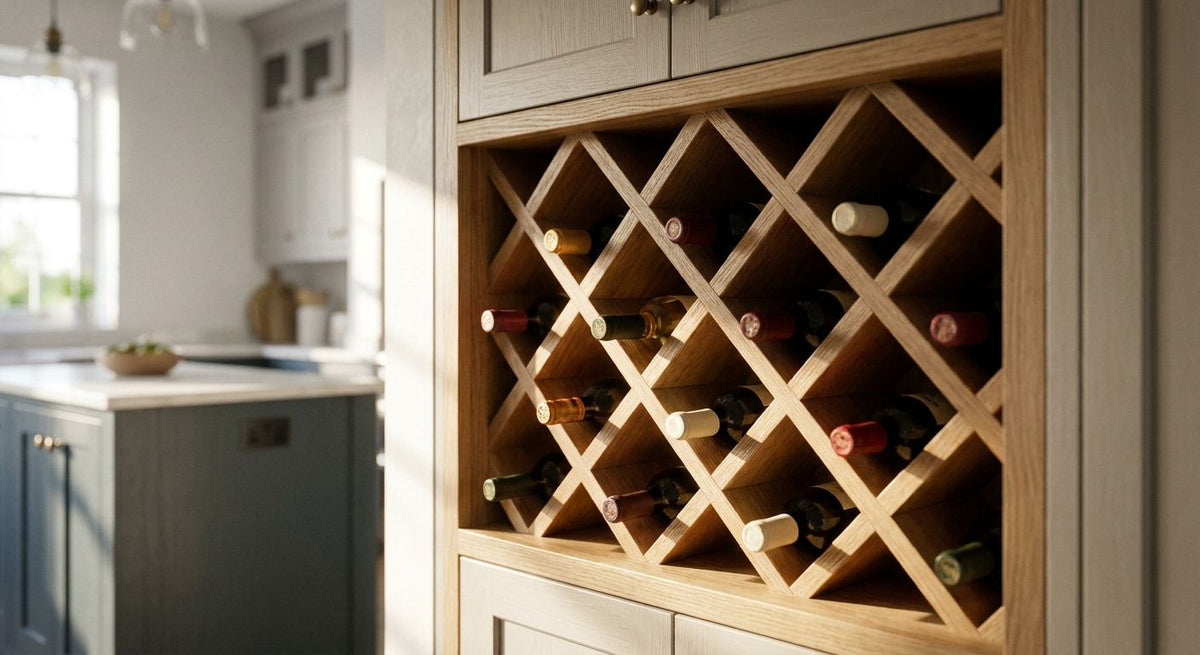
A wine rack insert for cabinet is a slide-in or built-in unit that fits inside an existing kitchen cabinet to hold bottles horizontally, and homeowners doing a partial kitchen refresh in 2026 use it to reclaim a narrow, half-empty cabinet without replacing the box. The segment that benefits most: anyone with a standard 24-inch base cabinet, a filler strip next to the fridge, or an upper cabinet that's never held anything but stray Tupperware lids.
- A wine rack insert for cabinet drops into a standard 24-inch base cabinet without replacing the box.
- Wire slide-out inserts fit bottles up to 3.25 inches wide -- measure before you buy in 2026.
- Solid wood inserts match stained cabinetry but need full-extension slides rated for the added weight.
- Match new pull hardware to the insert door finish, and order free samples before committing.
- Skip stackable diamond bins in deep upper cabinets -- they waste depth behind the bottles.
Why wine rack inserts matter for homeowners
Most kitchens built before 2020 assumed cabinets held pots and dry goods, not bottles lying on their sides. That leaves homeowners in 2026 with two choices when they want wine storage: tear out a cabinet and rebuild, or retrofit what's already there with an insert.
Retrofitting wins for one reason -- standard base cabinets run 24 inches deep and come in widths cut on 3-inch increments, which is the same increment most slide-in wire and wood inserts are manufactured to fit. The narrow filler cabinet next to the fridge or range, usually 3 to 9 inches wide, is prime insert territory that most homeowners walk past for years. Getting the hardware right on that cabinet door matters too -- see how other homeowners handled cabinet knobs for built-in wine cellar cabinets before finishing their own retrofit.
Measure your cabinet opening
Do this before you look at a single product. A rack that's a half-inch too wide won't slide in, and one that's too shallow won't clear the door.
- Measure interior width at the narrowest point, not the opening at the face frame
- Measure depth from the back wall to where the door closes
- Confirm you have at least 14 inches of depth if you want diagonal bottle storage
- Check for face frame overlap -- framed cabinets often lose a half-inch of usable width that frameless cabinets don't
- Note which way the door swings and whether a hinge cup intrudes on the opening
Decide between a slide-in insert and a built-in
The manual, no-cutting option comes first. A built-in only makes sense once a slide-in genuinely won't fit.
- Wire slide-out racks: fit openings from 3 to 15 inches wide, no cutting or drilling required
- Solid wood slide-out inserts: match stained or painted cabinetry, but need full-extension drawer slides rated for the load
- Stackable diamond bins: rest on an existing shelf, zero drilling, best in upper cabinets rather than base cabinets
- Custom cabinetmaker build-ins: reserved for non-standard widths, curved fronts, or openings under 3 inches
Check bottle diameter and orientation
A standard 750ml wine bottle runs about 3 to 3.25 inches in diameter at its widest point. Magnums and most Champagne bottles run wider, so measure your actual collection instead of assuming the average fits.
- Horizontal storage keeps the cork moist for bottles you're aging past a year
- Vertical storage works fine for short-term, counter-height access
- Diagonal racks need the most depth but hold the most bottles per inch of cabinet width
- If your collection skews toward Champagne or dessert wine, size the rack to the widest bottle you own, not the narrowest
“If the rack holds bottles diagonally, plan for at least 14 inches of cabinet depth behind the door.”
Match the insert to your cabinet finish
A slide-in rack with a hidden face doesn't need to match anything. One with a visible front does.
- Order finish samples before buying if the insert front will be visible with the door open
- Match wood species and stain sheen, not just the color name on a swatch
- If you're converting a full door into an open wine rack cutout, budget new hardware for that single door so it doesn't stand out
- A free sample against your actual cabinets settles finish arguments faster than a photo on a screen
Update the hardware on the wine rack cabinet
Once the insert is picked, the door hardware is the last visible detail -- and the one most homeowners get wrong by grabbing whatever's in the junk drawer.
- Match the pull or knob finish to the rest of the kitchen run, not the insert material
- A bar pull reads cleaner on a narrow wine rack door than a single center knob
- The Elements Hardware Gibson bar pull is sized for narrow filler-cabinet doors without overwhelming a 3-to-9-inch front
- Knobs.co ships free samples of cabinet hardware finishes so you can hold the actual metal against your cabinet before buying the full set
Install the insert
- Dry-fit the insert before drilling anything
- Use a hardware jig if you're placing new pulls on the converted door
- Close the door with bottles loaded to confirm clearance before final assembly
- Secure slide-out units to the cabinet floor or side rails -- don't let one rest unanchored
Maintain the rack
- Wipe wire racks periodically to prevent rust in humid kitchens
- Re-tighten wood insert screws once a year; wood moves seasonally
- Check hardware finish near the wine rack door for wear -- high-traffic spots near a wet bar or beverage station show finish wear first
Comparing wine rack insert options
| Option | Best for | Installation | Key limitation |
|---|---|---|---|
| Wire slide-out rack | Standard 3-15 in. base cabinets | Drops into existing opening, no cutting | Limited to bottles under 3.25 in. diameter |
| Solid wood slide-out | Stained or painted cabinetry that shows | Needs measured fit, full-extension slides | Heavier, needs slides rated for the added load |
| Stackable diamond bin | Deep upper or pantry cabinets | Sits on existing shelf, no drilling | Wastes depth behind the bottles |
| Custom cabinetmaker build | Non-standard openings, curved fronts | Built to order by a carpenter | Longest lead time, no returns once built |
Wire slide-out racks are the buy for most homeowners retrofitting a standard base cabinet in 2026 -- they need no cutting and cost the least in labor. Solid wood inserts are a hold if your cabinetry finish is unusual and worth matching exactly. Stackable bins are fine for upper cabinets but a skip for base cabinets, where they waste the cabinet's full depth. Custom builds are a wait unless your opening genuinely won't take a standard insert.
Common mistakes homeowners make
- Buying a standard-width insert without measuring the actual opening -- framed cabinets lose a half-inch to the face frame that frameless cabinets don't
- Choosing vertical storage for long-term wine -- upright bottles dry out corks over months, not years
- Ignoring door clearance -- a rack loaded with bottles can hit a drawer pull mounted just below it
- Mismatching hardware finish -- a satin nickel pull on a cabinet run finished in champagne bronze stands out immediately
- Skipping full-extension slides on wood inserts -- a loaded wood rack on standard slides sags within a year
FAQ
What size wine rack insert fits a standard kitchen cabinet?
Most standard base cabinets run 24 inches deep and come in widths cut on 3-inch increments, so wine rack inserts sized to 3, 6, 9, or 12 inches wide fit the majority of existing openings without modification.
Can you convert a regular cabinet into a wine rack without buying a new cabinet?
Yes -- a slide-in wire or wood insert fits into most existing base cabinet openings without cutting or replacing the cabinet box, which is the retrofit route most homeowners take in 2026.
How many bottles fit in a 12-inch wine rack insert?
At roughly 3.25 inches per bottle diameter, a 12-inch-wide insert holds about three bottles per row, with total capacity depending on how many rows the insert's height allows.
Is a wire or wood insert better for a wine rack?
Wire inserts install faster and cost less in labor since they need no matching finish; wood inserts look better when the front is visible but require full-extension slides for the added weight.
Do you need a cabinetmaker to install a wine rack insert?
No -- a slide-in wire or wood insert is a DIY job with basic measuring and a drill. A cabinetmaker is only necessary for non-standard openings or curved cabinet fronts.
What hardware finish should you use on a wine rack cabinet door?
Match the finish already used on the rest of the kitchen's pulls and knobs rather than the insert material -- ordering a free sample against your existing hardware settles the match before you buy.
How much clearance do you need behind a wine rack insert?
Plan for at least 14 inches of cabinet depth if the insert stores bottles diagonally; straight horizontal racks need less, closer to the bottle length itself.
Can a corner cabinet fit a wine rack insert?
Rarely as a standard slide-in -- corner cabinets have irregular access, so most homeowners either use a stackable diamond bin resting on the existing shelf or opt for a custom build.
One last thing
Check the filler strip next to your fridge or range before buying anything. Most base cabinet fillers are already cut to 3, 6, or 9 inches -- the exact same increments most wire wine inserts ship in -- so the empty space you've walked past for years might already be the right width for a slide-in rack with zero cutting involved.