

Best Mid Century Modern Knobs for Flat-Front Cabinets 2026
The best mid century modern knobs for flat-front cabinets in 2026: tapered cylinders, faceted mushrooms, and brass domes ranked by profile, finish, and price.

Flat-front cabinets have almost no surface detail, which means your hardware does all the decorative work. Pick the wrong knob and the whole kitchen reads generic; pick the right mid century modern profile and the cabinetry looks intentional and edited.
TL;DR: The best mid century modern knobs for flat-front cabinets in 2026 share three traits — a geometric or tapered silhouette, a finish that reads warm or matte rather than shiny, and a diameter between 1.25" and 1.5" that holds visual weight on a slab door. Brushed nickel and matte black are the two dominant finishes for this style. If you want one place to browse vetted options, the mid century modern collection at Knobs.co covers 50,000+ SKUs across major brands.
Shop the picks from this guide
In stock at Knobs.co · Free shipping on hardware orders $99+ · 110% price match
-
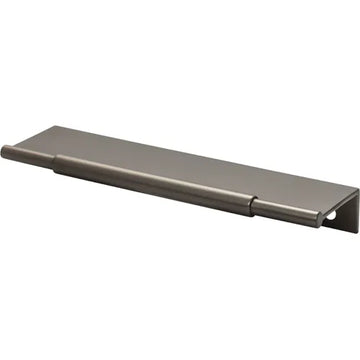 Top Knobs
Lynwood Crestview Tab Pull 6 InchAsh Gray
Top Knobs
Lynwood Crestview Tab Pull 6 InchAsh Gray
$17.42
$19.35 -
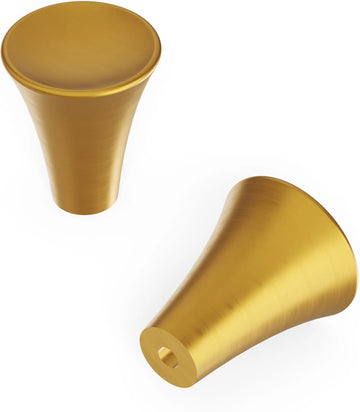 Hickory Hardware
Maven Collection Knob 15/16'' DiameterBrushed Golden Brass
Hickory Hardware
Maven Collection Knob 15/16'' DiameterBrushed Golden Brass
$7.20
$8.99 -
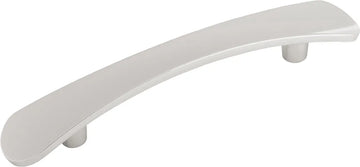 Belwith-Keeler
Vale Collection PullPolished Nickel / 3-3/4'' cc
Belwith-Keeler
Vale Collection PullPolished Nickel / 3-3/4'' cc
$22.50
$24.99 -
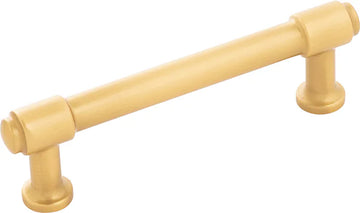 Hickory Hardware
Piper Collection Pull 3-3/4'' ccBrushed Golden Brass
Hickory Hardware
Piper Collection Pull 3-3/4'' ccBrushed Golden Brass
$12.00
$14.99 -
 Hickory Hardware
Maven Collection Knob 1-1/4'' DiameterBrushed Golden Brass
Hickory Hardware
Maven Collection Knob 1-1/4'' DiameterBrushed Golden Brass
$8.80
$10.99 -
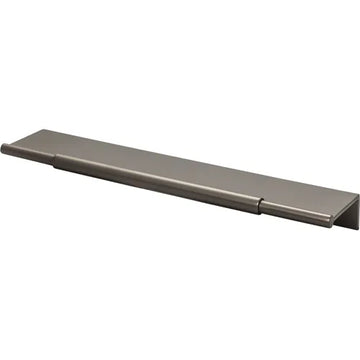 Top Knobs
Lynwood Crestview Tab Pull 8 InchAsh Gray
Top Knobs
Lynwood Crestview Tab Pull 8 InchAsh Gray
$22.64
$25.15

Why This Matters in 2026
Flat-front cabinetry (also called slab-front) is the dominant door style in new kitchen builds and renovations right now. Without raised panels, insets, or beadboard, the door surface is essentially a blank plane. Mid century modern hardware — think tapered cylinders, faceted mushroom shapes, angular barrels — introduces the visual complexity the door itself lacks. Get this pairing right and you add character without a single tile change.
How We Ranked
Rankings draw on three criteria applied to hardware available across Knobs.co's catalog of 50,000+ SKUs: (1) silhouette compatibility with flat-front doors specifically — profiles that read busy or ornate on plain slab doors were excluded; (2) finish durability, scored by PVD or lacquer coating quality relative to price; (3) bore standardization — every pick below uses the industry-standard 1-3/8" projection or sits on a single 1" bore hole so no template drilling is required. Price tiers are noted because this category runs from $4 to $40 per knob and the quality gap is real.
The Ranked List
1. Tapered Cylinder Knob in Brushed Nickel — The Safe Pick
A straight-sided or gently tapered cylinder in brushed nickel is the single most versatile mid century modern knob profile. The satin surface diffuses light rather than throwing a glare point, which flatters flat-front doors photographed under kitchen LED strips. Diameter runs 1.25"–1.375" across most major brands in this profile; projection is typically 1.25".
Why buy now: brushed nickel reads warm enough to pair with wood-tone lower cabinets and cool enough to pair with white or greige uppers — the two most common flat-front cabinet combinations specified in 2026 renovations. Browse the full brushed nickel finish collection to compare profiles side by side.
Verdict: Buy. This is the lowest-risk choice for a flat-front kitchen with no strong accent color.
2. Faceted Mushroom Knob in Matte Black — The Statement Pick
The faceted mushroom — a domed top cut into flat planes — is the most distinctly mid century profile in cabinet hardware. In matte black it reads sculptural rather than ornate, which is exactly what a slab door needs. Most faceted mushroom knobs clock in at 1.375" diameter with a 1" projection, sitting closer to the door than a standard dome and reducing the chance of snagging.
Matte black PVD coatings hold finish significantly better than painted finishes in humid kitchen environments; look for "PVD" or "physical vapor deposition" in the spec sheet, not just "matte black painted." The matte black finish collection at Knobs.co filters by this distinction.
Verdict: Buy if your cabinetry is white, off-white, or a saturated color. Hold if your cabinets are already dark — the contrast disappears.
3. Solid Brass Dome Knob, Unlacquered or Satin Brass — The Warm-Tone Pick
Unlacquered brass patinas naturally over 12–18 months, landing on a warmer, slightly darker tone that looks period-correct for authentic mid century interiors. Satin brass skips the patina process and stays consistent. Either way, the dome profile — a clean hemisphere, no facets — pairs exceptionally well with flat Walnut or rift oak veneer doors, the material choice in approximately 40% of mid century modern kitchen renovations according to NKBA 2025 trend data.
Diameter: most solid brass dome knobs run 1.25"–1.5". Weight per knob is noticeably heavier than zinc alloy versions — 2.5 oz vs. 0.9 oz is a common delta — and that weight telegraphs quality through the pull.
Verdict: Buy for wood-tone flat fronts. Consider if you want maintenance-free hardware — unlacquered brass requires occasional cleaning to control patina direction.
4. Angular Bar Knob (Short Pull, 2"–3" CC) — The Drawer Pick
For drawer fronts on the same flat-front run, a short angular bar knob — essentially a 2"–3" center-to-center pull — bridges the gap between a true knob and a full pull. The rectangular cross-section reads geometric and period-appropriate. At 2026 prices, quality zinc alloy versions with PVD finish start around $8–$12 each; solid brass versions start around $18.
This profile also works on upper cabinet doors when used as a single-hole pull (one screw, centered), though the visual weight skews slightly more masculine than a dome or cylinder.
Verdict: Buy for drawer fronts. Hold for upper doors unless the overall design is intentionally industrial.
5. Ceramic or Resin Inset Knob — The Wildcard
A small subset of mid century modern hardware uses ceramic or resin inserts — typically a white, black, or terracotta disc set into a brass or chrome bezel. This profile was common in original 1950s–1960s kitchen hardware and adds texture that plain metal knobs lack. The tradeoff: ceramic inserts chip if struck at an angle, and the bezel finish is rarely PVD, meaning it wears faster at the 3–5 year mark.
Use this profile sparingly — one or two accent pieces on a display cabinet, not a full kitchen run of 30 knobs.
Verdict: Consider for accent use. Skip for a full kitchen installation.
Comparison Table
| Profile | Finish Options | Diameter | Price Range (each) | Best Cabinet Color | Verdict |
|---|---|---|---|---|---|
| Tapered Cylinder | Brushed Nickel, Satin Brass, Matte Black | 1.25"–1.375" | $6–$22 | All | Buy |
| Faceted Mushroom | Matte Black, Antique Brass | 1.375" | $9–$28 | White, Color | Buy |
| Solid Brass Dome | Unlacquered Brass, Satin Brass | 1.25"–1.5" | $10–$30 | Wood Tone | Buy |
| Angular Bar Knob | Matte Black, Brushed Nickel | 2"–3" CC | $8–$20 | All | Buy (drawers) |
| Ceramic Inset | Brass + Ceramic | 1.25" | $14–$40 | Light | Consider |
What to Avoid
- Ornate or carved profiles. Acanthus leaf, rope-twist, or any profile with relief detail fights the flat-front door's clean geometry. The contrast reads as a mistake, not a mix.
- High-polish chrome on warm cabinetry. Polished chrome reflects environment aggressively; in a kitchen with wood tones or warm paint, it reads cold and out-of-decade. Brushed or satin finishes are the correct call for mid century work.
- Undersized knobs (sub-1" diameter) on full overlay doors. A 0.75" knob on a 15"×30" upper cabinet door disappears visually. Mid century modern design scales hardware up, not down — 1.25" is the practical floor for flat-front applications.
Where to Buy
- Knobs.co stocks 50,000+ SKUs from major brands; filter directly to mid century modern profiles via the mid century modern collection. Trade accounts get volume pricing starting at 25 pieces.
- Kitchen showrooms: useful for in-hand evaluation of weight and finish, but SKU breadth is typically 200–400 vs. 50,000+ online. Treat showrooms as a tactile sample step, then order online for price and selection.
- Big-box retail: adequate for entry-level zinc alloy hardware; limited to 3–5 profiles in this category and rarely stocks PVD matte black.
FAQ
What size knob works best on flat-front cabinet doors in 2026? 1.25" to 1.5" diameter is the standard range for flat-front doors. Anything smaller reads too delicate on a slab surface; anything over 1.75" starts to dominate the door rather than accent it.
Is matte black or brushed nickel better for mid century modern cabinets? Both are correct for the style. Matte black reads more graphic and works best on white or light cabinets. Brushed nickel is more neutral and handles transitions between wood-tone and painted cabinet sections without a finish clash.
How many knobs do I need for a typical kitchen? Count each door and each drawer front. A standard 10'×10' kitchen runs 30–40 hardware pieces. Order 5–10% extra for breakage and future replacements — finishes discontinue faster than most buyers expect.
Do I need a template to install mid century modern knobs? Not for single-hole knobs. All single-bore knobs use a standard 1" or 35mm hole. A sharp 1" spade bit or Forstner bit and a tape measure handle 95% of installations without a jig.
What finish holds up best in a high-humidity kitchen? PVD-coated finishes — whether matte black, brushed nickel, or satin brass — outlast painted or lacquered versions in humid environments. PVD applies finish at the molecular level; lacquer sits on top and can flake at cut edges within 2–4 years with regular use.
Can I mix knobs and pulls on flat-front cabinets? Yes. The standard convention is knobs on doors, pulls on drawers. In mid century modern kitchens, a short bar pull (3"–4" CC) on drawers paired with a cylinder or dome knob on doors is the most common combination seen in 2026 renovations.
Are brass knobs authentic to mid century modern design? Yes. Original mid century modern hardware from the 1950s–1960s used brass extensively, often with a satin or unlacquered finish. Polished brass is not authentic to the period; satin or brushed brass is.
What's the difference between zinc alloy and solid brass knobs? Solid brass is heavier (typically 2–3× the weight), more corrosion-resistant, and holds PVD or lacquer finishes better over time. Zinc alloy is less expensive and adequate in dry environments. For a kitchen or bathroom installation you plan to keep for 10+ years, solid brass is the correct spec.
One Last Thing
The original Eames-era kitchen hardware that mid century modern profiles reference was designed for cabinets that also had no handles — flat-front doors were a deliberate departure from the ornate Victorian millwork that preceded them. That context matters for one practical reason: mid century modern knobs are intentionally minimalist, which means the manufacturing tolerances show more than they do on decorative profiles. Run your fingertip across any knob you're considering — a rough parting line at the casting seam is a clear sign the finishing budget was cut. Quality mid century hardware should feel smooth at every edge.
Related Guides
- Brushed nickel cabinet knobs for craftsman homes
- Matte black cabinet pulls for white kitchens
- Best brushed nickel knobs for white cabinets
- Best matte black knobs for shaker cabinets
Shop Mid Century Modern
-
 Lynwood Hollin Cup Pull TK938PC
$13.91
Lynwood Hollin Cup Pull TK938PC
$13.91
-
 Lynwood Hollin Backplate TK929BSN
$18.27
Lynwood Hollin Backplate TK929BSN
$18.27
-
 Lynwood Hollin Knob Backplate TK922PN
$6.66
Lynwood Hollin Knob Backplate TK922PN
$6.66
-
 Wexler Collection Knob 1-1/2'' x 1/2'' Stainless Steel Finish B076337-SS
$21.60
Wexler Collection Knob 1-1/2'' x 1/2'' Stainless Steel Finish B076337-SS
$21.60
-
 Wexler Collection T-Knob 1-1/2'' x 1/2'' Stainless Steel Finish B076336-SS
$21.60
Wexler Collection T-Knob 1-1/2'' x 1/2'' Stainless Steel Finish B076336-SS
$21.60
-
 Lynwood Hollin Backplate TK924BSN
$6.03
Lynwood Hollin Backplate TK924BSN
$6.03
-
 Lynwood Hollin Knob Backplate TK922PC
$6.66
Lynwood Hollin Knob Backplate TK922PC
$6.66
-
 Lynwood Hollin Knob Backplate TK922HB
$6.66
Lynwood Hollin Knob Backplate TK922HB
$6.66


Browse all 94 in Mid Century Modern → Cabinet knobs Cabinet pulls & handles