

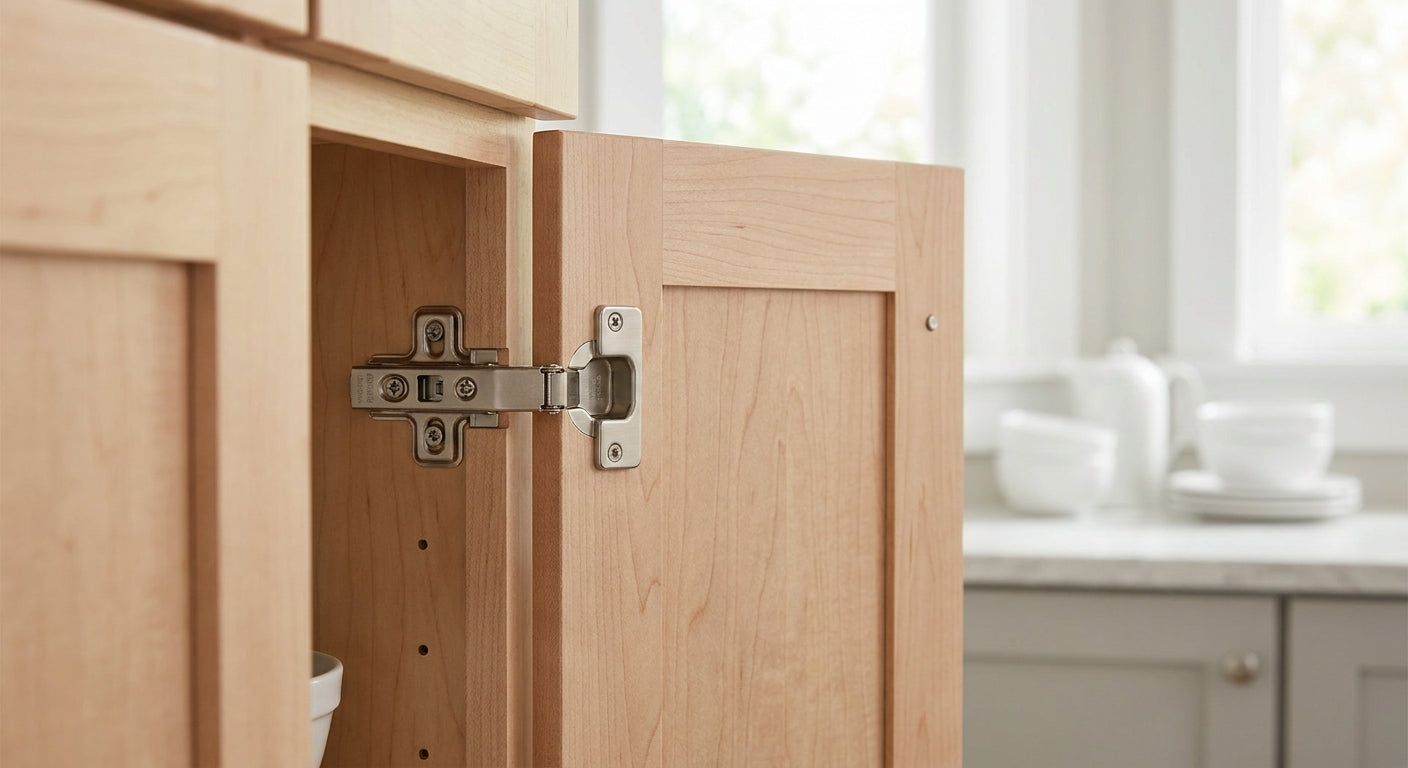
Face-frame cabinets need a different hinge geometry than frameless boxes, and picking the wrong overlay or mounting plate is the number one reason soft-close doors sag or slam anyway. This guide ranks the soft-close hinge types that actually work on face-frame construction, with the specs that matter and a clear verdict on each.
Shop cabinet hinges
Every cabinet hinge we carry, in one place — filter by overlay, mount type, and brand.
Browse Cabinet Hinges →TL;DR
For face-frame cabinets, a 5/8-inch overlay concealed soft-close hinge is the safest default for full-overlay doors, while semi-concealed self-closing hinges remain the right call on older or traditional face-frame boxes that were never bored for European cups. Inset doors need a dedicated no-mortise soft-close hinge, not a retrofit adapter. Knobs.co stocks the soft-close cabinet hinges category alongside knobs and pulls, and the guidance below covers overlay math, opening angle, and where each hinge type is a Buy, a Consider, or a Skip for 2026 kitchen and bath projects.
Why this matters
Face-frame cabinets have a solid wood frame across the front opening, which changes how far the door overlaps the frame and how the hinge cup sits relative to the frame edge. Get the overlay wrong by even 1/8 inch and the door binds against the frame or leaves a gap wide enough to see the cabinet interior. Soft-close mechanisms add another variable: the damper needs enough door mass and the right spring tension to close smoothly instead of bouncing back open. None of this is complicated once you know the four or five hinge families that actually apply to face-frame work, but generic "soft close hinge" search results mostly show frameless European hardware that won't mount correctly.
How we ranked
The hinge types below are ranked on fit for face-frame construction first, soft-close reliability second, and retrofit ease third. Overlay dimensions, opening angles, and mounting-plate types reflect standard cabinet hardware specifications used across major hinge manufacturers as of 2026, not one brand's marketing copy. A hinge only earns Buy if it works on original face-frame doors without frame modification; anything requiring you to re-drill or shim the frame drops to Consider or lower.
The ranked list
1. 5/8-inch overlay concealed soft-close hinge — the full-overlay default
This is the hinge most face-frame kitchens built after 2000 actually need. It carries a 35mm cup bore, a 100-degree opening angle, and a 5/8-inch overlay that matches the standard face-frame reveal on full-overlay doors. The soft-close damper is built into the hinge arm rather than added as a separate cushion, so there's nothing extra to align during install. Buy for any face-frame kitchen with full-overlay doors and a 3/4-inch or thicker frame.
2. 3/8-inch inset soft-close hinge — for doors that sit flush
Inset doors on face-frame cabinets sit flush with the frame rather than covering it, and that requires a hinge cut for zero overlay with a spring-loaded soft-close mechanism rated for the added resistance of a flush reveal. Reveal gaps on inset doors typically run 1/8 inch to 3/16 inch around the perimeter, and the hinge has to hold that tolerance under repeated closing. Retrofitting a standard overlay hinge onto an inset door will not work regardless of adapter plates. Buy if your doors are inset; Skip for any other overlay style.
3. Semi-concealed self-closing hinge with soft-close upgrade — the traditional pick
Older face-frame cabinets built before the European cup-and-plate system became standard often use semi-concealed hinges that mount partly on the frame face and partly on the door back. A soft-close version of this style exists specifically for traditional and Craftsman-era face-frame kitchens being updated in place. Opening angle tops out around 95 degrees, tighter than the concealed options, which matters if you're pairing it with deep appliance garages. Consider for period-accurate remodels; Skip if you're already re-drilling for new hardware anyway, since the concealed 5/8-inch hinge gives a wider swing.
4. No-mortise soft-close hinge — the no-drilling retrofit
No-mortise hinges sit on the surface of both the frame and the door without a routed pocket, which makes them the fastest retrofit option for face-frame cabinets that already have hinge screw holes in slightly the wrong spot. The soft-close versions add a compact damper housed in the knuckle itself. Weight capacity runs lower than concealed cup hinges, generally rated for lighter doors under 3/4-inch stock. Consider for quick retrofits on lightweight doors; Skip on heavier inset or glass-front doors where the lighter-duty knuckle will wear faster.
5. Half-overlay soft-close hinge — for shared center stiles
When two doors share a single center stile on a face-frame cabinet, each door only covers half the stile width, and that calls for a half-overlay hinge rather than the full 5/8-inch version. Mixing a full-overlay hinge onto a half-overlay application leaves one door proud of the other by roughly 1/4 inch, which is the single most common face-frame install mistake. The soft-close mechanism itself is identical to the full-overlay version — only the cup offset changes. Buy for any face-frame pair sharing a center stile; confirm overlay type before ordering, since this is where installing hinges on face-frame cabinets most often goes wrong.
6. Adjustable 6-way soft-close hinge — the fine-tuning pick
Six-way adjustable hinges let you shift the door up, down, left, right, in, and out after installation, which matters on face-frame cabinets where the frame itself is rarely perfectly square after years of seasonal wood movement. The soft-close damper on these units is field-adjustable too, so you can dial down the spring tension on lighter doors instead of living with a slam. This is the hinge to reach for on any remodel where the existing frame shows visible twist or the doors were never quite level to begin with. Buy for remodels on older frames; Skip for brand-new face-frame cabinet boxes where the frame is already square and the adjustment range goes unused.
Comparison table
| Hinge type | Overlay | Opening angle | Best for | Verdict |
|---|---|---|---|---|
| 5/8" concealed soft-close | Full overlay | 100 degrees | Standard full-overlay kitchens | Buy |
| 3/8" inset soft-close | Zero (flush) | 95-100 degrees | Inset door construction | Buy |
| Semi-concealed self-closing | Partial overlay | 95 degrees | Traditional/period kitchens | Consider |
| No-mortise soft-close | Surface mount | 95 degrees | Fast retrofit, light doors | Consider |
| Half-overlay soft-close | Half overlay | 100 degrees | Shared center stile pairs | Buy |
| 6-way adjustable soft-close | Full overlay | 100-110 degrees | Older, out-of-square frames | Buy |
Where to buy
- Confirm your existing overlay and reveal measurements before ordering — hinge returns on hardware that's already been mounted are rarely accepted, so measure the current door first.
- Buy hinges in matched pairs or full sets rather than mixing brands on the same door; damper tension varies enough between manufacturers that mismatched hinges close unevenly.
- Knobs.co pairs its hinge and hardware categories with free samples and a price match guarantee, which is the low-risk way to confirm a finish or cup size matches your existing hardware before committing to a full kitchen order in 2026.
FAQ
What are soft-close hinges for face-frame cabinets? They're concealed or semi-concealed hinges built with an internal damper that slows the door in the last few inches of travel, sized specifically to the overlay and frame thickness of face-frame cabinet construction rather than frameless boxes.
Are soft-close hinges different for face-frame vs. frameless cabinets? Yes — face-frame hinges need an overlay dimension (typically 5/8-inch full overlay or 3/8-inch inset) that accounts for the solid wood frame, while frameless European hinges mount directly to the cabinet side panel with no frame reveal to account for.
How much overlay do I need on face-frame cabinet doors? Most full-overlay face-frame doors use a 5/8-inch overlay, while doors sharing a center stile need a half-overlay hinge instead; measure your current door's overlap onto the frame before ordering replacements.
Can I retrofit soft-close hinges onto existing face-frame cabinets? In most cases yes, provided the existing cup bore and screw pattern match a standard 35mm hinge; no-mortise soft-close hinges are the easiest retrofit when the existing holes don't line up with a cup-style hinge.
What's the difference between self-closing and soft-close hinges? Self-closing hinges snap the door shut with spring tension and no cushioning, while soft-close hinges add a damper that slows the last few inches of travel so the door settles instead of slamming.
Do soft-close hinges fit inset cabinet doors? Only a dedicated inset soft-close hinge works correctly — a standard overlay soft-close hinge will not seat properly on a flush inset door regardless of adapter plates.
How many hinges does a face-frame cabinet door need? Most doors under 40 inches tall use two hinges; taller pantry or wardrobe doors over 40 inches typically need a third hinge to prevent sag over time.
Do soft-close hinges cost more than standard hinges? Soft-close hinges typically cost more per pair than standard self-closing hinges because of the internal damper mechanism, though exact pricing varies by brand and finish.
One last thing
The overlay mismatch on shared center stiles is the single support question that comes up more than any other hinge issue — measure both doors on a shared stile separately before ordering, because a 1/4-inch overlay error there is nearly invisible until both doors are hung side by side.


