

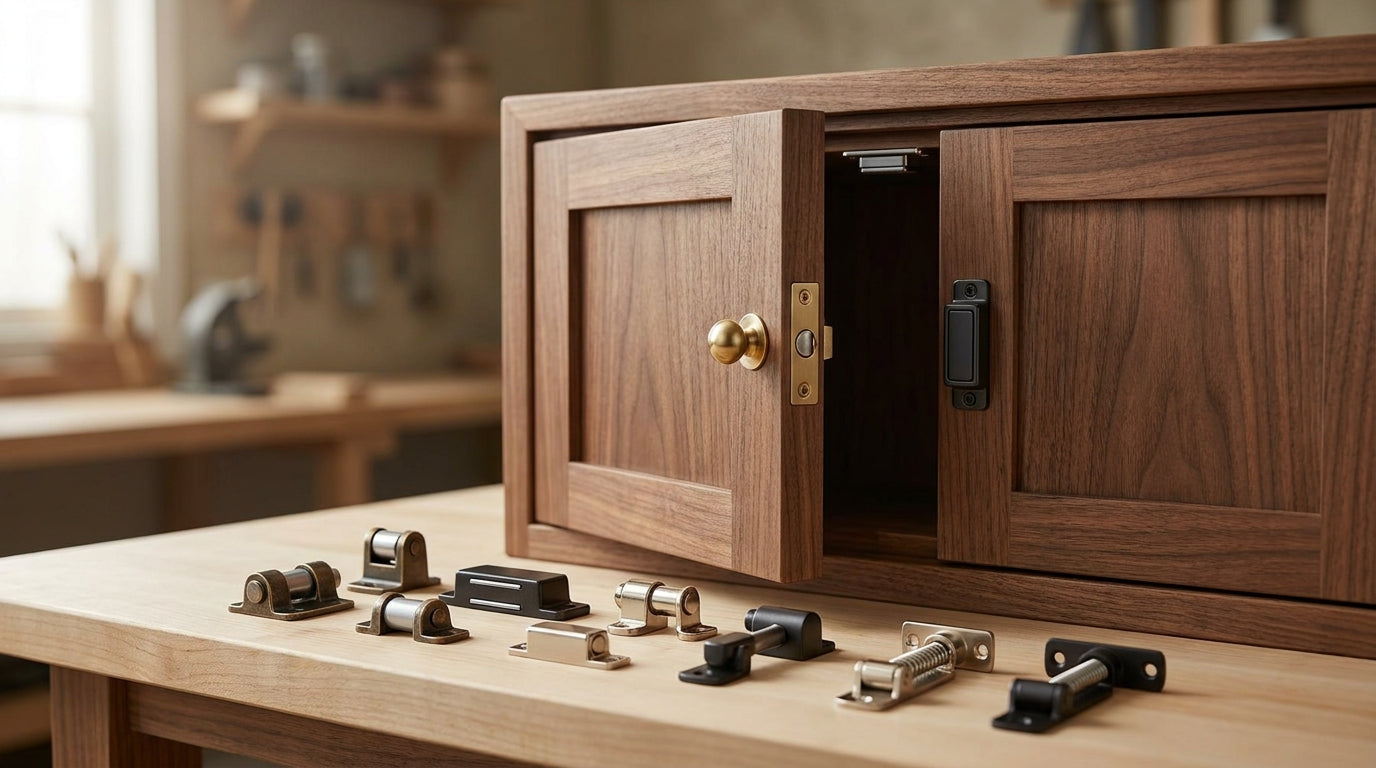
Overlay cabinet doors need a specific kind of catch or latch — one built for face-frame clearance, not the deeper reveal of an inset door. This guide breaks down what actually holds an overlay door shut in 2026, what to skip, and how the math changes once soft-close hinges enter the picture.
Shop catches and latches
Every catch and latch we carry, in one place — filter by type and finish.
Browse Catches and Latches →TL;DR
Cabinet catches and latches for overlay doors fall into four working categories: magnetic catches, roller catches, touch latches, and elbow catches. For most full-overlay kitchens built or remodeled in 2026, a magnetic catch rated for at least 5 pounds of pull force is the safe pick — Buy. Touch latches work for push-to-open panels but add a failure point on heavy doors — Consider. Friction ball catches are a Skip on overlay doors; they were engineered for inset clearance and rarely hold at a shallower reveal depth.
Why this matters
Overlay doors sit on top of the cabinet frame instead of recessing into it, and that changes the clearance a catch has to work with. Grab a catch off the shelf without checking overlay depth and you get one of two outcomes: it doesn't hold, or it drags on the door every time it closes. Both problems get blamed on the door alignment when the actual fix is a different catch.
This matters more in 2026 than it did a decade ago because so many overlay kitchens now ship with soft-close hinges standard. That doesn't eliminate the need for catches — it changes where they're actually necessary.
Who this is for
This is for homeowners replacing worn-out catches on full-overlay or partial-overlay kitchen and bath cabinets, and for trade pros specifying hardware on a new cabinet run who need the catch spec to match the hinge overlay and door weight. If you're outfitting a whole kitchen, Knobs.co stocks the hinges and pulls that pair with these catches, and the criteria below apply whether you're buying one catch or forty.
What to look for in catches and latches for overlay doors
Overlay type and clearance
Full overlay, partial overlay, and inset are three different clearance problems, and a catch built for one won't seat right on another. Full overlay doors cover almost the entire face frame, leaving a tight gap behind the door — measure that gap before buying, not after the catch arrives.
Holding force (pull-apart strength)
Catch strength is rated in pounds of pull force, and it needs to match door weight, not just door size. A tall pantry door on overlay hinges can weigh more than it looks, and an undersized catch will pop open on the first bump from a grocery bag.
Compatibility with soft-close hinges
If the cabinet already runs soft-close hinges, a catch is fighting the hinge's own closing tension. Adding a strong catch on top of soft-close hardware can cause the door to bounce or fail to seat fully — check hinge type before adding a catch at all.
Mounting surface and screw pattern
Catches mount to the cabinet interior, the door interior, or both, and overlay doors often have less flat surface to work with near the hinge side. A catch designed for face-frame mounting won't always transfer cleanly to a frameless overlay box.
Finish and door reveal match
A catch that's slightly too thick will hold the door a hair open, which reads as a warped door even when the door is fine. Check the reveal — the visible gap around the door — after installing any catch, not just before.
Noise and daily use
Roller catches click, magnetic catches don't, and that difference matters in a kitchen used daily. If quiet close matters more than raw holding power, weight the decision toward magnetic.
Top picks for overlay door catches and latches
Magnetic catch — the safe pick. Rated typically 5-10 pounds of pull force, mounts flush, and works silently on full overlay doors. This is the default choice for most 2026 kitchen remodels because it tolerates minor door misalignment better than mechanical types. Buy.
Roller catch — the old reliable. Lower cost than magnetic, holds around 3-4 pounds of force, and has been the standard on overlay cabinetry for decades. It works fine on lighter doors but tends to loosen its grip faster than magnetic over years of daily use. Consider.
Touch latch (push-to-open) — the no-handle option. Useful when a design calls for handleless overlay doors, but it adds one more mechanical part that can fail on a heavy door. Best reserved for lighter cabinets, not full-size pantry doors. Consider.
Elbow catch — the heavy-duty pick for double doors. Mounted on the inactive door of a double-overlay pair, it holds that door steady so the active door's catch or lock does the real work. Solid choice for tall two-door cabinets. Buy for double-door overlay runs.
Friction ball catch — the skip. Designed for the shallower clearance of inset doors, it rarely seats correctly on an overlay reveal and tends to work itself loose within a year. Skip it for overlay applications specifically.
Before locking in a catch, check the hinge type already installed on the door — this decides how much extra holding force you actually need. The soft-close cabinet hinges guide walks through which hinges already do most of the closing work, and where a catch is redundant.
What to avoid
- Inset-rated catches on overlay doors. The throw distance is built for a deeper recess and won't hold at overlay clearance, no matter how it looks in the package photo.
- Decorative touch latches on heavy pantry doors. They're rated for cabinet-weight doors, not the wider, heavier panels common on 2026 pantry and mudroom builds.
- Stacking a strong catch on top of soft-close hinges without checking clearance first. The combination can cause the door to bounce off the catch instead of seating.
Getting the mounting position right matters as much as picking the right catch type. The cabinet hardware jig guide covers how to keep placement consistent across a full run of overlay doors, which matters more once you're past a single cabinet.
Verdict comparison
| Catch type | Pull force | Noise | Best for | Verdict |
|---|---|---|---|---|
| Magnetic catch | 5-10 lb | Silent | Full overlay, daily-use kitchens | Buy |
| Roller catch | 3-4 lb | Audible click | Lighter overlay doors, budget jobs | Consider |
| Touch latch | 2-4 lb | Silent | Handleless overlay panels | Consider |
| Elbow catch | Varies by door | Silent | Double-door overlay pairs | Buy (double doors) |
| Friction ball catch | 1-2 lb | Silent | Inset doors only | Skip |
FAQ
What's the best catch for a full overlay cabinet door? A magnetic catch rated for 5-10 pounds of pull force is the best default for full overlay doors in 2026 because it holds reliably without the audible click of a roller catch.
Do overlay cabinet doors need catches if they already have soft-close hinges? Often no. Soft-close hinges provide their own closing tension, and a strong catch on top of that hardware can cause the door to bounce instead of seat properly. Check hinge type before adding a catch.
Is a roller catch better than a magnetic catch for overlay doors? Magnetic catches generally outperform roller catches on holding power and noise, but roller catches cost less and have a longer track record on lighter overlay doors.
Can I use an inset-door catch on an overlay cabinet? Not reliably. Inset catches are built for a deeper clearance and typically won't seat or hold correctly at overlay reveal depth.
How much pull force does a cabinet catch need? Match the rating to door weight, not just size — a tall, solid overlay door needs a catch rated well above the 2-4 pounds sufficient for a small upper cabinet.
What catch works for double overlay doors? An elbow catch on the inactive door, paired with a magnetic or roller catch on the active door, is the standard setup for double-overlay pairs.
Why does my overlay door catch make the door sit slightly open? The catch is likely too thick for the reveal, holding the door a fraction open at rest. Swap for a thinner-profile magnetic catch and recheck the gap.
Do touch latches work on heavy overlay pantry doors? Not reliably — touch latches are rated for lighter cabinet doors, and a heavy pantry door will wear the mechanism faster than a standard catch would.
One last thing
Most full-overlay kitchens finished in 2026 skip catches entirely on standard cabinet doors because soft-close hinges already do the job — catches now mostly show up on pantry doors, tall units, and double-door pairs where extra holding force still earns its place. If your cabinets already have soft-close hinges and the doors are staying shut fine, don't add a catch just because the old cabinet had one.


