

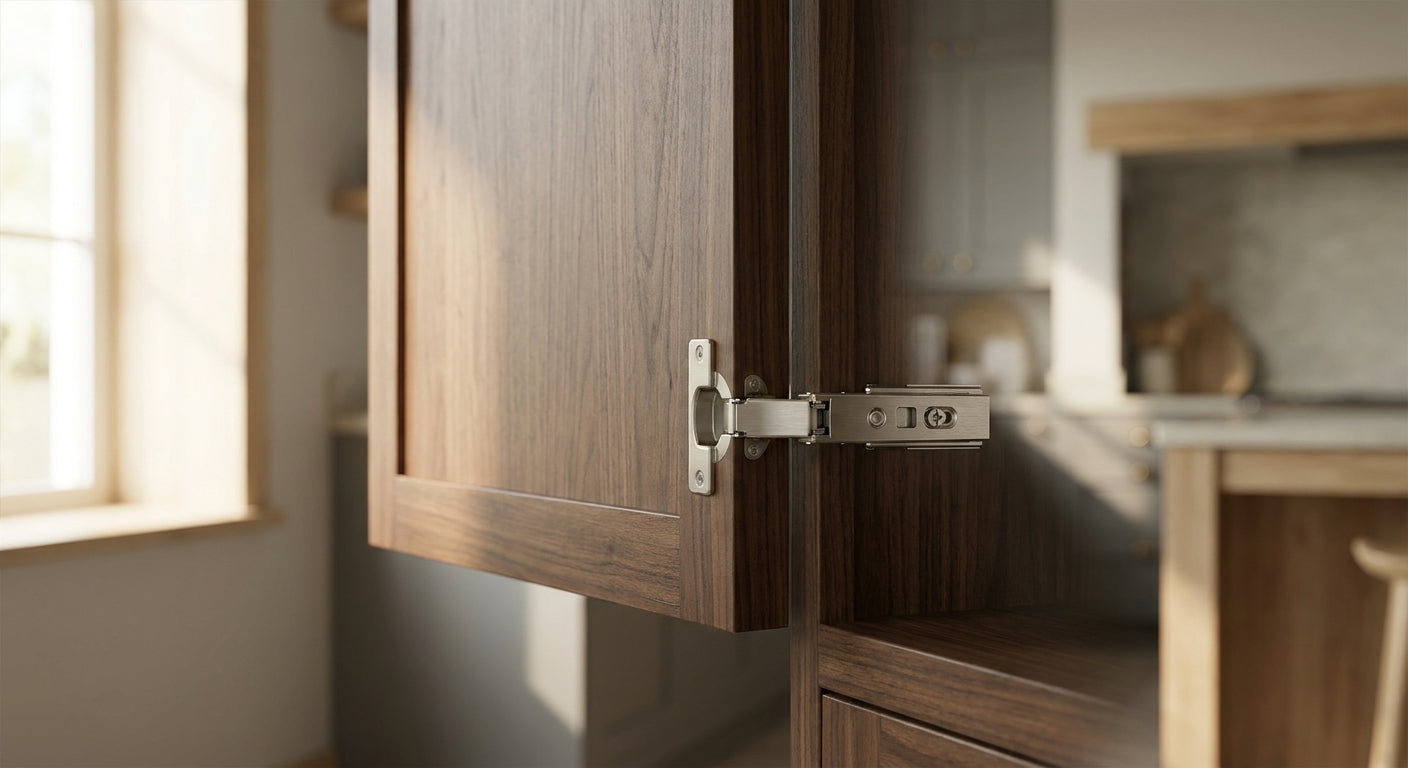
Inset cabinet doors sit flush inside the face frame, so the hinge has almost no margin for error — pick the wrong soft-close mechanism and the door either won't seat flush or it slams shut anyway. This guide ranks the hinge types that actually work for inset construction in 2026 and tells you which ones to skip.
Shop cabinet hinges
Every cabinet hinge we carry, in one place — filter by overlay, mount type, and brand.
Browse Cabinet Hinges →TL;DR
For soft close hinges inset cabinet doors, the concealed European soft-close inset hinge is the strongest all-around buy in 2026 — it disappears completely inside the frame and, on a standard 3-hinge run, holds doors in the 35-45 lb range without sagging. Wrap-around soft-close hinges are the better call on older face-frame cabinets with inconsistent gaps. Budget soft-close inset hinges with a fixed (non-adjustable) damper are a Skip — the closing mechanism wears out fast on doors opened more than a few times a day. If you're retrofitting an inset kitchen, match the hinge to your reveal width before you match it to price.
Why this matters
Inset doors expose the hinge, or nearly all of it, because the door sits inside the opening instead of over it. A hinge built for overlay doors won't clear the frame correctly, and a soft-close mechanism tuned for a lighter overlay door will either fail to close a heavier inset door or slam it because the damper can't handle the mass. Get this wrong and you're pulling doors back off the cabinet within a year. Soft-close cabinet hinges built specifically for face-frame and inset applications solve this, but not every hinge marketed as "soft close" is built for inset use — most of the mass-market ones are designed for frameless overlay boxes.
Knobs.co carries hinges across its catalog of more than 50,000 SKUs, and the categories below reflect what actually holds up on inset doors, not what's cheapest to stock.
How we ranked
Each hinge type below is scored against three things that matter specifically for inset doors: mounting compatibility with a face frame, weight capacity relative to a standard inset door (18"-24" wide, 3/4" thick), and how the soft-close damper performs after repeated daily cycling rather than in a showroom demo. Degree of opening and adjustability (3-way vs. fixed) get weighed heavier than finish options, because on an inset door a hinge that can't be adjusted in three directions will show as an uneven gap around the frame. None of this is about which hinge looks best in a photo — it's about which one keeps the door flush six months in.
The ranked list
1. Concealed European soft-close inset hinge — the safe pick
This is the standard for modern inset cabinetry in 2026: fully hidden when the door is closed, adjustable in three directions, and rated for a 110° opening on most models. On an 18"-24" wide door at 3/4" thickness, a 3-hinge set typically handles up to 40-45 lbs without visible sag after a year of use. The three-way adjustment is what earns this the top spot — it lets you dial in the reveal to a consistent 3/32" gap around the whole frame, which is what separates a professional-looking inset install from an amateur one. Buy.
2. Wrap-around soft-close hinge — best for older face-frame cabinets
Wrap-around hinges anchor to both the door and the face frame itself, which makes them more forgiving on cabinets where the frame gaps aren't perfectly consistent — common in older homes or custom builds. They typically open to 170°, wider than the concealed European style, which is useful in kitchens where you need the door fully out of the way for appliance access. The tradeoff is a visible hinge arm when the door is open, which some inset purists don't love. Buy if your frame gaps vary by more than 1/16" across the run; otherwise the concealed option wins.
3. Semi-concealed soft-close hinge — the traditional look
These show a small visible barrel on the outside of the door but conceal the mounting plate, which fits the look of Shaker and farmhouse inset kitchens better than a fully hidden hinge. Weight capacity runs slightly lower than the concealed European style — typically 30-35 lbs per 3-hinge set — so they're a better fit on lighter doors. If your inset kitchen leans traditional and you're not stacking heavy glass-front doors, this is a solid Consider.
4. Self-closing wide-throw inset hinge — for heavy or oversized doors
Wide-throw hinges add extra offset to clear thicker doors or applied moldings, and the self-closing versions in 2026 pair a heavier spring with a hydraulic damper rated for doors up to 55 lbs on a 3-hinge run. This is the pick for oversized pantry doors or inset doors with a decorative overlay added to the face. Anything lighter than that and the spring tension will feel too aggressive even with the damper working. Consider for oversized doors, Skip for standard 3/4" doors under 20" wide.
5. Adjustable 3-way soft-close corner hinge — for blind corner cabinets
Corner cabinets with inset doors need a hinge that can swing the door clear of the adjacent cabinet run, and the 3-way adjustable corner hinge is built for exactly that geometry — usually a 95°-100° opening angle instead of the standard 110°-170° range. It's a narrow use case, but if you skip it on a corner cabinet the door will bind on the neighboring frame every time. Buy only if you have a blind corner inset cabinet; otherwise this isn't the hinge you need.
6. Budget fixed-damper soft-close hinge — the one to skip
These show up cheap and marketed as "soft close" but use a fixed, non-adjustable damper with no 3-way tuning. On an inset door, where reveal precision matters more than on overlay doors, the lack of adjustment means you're stuck with whatever gap you get on install day. Worse, the fixed damper tends to lose resistance within 12-18 months of daily cycling, and once it does, the door goes back to slamming. Skip.
Comparison table
| Hinge type | Opening angle | Weight capacity (3-hinge set) | Adjustment | Verdict |
|---|---|---|---|---|
| Concealed European soft-close | 110° | 40-45 lbs | 3-way | Buy |
| Wrap-around soft-close | 170° | 35-40 lbs | 2-way | Buy (uneven frames) |
| Semi-concealed soft-close | 110° | 30-35 lbs | 2-way | Consider |
| Self-closing wide-throw | 110° | Up to 55 lbs | 3-way | Consider (heavy doors) |
| 3-way corner soft-close | 95°-100° | 30-35 lbs | 3-way | Buy (corners only) |
| Budget fixed-damper | 110° | 25-30 lbs | None | Skip |
Where to buy
- Match the finish to the rest of your hardware before you match the price. A mismatched hinge finish next to matte black pulls or brushed nickel knobs is the fastest way to make a fresh inset kitchen look unfinished.
- Order one extra hinge per door run if the cabinet has been in place more than five years. Frame settling means the third hinge sometimes needs a different offset than the top two, and you don't want to be short mid-install.
- Buy from a retailer that samples finishes before you commit a full order. Hinge finishes photograph differently than they look under kitchen lighting, and returning a full case of the wrong finish costs more time than ordering a sample first. Knobs.co backs orders with free shipping, free samples on select items, and a 110% price match guarantee, which matters more on hinges than on knobs because a full-kitchen hinge order isn't cheap to redo.
FAQ
What's the best soft close hinge for inset cabinet doors? The concealed European soft-close inset hinge is the best all-around option in 2026 for standard-weight inset doors, handling up to roughly 40-45 lbs per 3-hinge set with full 3-way adjustment for a consistent reveal.
Is a wrap-around hinge better than a concealed hinge for inset doors? Wrap-around hinges are the better call specifically on older cabinets with inconsistent face-frame gaps, since they anchor to both the door and the frame. On newer, consistent cabinetry, the concealed European hinge gives a cleaner look.
How much weight can a soft-close inset hinge hold? Most concealed European soft-close hinges rated for inset doors hold 40-45 lbs across a standard 3-hinge set; wide-throw versions built for heavier or oversized doors go up to about 55 lbs.
Do soft-close hinges work on all inset cabinet doors? Not all of them — hinges marketed generically as "soft close" are frequently built for frameless overlay doors, not inset construction. Confirm the hinge is rated for face-frame or inset mounting before ordering.
What opening angle do I need for a corner inset cabinet? Blind corner inset cabinets typically need a 3-way adjustable corner hinge with a 95°-100° opening angle, narrower than the 110°-170° range used on standard inset doors, so the door clears the adjacent cabinet run.
How long do soft-close hinge dampers last? Adjustable dampers on concealed European and wrap-around hinges typically hold up for years of daily cycling. Fixed, non-adjustable dampers on budget hinges commonly lose resistance within 12-18 months.
Can I install soft-close hinges on face-frame cabinets myself? Yes, on most face-frame inset setups a wrap-around or semi-concealed soft-close hinge installs with a standard drill and the existing mounting holes in most cases. Check hinge-specific placement before drilling into a new frame.
One last thing
The detail that trips up most inset installs isn't the hinge brand, it's the reveal — a 3-way adjustable hinge lets you fine-tune a consistent 3/32" gap around the whole door, and that gap is the single biggest visual tell between a kitchen that looks custom-built and one that looks like a DIY retrofit. Spend the extra adjustment step before you spend more money on a different hinge.


