

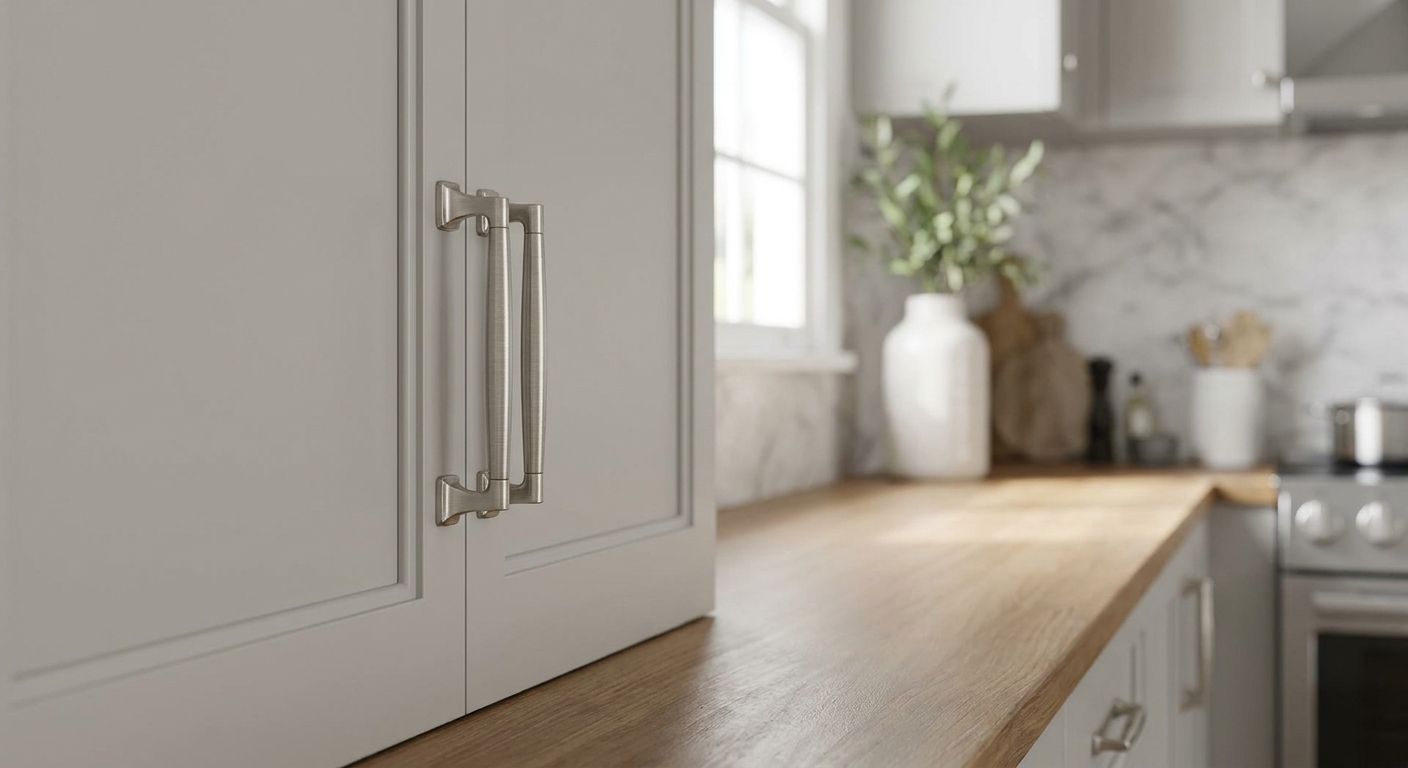
Brushed nickel cabinet hinges bridge the gap between the warm metals of traditional cabinetry and the flat, clean lines of contemporary kitchens — exactly the balance a transitional kitchen needs in 2026.
Shop the finish
Every brushed nickel knob and pull we carry, in one place — filter by size, style, and brand.
Browse Brushed Nickel Cabinet Hardware →- Brushed nickel cabinet hinges match shaker doors and modern bar pulls without looking dated or too cold. Buy for most transitional remodels.
- European concealed hinges disappear inside frameless cabinets; face-frame kitchens with inset doors need semi-concealed styles instead.
- Soft-close brushed nickel hinges cost more than standard butt hinges but stop cabinet doors from slamming shut.
- Match hinge finish to pulls and knobs first — mismatched sheen is the most common transitional-kitchen mistake in 2026 remodels.
- Measure door thickness and overlay before ordering; a 1/2-inch overlay hinge on a 5/8-inch reveal door will not close flush.
Why this matters
Transitional kitchens live or die on finish consistency. Mix a cool, shiny chrome hinge with a warm brushed nickel pull and the eye catches it immediately, even if the buyer can't say why the kitchen feels "off."
Brushed nickel splits the difference between the traditional warmth of oil-rubbed bronze and the stark modernism of matte black or polished chrome. That's why it's become the default hinge finish for 2026 transitional projects — it reads neutral enough to pair with either wood tone.
The catch: hinges are functional hardware first, decorative second. Getting the finish right and getting the mechanism wrong (wrong overlay, wrong mount type, no soft-close on a heavy door) creates a kitchen that looks good in photos and slams shut every time someone closes a cabinet.
Who this is for
This guide is for homeowners replacing builder-grade hinges during a kitchen refresh, for contractors specifying hardware across a multi-cabinet job, and for designers coordinating hinge finish with pulls and knobs already picked out. If you already own the doors and just need the right brushed nickel cabinet hinges to match hardware you've selected, skip to the comparison table below.
What to look for in brushed nickel cabinet hinges for transitional kitchens
Finish consistency with your pulls and knobs
Brushed nickel isn't one finish — it ranges from a matte, low-sheen version to a brighter satin nickel that leans closer to polished chrome. Order a hinge sample alongside your pull and knob samples before committing to a full kitchen order; sheen mismatches show up under kitchen lighting in ways they never do in a photo.
Concealed vs. semi-concealed vs. exposed mounting
Frameless (European-style) cabinet boxes take concealed hinges that hide entirely inside the cabinet, showing nothing but the door edge. Face-frame cabinets with an inset door need a semi-concealed or full-inset hinge instead — a concealed hinge simply won't mount correctly on a face frame.
Overlay and door thickness
Most stock cabinet doors run 3/4-inch thick with an overlay between 1/2-inch and 5/8-inch. Get this wrong and the door either won't sit flush against the box or will bind on the adjacent cabinet. Measure your actual door reveal — don't assume it matches your last kitchen.
Self-closing vs. soft-close function
Self-closing hinges use spring tension to snap the door shut from a few degrees open. Soft-close hinges add a hydraulic damper that slows the last few inches of travel. For a transitional kitchen with heavier shaker doors, soft-close is worth the extra cost — it's the difference between a door that clicks and one that bangs.
Screw hole spacing and mounting plate compatibility
If you're replacing hinges on existing cabinets rather than doing new construction, match the mounting plate screw pattern to your existing holes. A hinge with a different hole spacing means new holes, filler, and a refinishing job you didn't plan for.
Adjustability
Three-way adjustable concealed hinges let you fine-tune a door up-down, left-right, and in-out after installation — essential for frameless cabinets where doors need to align across a full run. Fixed, non-adjustable hinges are cheaper but leave you stuck if a door sags six months in.
Top picks by hinge type
European concealed hinge — the disappearing act. Mounts entirely inside the cabinet box on a 35mm cup bore, standard on nearly every frameless cabinet made since the 1990s. Nothing shows from outside the door except a clean seam. Buy for any frameless transitional kitchen; read the full breakdown in European concealed hinges for frameless cabinets.
Semi-concealed inset hinge — the face-frame fix. Built for face-frame cabinets where the door sits flush inside the frame opening rather than overlaying it. A standard concealed hinge won't work on this door style — you need a hinge designed specifically for the inset reveal. Buy for face-frame transitional kitchens with inset doors; details in the guide to inset door hinges.
Soft-close butt hinge — the quiet upgrade. Adds a hydraulic close mechanism to a traditional exposed or semi-exposed hinge body. Costs more per pair than a standard self-closing hinge but eliminates the slam on heavier solid-wood shaker doors. Buy for high-traffic kitchens with kids or a busy household.
Standard non-self-closing butt hinge — the budget pick. No spring, no damper — the door stays wherever you leave it. Lowest cost per pair and the simplest install, but it won't close itself and offers no protection against a slammed door. Consider only for low-budget refreshes or secondary cabinetry like a laundry room or garage.
Decorative exposed hinge with visible barrel — the traditional throwback. Shows a full hinge barrel and finial on the face of the door, a look borrowed straight from traditional cabinetry. It reads too ornate against the clean bar pulls typical of a transitional kitchen. Skip unless you're leaning the room further traditional than transitional.
What to avoid
- Polished nickel or bright chrome mistaken for brushed nickel. They photograph similarly online but sit noticeably cooler and shinier next to a brushed or satin pull in person.
- Non-adjustable concealed hinges on a full cabinet run. Without three-way adjustment, one sagging door means replacing the hinge instead of a 30-second tweak with a screwdriver.
- Undersized overlay hinges ordered by guesswork. A hinge sized for a 1/2-inch overlay on a door with a 5/8-inch reveal leaves a visible gap or binds against the frame — measure first.
Verdict comparison table
| Hinge type | Best for | Mount/overlay | Verdict |
|---|---|---|---|
| European concealed | Frameless cabinets | 35mm cup, 3-way adjustable | Buy |
| Semi-concealed inset | Face-frame, inset doors | Inset-specific mount | Buy |
| Soft-close butt | Heavy shaker doors, high traffic | 1/2" to 5/8" overlay | Buy |
| Standard butt (non-self-closing) | Low-budget, secondary cabinets | Standard overlay | Consider |
| Decorative exposed barrel | Traditional-leaning rooms | Face-mounted | Skip for transitional |
Before ordering a full set, request finish samples of your hinge, pull, and knob together — Knobs.co ships free samples so you're matching real metal under your own kitchen lighting instead of guessing from a product photo. The 110% price match guarantee applies once you've settled on the exact hinge, so lock the finish decision first.
FAQ
What's the best hinge type for a transitional kitchen with shaker cabinets?
European concealed hinges are the best fit for frameless shaker cabinets, and semi-concealed inset hinges work for face-frame shaker doors. Both hide the mechanism and keep the clean-lined look transitional kitchens rely on.
Is brushed nickel better than matte black for a transitional kitchen in 2026?
Neither is universally better — brushed nickel pairs more naturally with warm wood tones and traditional-leaning finishes, while matte black leans the room more contemporary. Match the hinge to whichever pull and knob finish you've already chosen.
How much does it cost to replace cabinet hinges with brushed nickel?
Cost depends on hinge type and door count, since concealed and soft-close hinges price higher per pair than standard butt hinges. Check current pricing per hinge style on the product pages before totaling a whole-kitchen order.
Do brushed nickel hinges match brushed nickel pulls exactly?
Not always — brushed nickel ranges from matte to a brighter satin sheen depending on the manufacturer. Order a hinge and pull sample together before buying a full set to confirm the sheen matches under your own lighting.
Can I use concealed hinges on face-frame cabinets?
Standard European concealed hinges are designed for frameless cabinet boxes and typically won't mount correctly on a face-frame cabinet. Face-frame cabinets need a semi-concealed or full-inset hinge instead.
What overlay size do I need for cabinet hinges?
Most stock cabinet doors use a 1/2-inch to 5/8-inch overlay, but the only reliable way to know is measuring your actual door reveal. Ordering by guesswork is the most common reason replacement hinges don't sit flush.
Are soft-close hinges worth the extra cost?
Soft-close hinges are worth it on heavier solid-wood doors and in households with kids, since they eliminate slamming that standard self-closing hinges don't fully control. On lighter secondary cabinetry, a standard self-closing hinge is often enough.
How do I know if my cabinets are frameless or face-frame?
Frameless cabinets have doors that overlay the cabinet box directly with no visible wood frame around the opening; face-frame cabinets show a solid wood frame around the box front. That distinction determines whether you need a concealed or semi-concealed hinge.
One last thing
Most transitional kitchen remodels in 2026 fail the finish test not on the pulls, but on the hinges nobody thinks to sample — order a hinge alongside your pull and knob samples before the full order ships, not after the doors are hung.


