

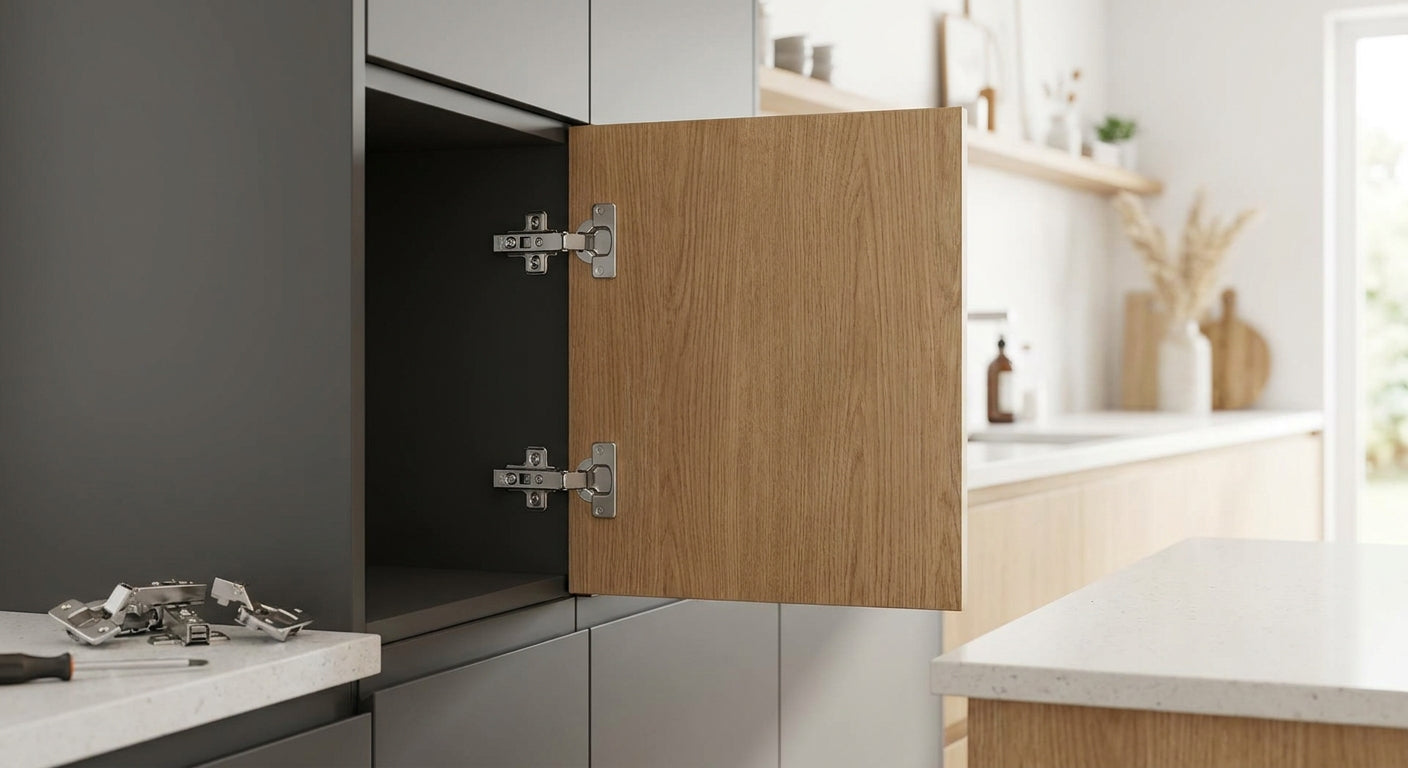
European concealed hinges for frameless cabinets use a 35mm cup and a clip-on mounting plate — the hardware standard behind almost every full-overlay kitchen built in the U.S. since the 1990s — and getting the overlay or opening angle wrong is the fastest way to end up with doors that won't close flush in 2026.
Shop cabinet hinges
Every cabinet hinge we carry, in one place — filter by overlay, mount type, and brand.
Browse Cabinet Hinges →- European concealed hinges for frameless cabinets need a 35mm cup and clip-on plate — a face-frame semi-concealed hinge won't fit or adjust.
- Standard 100-110 degree hinges cover flat-front doors; 165-degree wide-angle hinges are the fix for blind corners. Buy accordingly.
- Soft-close is standard on 2026 builds — skip standard-close unless matching an older kitchen exactly.
- Three-way adjustment (height, depth, reach) is mandatory on frameless boxes since there's no face frame to hide a crooked door.
Shop the picks from this guide
In stock at Knobs.co · Free shipping on hardware orders $99+ · 110% price match
-
 Amerock
Functional Hardware 3/8'' Offset Non-Self Closing Face Mount Cabinet Hinge - 1 Pair BPR3406Antique Copper
Amerock
Functional Hardware 3/8'' Offset Non-Self Closing Face Mount Cabinet Hinge - 1 Pair BPR3406Antique Copper
$6.99
$8.22 -
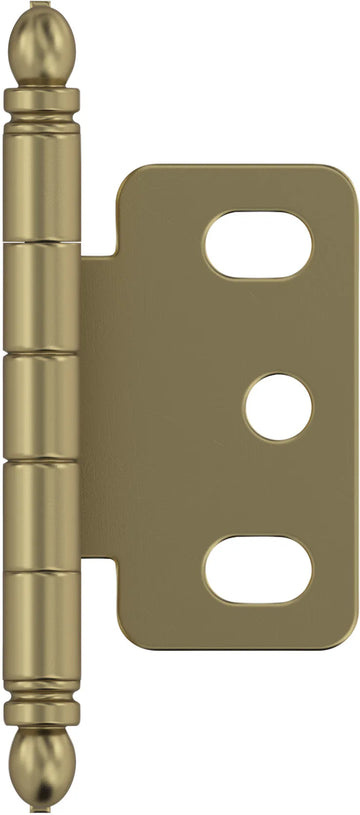 Amerock
Functional Hardware 3/4'' Door Thickness Full Inset Partial Wrap Ball Tip Cabinet Hinge - Single Hinge PK3180Golden Champagne
Amerock
Functional Hardware 3/4'' Door Thickness Full Inset Partial Wrap Ball Tip Cabinet Hinge - Single Hinge PK3180Golden Champagne
$5.90
$6.93 -
 Amerock
Functional Hardware 1/2'' Overlay Double Demountable Cabinet Hinge - 1 Pair BPR8704Burnished Brass
Amerock
Functional Hardware 1/2'' Overlay Double Demountable Cabinet Hinge - 1 Pair BPR8704Burnished Brass
$12.95
$15.23 -
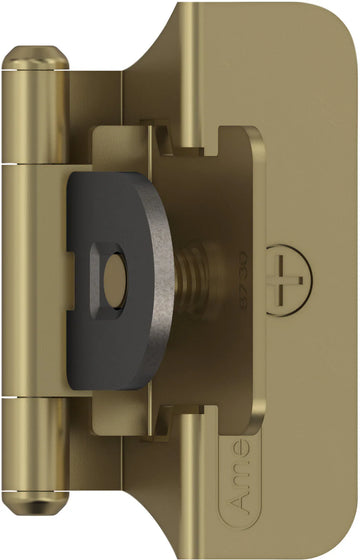 Amerock
Functional Hardware 1/4'' Overlay Double Demountable Cabinet Hinge - 1 Pair BPR8701Golden Champagne
Amerock
Functional Hardware 1/4'' Overlay Double Demountable Cabinet Hinge - 1 Pair BPR8701Golden Champagne
$12.95
$15.23 -
 Amerock
Functional Hardware Variable Overlay Self Closing Face Mount Cabinet Hinge - 1 Pair BPR3429Polished Chrome
Amerock
Functional Hardware Variable Overlay Self Closing Face Mount Cabinet Hinge - 1 Pair BPR3429Polished Chrome
$5.32
$6.25 -
 Amerock
Functional Hardware 3/4'' Door Thickness Full Inset Full Wrap Ball Tip Cabinet Hinge - Single Hinge PK3175Antique Brass
Amerock
Functional Hardware 3/4'' Door Thickness Full Inset Full Wrap Ball Tip Cabinet Hinge - Single Hinge PK3175Antique Brass
$5.56
$6.54


Why this matters
Frameless cabinets — also called Euro-style or full-overlay — have no face frame to lean on. The hinge cup bores directly into the door's side panel, and the mounting plate screws straight to the cabinet box.
Get the cup depth, overlay, or opening angle wrong and the door either won't close flush or it binds against the cabinet next to it. This isn't cosmetic — a hinge sized for a face-frame cabinet doesn't adjust far enough to compensate on a frameless box.
Read Knobs.co's guide on choosing the right cabinet hinge before you order if you're not certain whether your boxes are frameless or face-frame — the two hardware families aren't interchangeable, and mixing them up is the single most common return reason on hinge orders.
Who this is for
This guide is for anyone replacing or specifying hinges on frameless cabinetry — homeowners re-hanging doors after a repaint, contractors installing flat-pack or custom Euro-style boxes, and cabinet shops matching hardware across a production run. If your cabinet doors sit flush over the box edge with no visible wood frame around the opening, you're working with frameless construction, and every criterion below applies directly.
What to look for in European concealed hinges for frameless cabinets
Cup diameter and boring depth
Every European concealed hinge for frameless cabinets bores a 35mm cup into the door panel, typically 11.5mm to 13mm deep. Doors thinner than 5/8-inch (16mm) can't take a full-depth cup without punching through the face — measure before you drill, not after. The 35mm spec doesn't vary by brand; it's an industry standard, so the same drill bit works across nearly every clip-on hinge on the market in 2026.
Overlay type: full, half, or inset
Full overlay is the standard for frameless kitchens — the door covers the cabinet edge completely with a 1/8-inch to 3/16-inch reveal between doors. Half overlay and inset hinges exist for mixed installations, but on a true frameless box you almost always want full overlay. Order the wrong overlay and the door either overlaps its neighbor or leaves a gap wide enough to see into the cabinet.
Opening angle: 100-110 degrees vs 165 degrees
Standard 100-110 degree hinges handle flat-front doors on the majority of base and wall cabinets. Blind-corner cabinets and lazy Susan units need a 165-degree wide-angle hinge, or the door hits the adjacent cabinet before it fully opens. Check every blind corner before you order — this is the most common hinge-order mistake on frameless kitchens.
Three-way adjustment
A frameless cabinet has no face frame to hide a crooked door, so the mounting plate needs height, depth, and reach adjustment — typically plus or minus 2mm on height and depth, plus or minus 3mm on reach. Skip a hinge without all three axes and you'll end up shimming the cabinet box itself, which is slower and less reliable than turning a screw. Rule of thumb: if the door doesn't sit flush after three turns of the adjustment screw, the hinge is wrong for the cabinet, not the door.
“If the door doesn't sit flush after three turns of the adjustment screw, the hinge is wrong for the cabinet, not the door.”
Soft-close vs standard action
Soft-close is built into the hinge body on nearly every 2026 frameless kitchen — there's no separate dampener to install or fail. Standard-close hinges cost less but let doors slam, which loosens screws in particleboard boxes over time. Match soft-close to soft-close when adding cabinets to an existing frameless run; mixing the two makes a kitchen sound inconsistent from one door to the next.
Top picks: which concealed hinge type to buy in 2026
The standard pick: 110-degree full overlay soft-close
This covers roughly the majority of frameless kitchen doors in production today. It handles flat-front doors, opens wide enough for full drawer and shelf access, and the soft-close mechanism sits in the cup body — no separate part to buy. Browse soft-close cabinet hinges to compare finishes and mounting styles before ordering. Buy for any standard base or wall cabinet door.
The corner solver: 165-degree wide-angle
Blind-corner cabinets and lazy Susan units need the extra swing or the door hits the adjacent cabinet before it clears the opening. The tradeoff is a slightly larger mounting plate footprint that needs more clearance inside the box. Buy if even one blind-corner cabinet exists in the run — mixing angle types across a single kitchen is normal and expected.
The heavy-door upgrade: reinforced hardware
Tall pantry doors and doors over 40 lbs need reinforced hinges rated for the extra load, or the top corner sags within a year. Three hinges per door instead of two is the more reliable fix for anything over 36 inches tall. Consider for pantry cabinets and oversized doors; skip it on standard 30-inch wall cabinet doors where it's overkill.
The budget-conscious skip: non-adjustable standard-close
Non-adjustable, standard-close hinges turn up in bargain hardware bins and look identical to a proper concealed hinge at a glance. Without three-way adjustment, you can't correct a door that shifts after the cabinet settles — and frameless boxes settle. Skip these for anything beyond a shed or utility cabinet.
What to avoid
- Face-frame semi-concealed hinges sold as "concealed" — these mount to a face-frame lip and won't bore correctly into a frameless side panel, no matter how similar the finish looks.
- Non-adjustable decorative cup hinges — identical to adjustable versions in a product photo, but with no set screws to correct a door that shifts.
- Mismatched cup depth on thin doors — a 13mm-deep cup on a 5/8-inch door punches through the face; confirm door thickness against boring depth before drilling anything.
Verdict comparison
| Hinge type | Opening angle | Adjustment | Best for | Verdict |
|---|---|---|---|---|
| Standard full overlay soft-close | 100-110 degrees | 3-way | Flat-front doors, base and wall cabinets | Buy |
| Wide-angle soft-close | 165 degrees | 3-way | Blind corners, lazy Susan cabinets | Buy |
| Reinforced heavy-door | 110 degrees | 3-way | Pantry doors, doors over 40 lbs | Consider |
| Non-adjustable standard-close | 100-110 degrees | None | Utility or shed cabinets only | Skip |
Knobs.co stocks more than 50,000 SKUs of cabinet hardware across dozens of brands, and concealed hinges are one category where the wrong pick doesn't just look off — it stops the door from closing. Matching cup diameter, overlay, and opening angle to the cabinet in front of you matters more than finish or brand name here.
FAQ
What are European concealed hinges for frameless cabinets?
They're clip-on hinges with a 35mm cup that bores into the door and a mounting plate that screws to the cabinet side panel, hidden from view when the door is closed. Frameless cabinets rely on them since there's no face frame to mount hardware to instead.
Are European hinges the same thing as soft-close hinges?
No — soft-close is a mechanism built into some concealed hinges, not a separate hinge category. Most 2026 European concealed hinges ship with soft-close built in, but standard-close versions of the same cup design still exist.
Can you use a European concealed hinge on a face-frame cabinet?
Only with a face-frame adapter plate designed for that purpose — a standard frameless mounting plate won't reach or adjust correctly on a face-frame box. Check the plate spec before ordering, not the cup spec.
What opening angle do blind-corner cabinets need?
165 degrees. A standard 100-110 degree hinge lets the door swing wide enough for flat-front cabinets but not far enough to clear an adjacent blind-corner cabinet.
How much overlay adjustment does a frameless hinge need?
Look for three-way adjustment — roughly plus or minus 2mm on height and depth and plus or minus 3mm on reach. Frameless boxes have no face frame to hide a misaligned door, so the adjustment range does all the correcting.
Do frameless cabinets require special hinges?
Yes — frameless cabinets need clip-on European concealed hinges with a 35mm cup, not face-frame semi-concealed hinges. The two mounting systems are not interchangeable even though both are called concealed hinges.
How much do concealed cabinet hinges cost in 2026?
Standard soft-close concealed hinges typically run $3 to $15 each in 2026, with wide-angle and heavy-duty versions costing more. Check current pricing on the specific product page since finish and brand affect cost.
What size drill bit do you need for concealed hinges?
A 35mm Forstner bit is the standard for boring the hinge cup on European concealed hinges. Boring depth runs 11.5mm to 13mm depending on the hinge line, so confirm depth against your door thickness first.
One last thing
The 35mm cup spec hasn't changed in decades, but boring depth has — most 2026 hinge lines bore 11.5mm to 13mm deep, and that half-millimeter difference is exactly what causes a cup to punch through a thin door. Measure your door stock against the boring depth before you buy the drill bit, not after you've already bored four holes wrong.


