

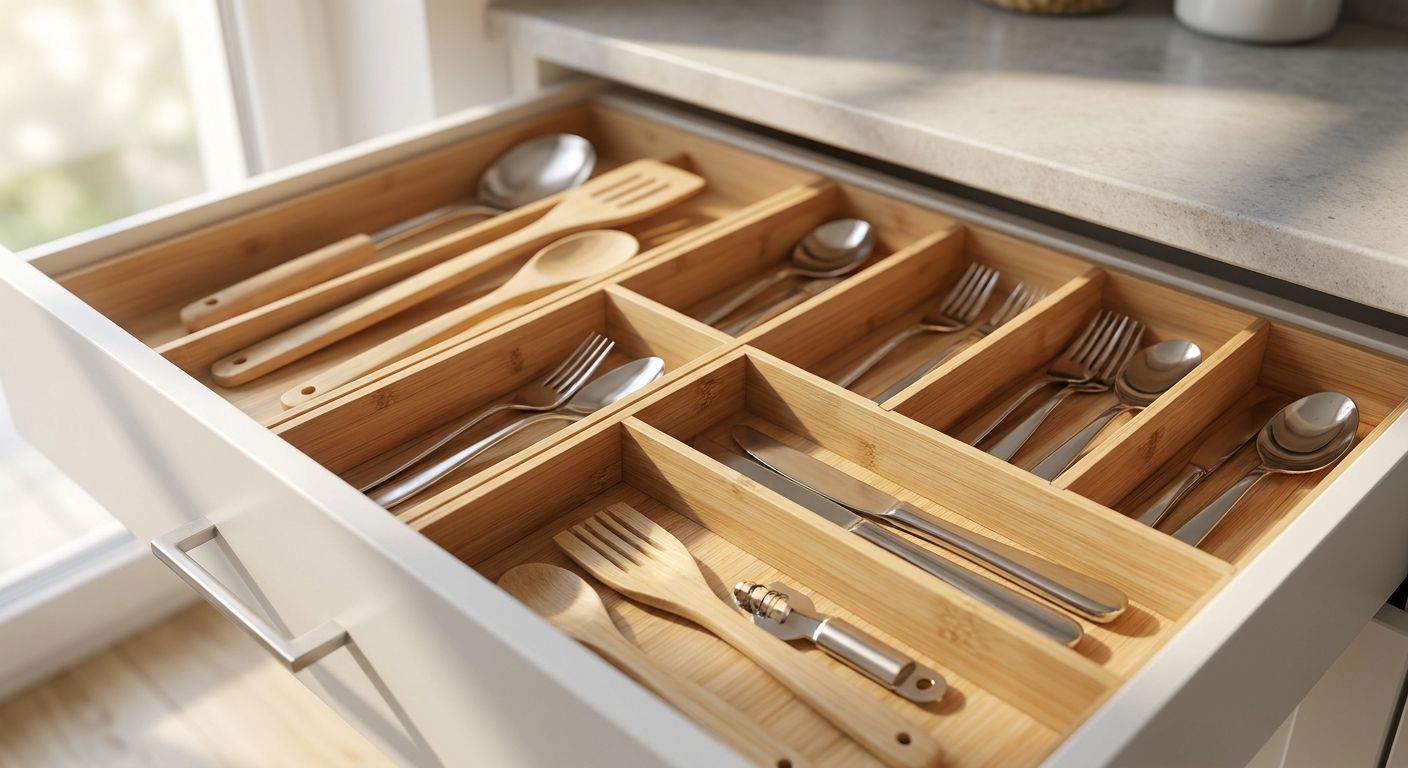
Cabinet drawer dividers separate one junk drawer from a drawer that actually works, and in 2026 the market is flooded with versions that look identical online but behave very differently once they're loaded with spatulas, silverware, and everything else that migrates into a kitchen drawer. This guide breaks down what holds up under daily use and what to skip before you buy.
- Spring-loaded bamboo dividers that expand to fit the drawer interior are the safest cabinet drawer dividers for kitchen organization in 2026 — buy adjustable, skip fixed-size kits.
- Weak drawer slides undo good dividers fast; check load rating before you add weight to a drawer box.
- Rev-A-Shelf's 45-inch pantry pull-out unit solves the storage problem dividers can't — vertical pantry space, not drawer clutter. Consider it.
- Foam peg-board kits that require drilling into a laminate drawer bottom are a skip for kitchen use; they loosen within months of daily opening and closing.
Why This Matters
A drawer full of loose utensils isn't a storage problem, it's a friction problem — every meal, you're digging. Cabinet drawer dividers fix that, but only if they're sized to the drawer's actual interior depth and rated for the weight you're putting in them. Get the sizing or the material wrong and the divider becomes one more thing rattling around in the drawer by mid-2026.
Knobs.co has spent two decades selling the hardware that goes into these drawers — hinges, slides, pulls — and the pattern is consistent: organization products fail at the slide, not the divider. If the drawer box can't carry the load, the best small kitchen drawer organizers in the world won't stay put.
Who This Is For
This guide is for homeowners organizing an existing kitchen — not a full remodel — who want the utensil drawer, the junk drawer, or the flatware drawer to actually function without buying a new cabinet. If you're mid-remodel and choosing hardware from scratch, the calculus is different; this is for the drawer you already have.
What to Look for in Cabinet Drawer Dividers for Kitchen Organization
Material and Rigidity
Bamboo and solid acrylic hold their shape under daily use; thin injection-molded plastic flexes and lets items slide underneath within a few months. Rigidity matters more than looks here — a divider that bows under a stack of spatulas isn't dividing anything.
Adjustable Width vs. Fixed Size
Spring-loaded, expandable dividers fit a range of drawer widths and adjust as you rearrange; fixed-size kits only work if your drawer matches the listed dimension exactly. Most kitchen drawers aren't standard, so adjustable wins for anyone who hasn't measured down to the eighth-inch.
Drawer Depth and Slide Capacity
The divider only works if the drawer box underneath it can carry the added weight without sagging. Before loading a drawer with dividers plus contents, confirm the drawer slides are rated for daily use — undersized slides are the number one reason organized drawers stop closing smoothly by year two.
Compatibility with Existing Hardware
Dividers that sit too high can catch on the underside of the cabinet top or interfere with pull placement when the drawer is fully open. Measure clearance between the drawer's top edge and any overhead cabinet lip before buying tall divider inserts.
Non-Slip Grip
A divider that shifts every time the drawer opens defeats the purpose. Rubber feet or a non-skid base keep the divider anchored, especially in drawers that get opened dozens of times a day.
Top Picks for Cabinet Drawer Dividers
The safe pick: adjustable spring-loaded bamboo dividers. These expand to fit the drawer interior rather than requiring an exact cut, and bamboo doesn't warp the way thin plastic does under daily kitchen humidity. Buy — this is the default choice for a standard utensil or junk drawer in 2026.
The specialist pick: a dedicated flatware layout. If the drawer in question is strictly for silverware, a divider built for that job beats a generic one every time. The cutlery organizer guide breaks down slot sizing for full flatware sets versus mixed utensil drawers. Consider for a dedicated flatware drawer, skip if the drawer is mixed-use.
The wildcard: skip the drawer entirely. Some storage problems aren't drawer problems. A pull-out organizer inside the cabinet handles pots, lids, and bulk items that no drawer divider can manage, and it uses cabinet depth a drawer never reaches. Consider this route for anything too tall or bulky to divide.
The skip: foam peg-board kits that require drilling. These need holes drilled into the drawer bottom to reposition the pegs, which is fine for a jewelry box and a bad idea for a laminate kitchen drawer bottom that flexes under daily use. Pegs loosen and pull through within months. Skip for kitchen applications.


What to Avoid
- Dollar-store plastic trays sized for a generic drawer. They rarely match actual interior depth, and thin plastic cracks at the seams within a year of daily use.
- Dividers measured against the drawer face, not the interior. The drawer front is almost always larger than the usable interior box — measure inside the drawer, not the opening.
- Any divider system installed over worn-out slides. Adding weight to a drawer that already drags or sticks just accelerates the slide failure — fix the slide first, organize second.
Verdict Comparison
| Divider Type | Adjustability | Best For | Verdict |
|---|---|---|---|
| Spring-loaded bamboo | High — expands to fit | Utensil and junk drawers | Buy |
| Fixed acrylic grid | Low — cut to size | Uniform flatware sets | Consider |
| Pull-out base cabinet organizer | Built-in, non-adjustable | Pots, lids, bulk items | Consider |
| Foam peg-board kit | Medium — repositionable pegs | Delicate, low-use drawers only | Skip for kitchens |
FAQ
What are the best cabinet drawer dividers for kitchen organization in 2026?
Adjustable, spring-loaded bamboo or solid acrylic dividers are the best choice for most kitchens in 2026 because they expand to fit the drawer's actual interior depth instead of requiring an exact-size cut. Fixed-size kits only work if the drawer matches the listed dimension precisely.
Is bamboo better than plastic for drawer dividers?
Bamboo holds its shape under daily loading and doesn't warp the way thin injection-molded plastic does. Plastic dividers tend to flex and let items slide underneath within a few months of regular kitchen use.
How much weight can a kitchen drawer with dividers hold?
It depends entirely on the drawer slide rating, not the divider itself — a divider adds organization but doesn't change how much weight the underlying slide can carry. Check the slide's rated capacity before loading a drawer with dense items like flatware or cast iron tools.
Should I measure the drawer front or the interior for dividers?
Always measure the interior depth and width of the drawer box, not the drawer front or opening. The front is almost always larger than the usable interior space, and a divider sized to the front will be too big.
Do drawer dividers work in shallow drawers?
Shallow drawers need low-profile, fixed-height dividers rather than tall adjustable ones, since tall inserts can catch on the drawer front when it's opened fully. Measure vertical clearance before buying a tall divider system.
Are pull-out cabinet organizers better than drawer dividers?
For pots, lids, and bulky cookware, yes — a pull-out base cabinet organizer uses cabinet depth that a drawer never reaches. For utensils and flatware, a drawer divider is still the simpler and cheaper fix.
Do I need new drawer slides before adding dividers?
If the drawer already drags, sticks, or sags when loaded, replace the slides before adding dividers. Adding weight to a failing slide just speeds up the failure and undoes the organization work.
One Last Thing
Most "universal" drawer dividers are sized against the drawer face, but base cabinet drawer boxes typically run a few inches shallower than the front suggests — measure the interior, not the opening, before you order anything. It's the single most common return reason for organization products, and it's avoidable with a tape measure and thirty seconds.