

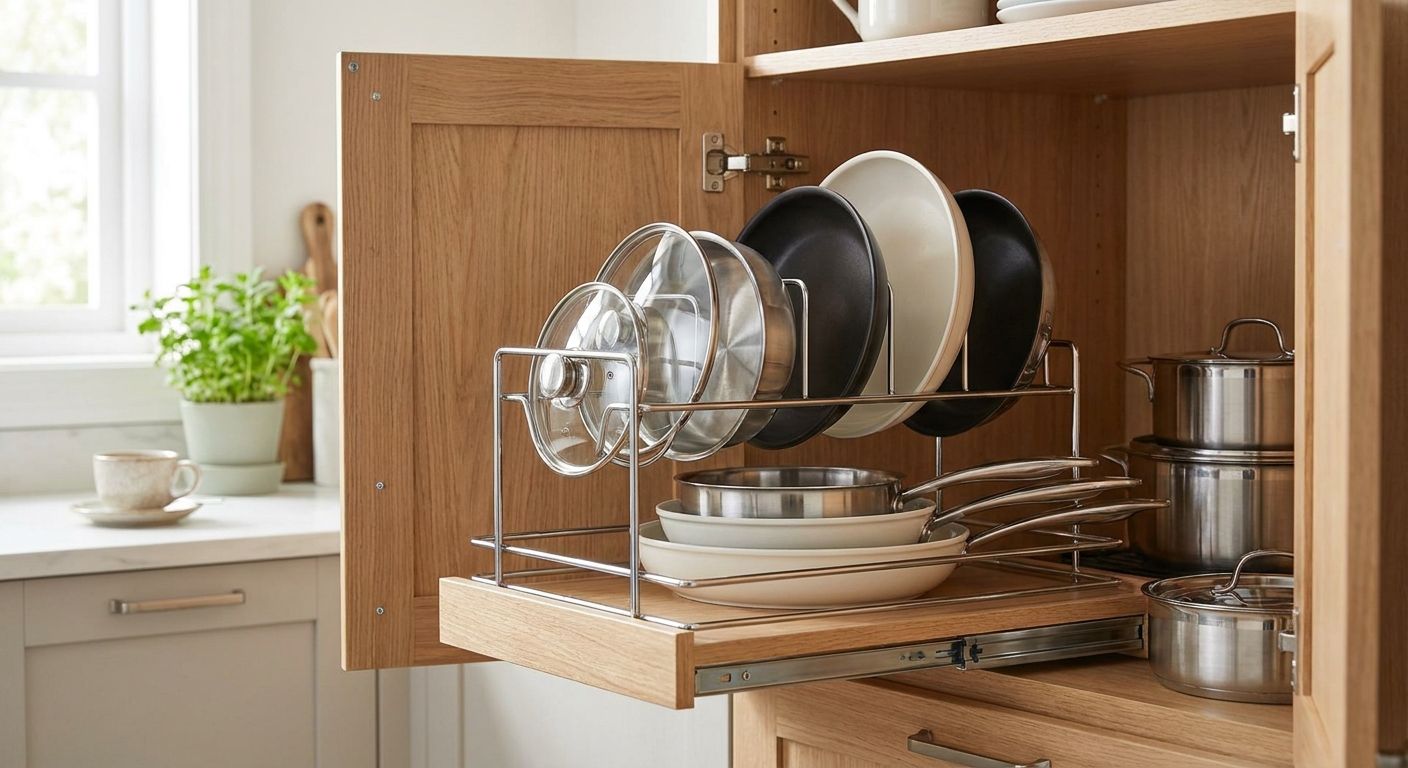
Pots and pans put more stress on a kitchen cabinet than almost anything else you own — stacked cast iron scratches shelving, loose lids rattle behind drawer fronts, and a bargain slide sags within a year of daily use. This guide breaks down what actually makes a pot and pan organizer cabinet hold up in 2026, which hardware decisions matter most, and where you can safely spend less.
- A pot and pan organizer cabinet lives or dies on the drawer slide, not the box — full-extension, 100-lb-rated slides are the baseline for 2026.
- Rev-A-Shelf's 45-inch pantry door unit turns a standard base cabinet door into usable pot and pan storage — Buy for most kitchens.
- Corner cabinets need a lazy Susan or blind-corner pull-out, not a fixed shelf, if you want real pot and pan organizer cabinet performance.
- Soft-close hinges matter more on pot and pan cabinets than anywhere else in the kitchen because a loaded door slams harder and wears hardware faster.
Why this matters
A pot and pan organizer cabinet isn't a shelf insert you buy once and forget — it's a system of pull-out hardware, drawer slides, and hinges that all have to survive repeated heavy loads, week after week, for years. Get the hardware wrong and the drawer bows or the door stops closing flush long before the cabinet box itself gives out.
Knobs.co fields enough questions about sagging pot drawers to know exactly where systems fail first: the slides, then the hinges, then the pulls people grab with wet hands. Knobs.co carries Rev-A-Shelf pull-out shelves built for this kind of daily heavy-lift storage, along with the hinges and drawer hardware that keep the whole assembly working past year one.
Who this is for
This guide is for homeowners retrofitting an existing base cabinet, remodelers speccing new cabinetry for 2026 builds, and anyone tired of digging past three lids to find one pan. If you're storing a stack of cast iron, a couple of stockpots, or anything over 5 pounds per piece, the criteria below matter more than the finish or the color of the pull.
What to look for in a pot and pan organizer cabinet
Weight capacity of the pull-out mechanism
A 12-inch cast iron skillet weighs roughly 8 pounds on its own — stack three of them with lids and you're pulling 25-plus pounds out of a drawer every time you cook. Any pull-out mechanism rated under that number will flex, bind, or drop off its rails within a couple of years of that kind of daily load.
Full-extension, soft-close drawer slides
Partial-extension slides leave the back third of the drawer out of reach, which defeats the whole point of a pot and pan organizer cabinet. Full-extension, soft-close slides let you see and grab everything without crouching, and the soft-close action keeps a heavy, fully-loaded drawer from slamming shut on its own weight.
Corner cabinet accessibility
Standard corner base cabinets run 33 or 36 inches wide, and that dead corner space is where most pot and pan storage goes to waste. A lazy Susan or a blind-corner pull-out reclaims that space; a fixed shelf just turns it into a black hole you reach into blind.
Vertical dividers for lids and bakeware
Lids are the actual chaos generator in most kitchens, not the pots themselves. Vertical dividers keep lids upright and separated from stacked pans so nothing has to be unstacked just to grab one skillet.
Hardware built for daily heavy use
The pull you grab on a loaded pot drawer takes more abuse than any other pull in the kitchen — wet hands, constant tugging, and the extra torque of a heavy drawer all shorten the life of undersized hardware. This is where an appliance-pull-style bar or a substantial cup pull outperforms a small decorative knob.
Top picks for a pot and pan organizer cabinet
The safe pick: the 45-inch pantry door organizer. Rev-A-Shelf's 45-inch pantry door organizer mounts to the inside of a base or pantry door and adds a second layer of storage without touching the drawer boxes underneath. It's the lowest-disruption way to add pot and pan organizer cabinet capacity to a kitchen you're not fully gutting in 2026. Verdict: Buy for standard base cabinets with room behind the door.
The corner-cabinet fix: lazy Susan organizers. If your pots and pans are getting swallowed by a blind corner cabinet, lazy Susan organizers for corner cabinets solve the exact problem a fixed shelf can't. Rotating shelves bring stacked stockpots and lids to the front instead of leaving them wedged in a dead corner. Verdict: Buy if you have a 33-inch or 36-inch corner base cabinet in play.
The upgrade that matters most: heavy-duty drawer slides. None of the above holds up long-term without the slide underneath it doing its job. Swapping in heavy-duty drawer slides rated well above the 100-lb baseline is the single upgrade that determines whether a pot and pan organizer cabinet lasts five years or fifteen. Verdict: Buy — this is the upgrade that protects every other purchase on this list.
The narrow-space option: pull-out wall fillers. Not every kitchen has room for a full pantry unit. Rev-A-Shelf's 3-inch pull-out wall filler (432-WFBBSC36, $305.10) and the 8-inch wood pull-out wall organizer (448-BBSCWC36-8C, $309.36) both slot into narrow gaps between cabinets and work well for storing pot lids, cutting boards, and trays vertically, freeing up drawer space for the pans themselves. Verdict: Consider if you have 3 to 8 inches of unused wall gap and want lid storage without redesigning a drawer.


Verdict comparison table
| Pick | Best for | Weight handling | Verdict |
|---|---|---|---|
| 45-inch pantry door organizer | Standard base cabinets | Moderate, spread across shelves | Buy |
| Lazy Susan corner organizer | 33-36 inch corner cabinets | Moderate, rotating load | Buy |
| Heavy-duty drawer slides | Any pot and pan organizer cabinet drawer | 150+ lbs rated | Buy |
| Narrow pull-out wall filler | 3-8 inch wall gaps | Light, lids and trays only | Consider |
What to avoid
- Wire pot racks with thin-gauge rails. They look like a cheap fix but thin wire flexes under cast iron and leaves permanent dents in coated pan bottoms.
- Partial-extension slides marketed as "heavy-duty." The label refers to weight, not reach — you still can't get to the back third of the drawer, which defeats the point of a pot and pan organizer cabinet.
- Fixed shelves in corner cabinets. They look like more storage on paper but in practice become the place pans go to disappear until the next deep clean.
FAQ
What's the best pot and pan organizer cabinet setup for a small kitchen?
A single pull-out drawer with vertical dividers, mounted on full-extension slides, handles most small kitchens without eating extra cabinet space. Add a narrow pull-out wall filler for lids if you have a 3-8 inch gap between cabinets.
Is a lazy Susan better than a blind-corner pull-out for pots and pans?
A lazy Susan works better for round cookware like stockpots and skillets because rotation brings items to the front without lifting. Blind-corner pull-outs suit taller, boxier items like bakeware sets better.
How much weight should a pot and pan organizer drawer hold?
Plan for at least 25-30 lbs per drawer if you own cast iron, since a stack of three 12-inch skillets alone runs close to that. Full-extension slides rated 100 lbs or higher give you margin above daily use.
Do soft-close hinges matter for pot and pan cabinets specifically?
Yes — a loaded pot drawer or door is heavier than average, so it slams harder without soft-close hardware. That extra force wears out standard hinges and slides faster than in lighter-use cabinets.
Can I add a pot and pan organizer to an existing cabinet without replacing the box?
In most cases yes. Door-mounted units and pull-out wall fillers install into existing cabinet openings, and upgrading just the drawer slides is a common retrofit for 2026 kitchen refreshes.
What size cabinet fits a lazy Susan organizer?
Most lazy Susan organizers are built for 33-inch or 36-inch corner base cabinets, which are the standard corner cabinet widths in U.S. kitchens. Measure your cabinet opening before ordering to confirm fit.
How long do pull-out pot and pan organizers last?
A pull-out system built on full-extension, soft-close slides with a rated capacity above your actual load typically outlasts the cabinet's finish. Undersized slides are the most common failure point within the first two to three years.
One last thing
Most people upgrade the organizer and leave the original builder-grade hinges in place — that's backwards. The hinge and slide take more repeated stress than the organizer insert ever will, so if you're only budgeting for one upgrade in 2026, put it into the hardware, not the shelf insert.