

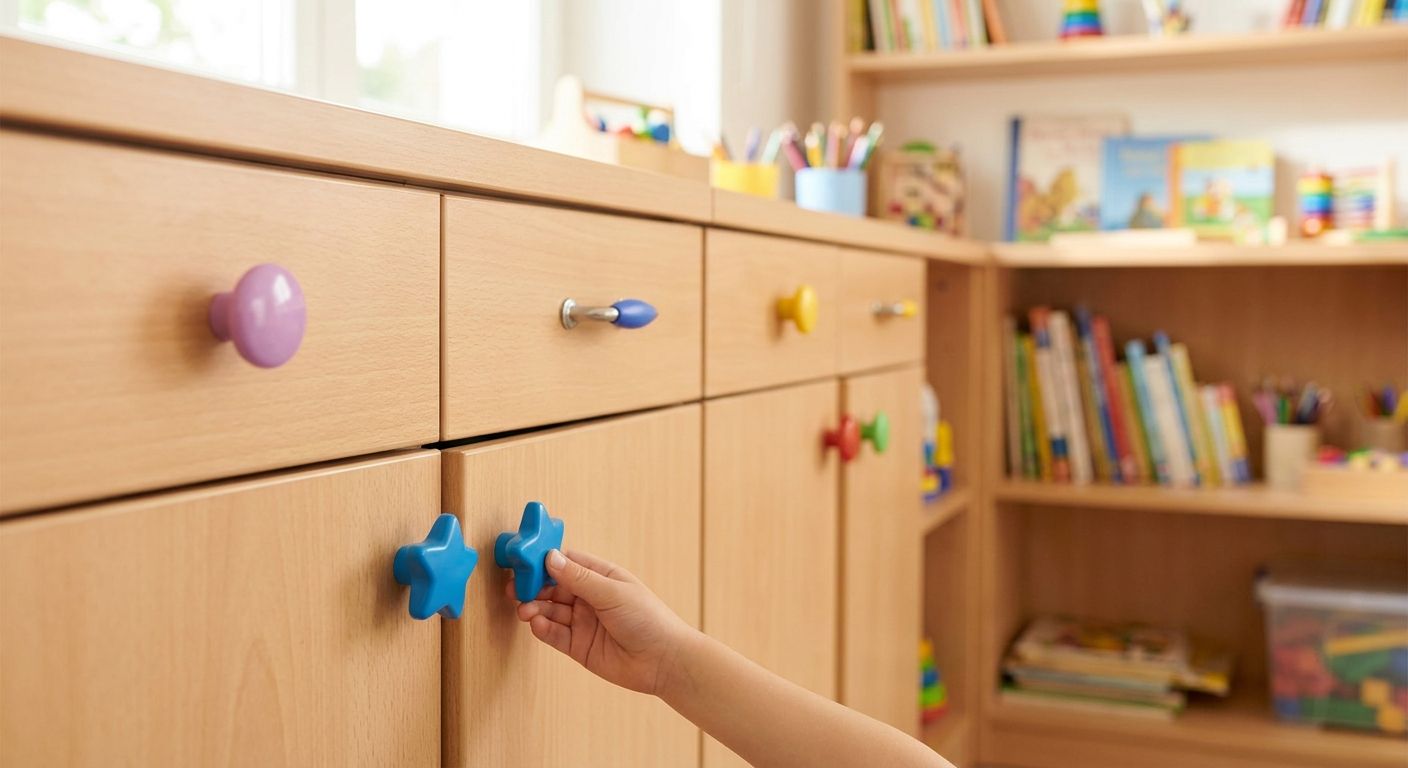
Cabinet hardware for daycare cabinets has to survive things residential hardware never sees: sanitizer wipe-downs three times a day, constant small-hand pulling at odd angles, and a licensing inspector checking whether cleaning-supply cabinets actually lock. A daycare or preschool classroom doesn't need pretty hardware first — it needs hardware that won't strip, snag, or slam shut on a toddler's fingers.
- Cabinet hardware for daycare cabinets should prioritize bar pulls over knobs for small-hand grip and one-handed use.
- Soft-close hinges cut slam force and reduce pinch injuries on high-traffic classroom cabinets.
- Fingerprint-resistant finishes like matte black or brushed nickel hide daily sanitizer streaks better than polished brass.
- Childproof locks belong on any cabinet storing cleaning supplies, sharps, or medication per most licensing checklists.
- Standardizing hole spacing across every cabinet run in 2026 saves a full re-drill when hardware wears out.
Why cabinet hardware for daycare cabinets matters
A home kitchen gets opened maybe 40-50 times a day. A daycare classroom cabinet holding art supplies, snack bins, or nap mats gets opened by a rotating set of small hands dozens of times an hour during a school day. That volume wears out cheap hardware fast, and it exposes design flaws — sharp edges, single-point knobs, unlabeled sanitized cabinets — that don't show up in a residential remodel.
Licensing inspections add another layer most homeowners never deal with. Cabinets storing cleaning chemicals, first-aid supplies, or medication typically need a functioning lock, not just a childproof latch that a curious 4-year-old can defeat in a week. Getting the hardware right the first time means fewer callbacks from the facility director and fewer replacement orders in year two. Childproof cabinet locks built for kitchens generally hold up in classroom cabinets too, since the mounting hardware and latch mechanisms are the same regardless of the room.
Update your grip style before anything else
Most daycare cabinet failures start with the wrong grip shape, not the wrong finish.
- Swap decorative knobs for bar pulls at least 4 inches long so a 3-year-old can find them one-handed
- Avoid tiny mushroom or acorn knobs — they require pinch-grip strength most toddlers under 4 don't have
- Size pulls to door width: a 6-inch pull on a 12-inch door is easier to locate than a 3-inch knob
- Keep pull height consistent across a room so kids build muscle memory for where handles are
- Skip recessed finger pulls on cabinets kids use daily — they're harder to locate by touch
Reduce pinch and slam risk with soft-close hardware
Standard hinges let a heavy door slam shut under its own weight, and daycare doors get pushed shut fast by kids leaving a room.
- Install soft-close hinges on any cabinet at or below shoulder height for a 3- to 5-year-old
- Check that soft-close pull-outs and drawer glides use a dampened stop, not just a friction catch
- Retrofit existing face-frame cabinets with soft-close hinge inserts instead of replacing full doors
- Test the close speed by hand before installing across a full room — some soft-close units are still too fast for a licensing walkthrough
The manual fix — adding aftermarket soft-close dampers to existing hinges — costs less than replacing hardware, but a full hinge swap is faster when you're outfitting a whole new classroom wing. Rev-A-Shelf soft-close pull-outs and wall fillers turn awkward gaps into usable, quieter storage, which matters in rooms full of kids and noise-sensitive naptime schedules.


Pick finishes that hide daily wear and sanitizer streaks
A finish that looks great on day one but shows every smudge by week two isn't the right pick for a classroom.
- Choose matte black, brushed nickel, or satin finishes over polished brass or chrome
- Avoid unlacquered or living finishes that need special cleaning — they tarnish faster under frequent sanitizer contact
- Test a finish sample under a UV or fluorescent classroom light before ordering a full run
- Ask whether the finish is rated for commercial cleaning chemicals, not just residential use
Standardize hole spacing across every cabinet run
Mismatched hole spacing is the reason so many daycare renovations end up drilling new holes instead of swapping hardware directly.
- Measure center-to-center spacing on every existing cabinet before ordering replacements
- Order one hardware line across the whole facility so future replacements match without redrilling
- Use a drill template or jig for multi-room installs to keep spacing identical
- Confirm screw length matches your door and drawer front thickness before the crew starts drilling
Lock down cabinets that store chemicals or medication
Most state licensing checklists require secured storage for cleaning products, sharps, and medication — a childproof latch alone often doesn't satisfy that requirement.
- Install a keyed or combination lock, not just a magnetic childproof latch, on chemical and medication cabinets
- Label locked cabinets clearly for staff so nobody assumes a latch is a lock
- Test that the lock still functions after repeated sanitizer wipe-downs — some adhesive-mounted latches fail within months
- Check your state's specific childcare licensing checklist before final sign-off, since requirements vary by state
Order hardware in bulk to simplify future repairs
One-off ordering is the fastest way to end up with three mismatched pull styles in the same building within two years.
- Order 10-20% extra hardware per run to cover future breakage without a re-order delay
- Keep a spare box labeled by room so staff can swap a broken pull without waiting on shipping
- Standardize across every classroom, not just the newest one, so replacements stay interchangeable
- Loop in whoever manages facility repairs so they know what SKU to reorder
Knobs.co stocks over 50,000 SKUs, which makes matching an existing daycare's hardware line easier than hunting down a discontinued residential brand years after the original install.
Comparing hardware options for daycare and classroom cabinets
| Option | Best for | Key limitation |
|---|---|---|
| Bar pulls | High-traffic cabinets opened by toddlers and preschoolers | Longer pulls can snag loose clothing in tight aisles |
| Cup pulls | Deep drawers holding bins, toys, or supplies | Harder to grip with wet or gloved staff hands |
| Knobs | Low-traffic storage or display cabinets | Single-point grip is tougher for kids with limited dexterity |
| Flush/recessed pulls | Rooms wanting snag-free, low-profile fronts | Slower to install, less forgiving of measurement error |
| Soft-close hinge retrofit | Any classroom wanting quieter, safer closing | Retrofitting existing doors requires a matching hinge cup bore |
Verdict: bar pulls with soft-close hinges are the strongest default for daycare and classroom cabinets in 2026 — they're easiest for small hands to find and the soft-close action cuts down on slammed-finger incidents during a busy school day.
Common mistakes daycares make with cabinet hardware
- Buying residential-scale knobs. A 1-inch decorative knob sized for a homeowner's kitchen island is too small for a 3-year-old's grip strength.
- Skipping soft-close entirely. Standard hinges save a few dollars upfront but lead to slammed-finger incidents that trigger incident reports.
- Mixing finishes and hole spacing room to room. It looks fine on day one and turns into a redrilling project the first time hardware needs replacing.
- Trusting a magnetic latch to double as a lock. Licensing inspectors checking chemical or medication storage usually want a keyed or combination lock, not just a childproof latch.
- Ordering exact quantities with no spares. A single broken pull shouldn't mean a cabinet sits handle-less for two weeks waiting on a reorder.
FAQ
What's the best cabinet hardware for daycare cabinets in 2026?
Bar pulls at least 4 inches long paired with soft-close hinges are the strongest default for daycare cabinets in 2026. They're easier for small hands to grip and the soft-close action reduces pinch injuries from slamming doors.
Are knobs or pulls better for daycare cabinets?
Pulls beat knobs for daycare use because they don't require the pinch-grip strength most kids under 4 lack. Bar pulls also give staff a faster, one-handed grab during busy transitions.
Do daycare cabinets need childproof locks by law?
Most state licensing checklists require secured storage for cleaning chemicals, sharps, and medication, and a magnetic childproof latch usually doesn't satisfy that on its own. Check your specific state's childcare licensing checklist, since requirements vary.
How often should daycare cabinet hardware be replaced?
There's no fixed schedule, but hardware exposed to daily small-hand use and sanitizer should be inspected each semester for looseness or stripped screws. Ordering 10-20% extra hardware upfront avoids a shipping delay when something breaks.
What finish holds up best to daily sanitizing in a classroom?
Matte black, brushed nickel, and satin finishes hide smudges and sanitizer streaks better than polished brass or chrome. Unlacquered living finishes tend to tarnish faster under frequent chemical contact and aren't ideal for daycare use.
Is soft-close hardware worth it for a daycare renovation?
Yes — soft-close hinges cut the slam force on doors that get pushed shut fast by kids leaving a room, which lowers the risk of pinched fingers. Retrofitting existing hinges with soft-close inserts is usually cheaper than a full door swap.
How do I match new hardware to an existing daycare's cabinet line?
Measure the existing hole spacing and screw length before ordering, then buy from a supplier stocking a wide catalog so a discontinued line doesn't force a full re-drill. Knobs.co carries over 50,000 SKUs, which makes matching an older install easier.
What cabinet hardware works best for a daycare kitchen or snack prep area?
Cup pulls handle deep drawers holding bins and supplies well, but bar pulls with a sanitizer-friendly finish are the more versatile daycare kitchen choice for 2026. Avoid polished finishes that show fingerprints and grease within a single shift.
One last thing
Most hardware catalogs never mention pull length relative to door width, but it's the detail that decides whether a toddler finds the handle without help. On a 12-inch-wide toddler-height door, a 6-inch bar pull reads faster than a 3-inch knob — measure door width before ordering, not after the crew shows up. Get that one measurement right across every room in 2026 and the redrilling headache never happens.