

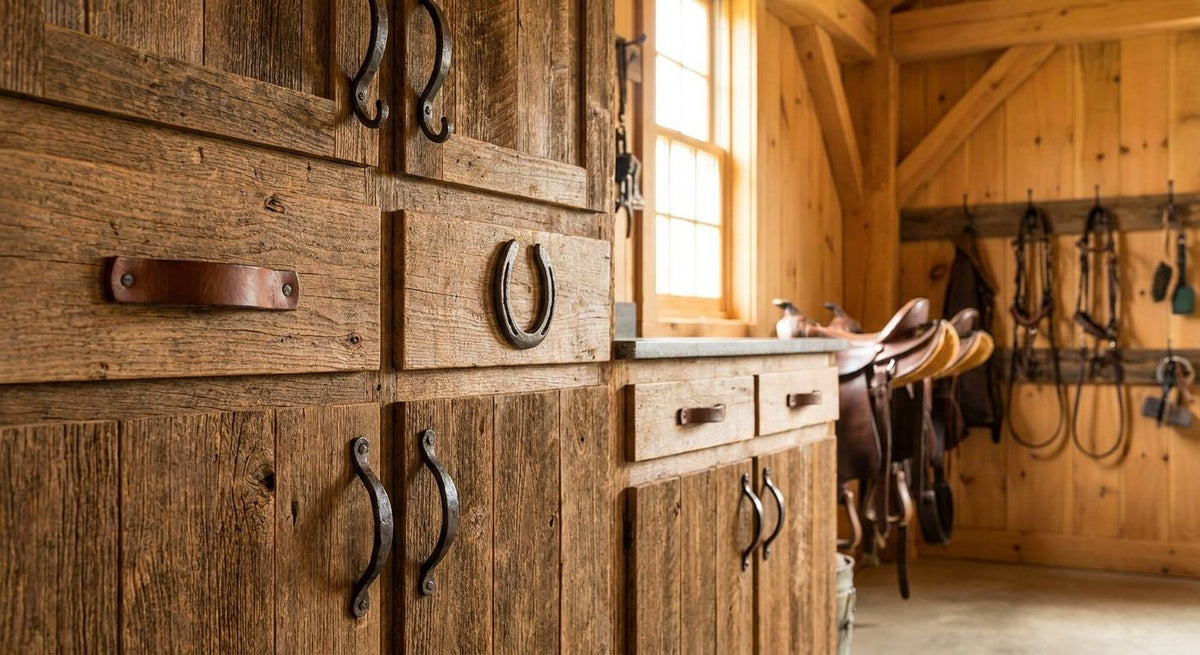
Cabinet pulls for tack room and barn cabinets need to survive dust, grooming spray, and gloved hands — not just look good in a showroom photo. A tack room isn't a kitchen: hardware gets grabbed with wet or gloved hands dozens of times a day, and the wrong finish or shape slows down chore time and looks tarnished within a season.
- Bar pulls beat knobs for barn cabinets because gloved hands need a full grip, not a pinch point.
- Stainless steel and matte black finishes resist barn dust and grooming-spray corrosion better than polished brass in 2026 barns.
- Knobs.co stocks bar pulls, appliance pulls, and hinges rated for heavy daily use across 50,000+ SKUs.
- Standard 96mm-160mm centers cover most tack cabinet drawer fronts without custom drilling.
- Buying hardware in bulk cuts per-unit cost when outfitting more than one stall or tack room.
Why this matters
Tack rooms and barn cabinets get treated differently than a kitchen ever will. Boots, gloves, hay dust, fly spray, and hose-down cleaning all hit the hardware, and most homeowners default to whatever pull matched their house kitchen — which is usually the wrong call. Knobs.co carries hardware built for this kind of daily abuse, not just aesthetic photo shoots, and that distinction matters more in a barn than almost anywhere else in a home.
The difference shows up fast: a polished brass knob that looks sharp in a farmhouse kitchen tarnishes within months next to a wash stall, while a bar pull in matte black or stainless steel shrugs off the same environment for years. Cabinet pulls for tack room use need to be chosen for the job, not the catalog photo.
Why cabinet pulls matter for tack room and barn cabinets
A tack room isn't judged on style points — it's judged on whether you can grab a halter with a gloved hand at 6 a.m. in January. Search behavior around this topic skews toward function-first phrases: "barn cabinet hardware," "gloved hand pulls," "rust proof cabinet pulls" — buyers are troubleshooting a real problem, not browsing for inspiration.
That changes the shopping list. Knob diameter and finish sheen, which dominate kitchen remodel decisions, take a back seat to grip length, corrosion resistance, and how many pulls you need to order at once for a whole barn aisle of cabinets.
Measure your barn cabinet doors before you order
Get the actual drawer front and door dimensions before picking a pull length — barn cabinetry is often built with wider, deeper fronts than kitchen cabinetry, which changes what looks and functions right.
- Measure drawer front width and divide by three for a proportional pull length
- Note screw-hole centers on any existing hardware you're replacing
- Check door thickness if you're also swapping hinges at the same time
- Record whether doors are inset or overlay — it changes hinge selection later
- Round up to the nearest stocked length rather than special-ordering a custom size
Choose a finish that survives dust, moisture, and grooming spray
Skip anything with a delicate lacquer coat. Barns run humid, dusty, and occasionally get hosed down, and a finish rated for a dry kitchen won't hold up the same way.
- Stainless steel resists corrosion from grooming sprays and fly repellent overspray
- Matte black powder coat hides scuffs and dust better than polished chrome
- Oil-rubbed bronze ages gracefully and doesn't show fingerprints from gloved hands
- Avoid unlacquered brass unless you want a living patina — it will tarnish fast in a barn
- Test a sample finish near a wash stall for a season before committing to a full order
Pick bar pulls over knobs for gloved hands
Knobs work fine in a house. In a barn, a full bar pull gives you something to hook fingers or a gloved hand through, which matters when you're carrying a bucket in the other hand.
- Bar pulls in the 5-8 inch range suit most tack cabinet drawers
- Longer pulls (12-18 inches) work better on wide feed-room or blanket-storage cabinets
- Wire pulls offer a lighter-duty option for smaller tack trunks and lockers
- Cup pulls suit face-frame barn cabinets where a bar pull would clash with trim
- Reserve knobs for lightweight cabinet doors that don't get grabbed under load
The Top Knobs Amwell bar pull is a straightforward option in this category — full bar profile, no unnecessary ornamentation, and a finish that's built to be handled daily rather than admired from across a room. Buy if you want a no-nonsense bar pull that won't need babying in a barn environment.
Match pull spacing so you're not redrilling holes
Standard cabinet hardware runs on set hole-center spacing — matching it to your existing holes (or planning new cabinetry around it) saves a redrilling headache later.
- 96mm and 128mm centers cover the majority of standard cabinet pulls
- Wider barn cabinet drawers often use 160mm or longer centers
- Confirm center-to-center measurement before ordering, not just overall pull length
- Use a jig if you're drilling new holes across multiple identical cabinets
- Keep one spare pull on hand in case a hole gets stripped during install
Upgrade hinges and slides so doors hold up under tack weight
A saddle rack door or a feed-bin cabinet takes more daily stress than a bathroom vanity. Self-closing hinges and rated slides keep doors from sagging under repeated use.
- Self-closing hinges reduce wear from doors left swinging open
- Full-wrap hinges add strength on heavier solid-wood barn cabinet doors
- Soft-close slides protect drawers loaded with heavier tack and tools
- Stainless or plated hinge finishes match the same corrosion logic as pulls
- Check hinge overlay type (inset, full, partial) against your actual door construction


Buy hardware in bulk if you're outfitting more than one tack room
Barns rarely have just one cabinet. If you're doing multiple stalls, a feed room, and a wash bay, ordering matched hardware in one pass avoids finish-lot mismatches down the line.
- Order 10-15% extra pulls to cover future repairs or replacements
- Confirm the finish lot is consistent across a bulk order before installing
- Ask about trade pricing if you're a barn builder or contractor doing repeat jobs
- Standardize on one pull style across all barn cabinetry for a cleaner look
- Keep leftover hardware labeled by cabinet run in case of future swaps
The same logic applies to the rest of a working equestrian property — maintaining your arena footing is a recurring line item, not a one-time purchase, and barn hardware works the same way: budget for replacement cycles instead of treating one order as permanent.
Compare pull styles for tack rooms and barn cabinets
| Option | Best for | Material notes | Key limitation |
|---|---|---|---|
| Bar pulls | Daily-use tack and feed cabinets | Stainless steel or matte black hold up best | Longer sizes cost more per unit |
| Wire pulls | Lightweight tack trunks and lockers | Thin profile, easy to grip | Less durable under heavy repeated pull |
| Cup/bin pulls | Face-frame barn cabinets | Recessed design avoids snagging | Harder to grab with thick gloves |
| Appliance pulls | Wide feed-room or blanket cabinets | Long bar spans wide drawer fronts | Overkill on small drawers |
The Amerock Status pull works as a mid-length bar option for standard tack locker drawers where you don't need the reach of a full appliance pull. Buy if your cabinet fronts run in the 12-18 inch range and you want one style across the whole run.
Common mistakes barn owners make with tack room hardware
- Reusing kitchen leftovers. Polished brass or chrome pulled from a house remodel tarnishes fast next to a wash stall — barn hardware needs its own finish decision.
- Undersizing the pull. A short knob doesn't work with a gloved hand carrying a bucket; bar pulls in the 5-8 inch range solve this on most drawers.
- Ignoring hinge load. Pulls get the attention while hinges quietly fail first under the weight of a loaded feed-bin door.
- Ordering one at a time. Piecemeal ordering across multiple cabinets leads to finish-lot mismatches that are obvious once installed.
- Skipping the screw-hole check. Assuming standard kitchen centers match barn cabinetry causes redrilling that damages the door face.
FAQ
What's the best cabinet pull for a tack room?
Bar pulls in stainless steel or matte black are the best cabinet pulls for tack room use in 2026 because they resist corrosion and give gloved hands a full grip. Knobs work fine on lighter, less-used doors.
Are bar pulls better than knobs for barn cabinets?
Yes, for daily-use drawers and doors, because a bar pull lets you hook fingers or a gloved hand through it instead of pinching a small knob. Knobs still work on lighter cabinets that don't get grabbed under load.
What finish holds up best in a barn or tack room?
Stainless steel and matte black powder coat hold up best against barn dust, moisture, and grooming spray. Polished brass and chrome show tarnish and fingerprints much faster in that environment.
How much does it cost to outfit tack room cabinets with pulls?
Cost depends on how many cabinets you're outfitting and the pull style you choose, so check current pricing on the product page before budgeting a full order. Bulk ordering typically lowers the per-unit cost for multi-cabinet barn projects.
Should I use knobs or pulls on tack room cabinets?
Pulls are the better default for barn cabinetry because they suit gloved hands and daily heavy use. Reserve knobs for decorative or lightly-used doors where grip strength isn't a factor.
Do stainless steel pulls rust in a barn environment?
Stainless steel resists rust far better than unlacquered brass or plated finishes in humid barn conditions. It's one of the more reliable choices for tack rooms and wash-bay-adjacent cabinetry.
What's the standard pull length for wide tack cabinet doors?
Wide feed-room or blanket-storage cabinet doors typically call for 12 to 18 inch pulls or appliance-style bars, while standard tack lockers work fine with 5 to 8 inch bar pulls.
Can I mix hinge and pull finishes in a tack room?
You can, but matching finishes across pulls and hinges gives barn cabinetry a more finished look and avoids an obviously mismatched hardware set once everything is installed.
One last thing
The detail most barn owners skip: check hinge overlay type before ordering pulls, because a mismatched hinge swap forces you to redrill the same door twice in one project. Get the hinge and pull order right together in 2026 and you install once — not twice.