

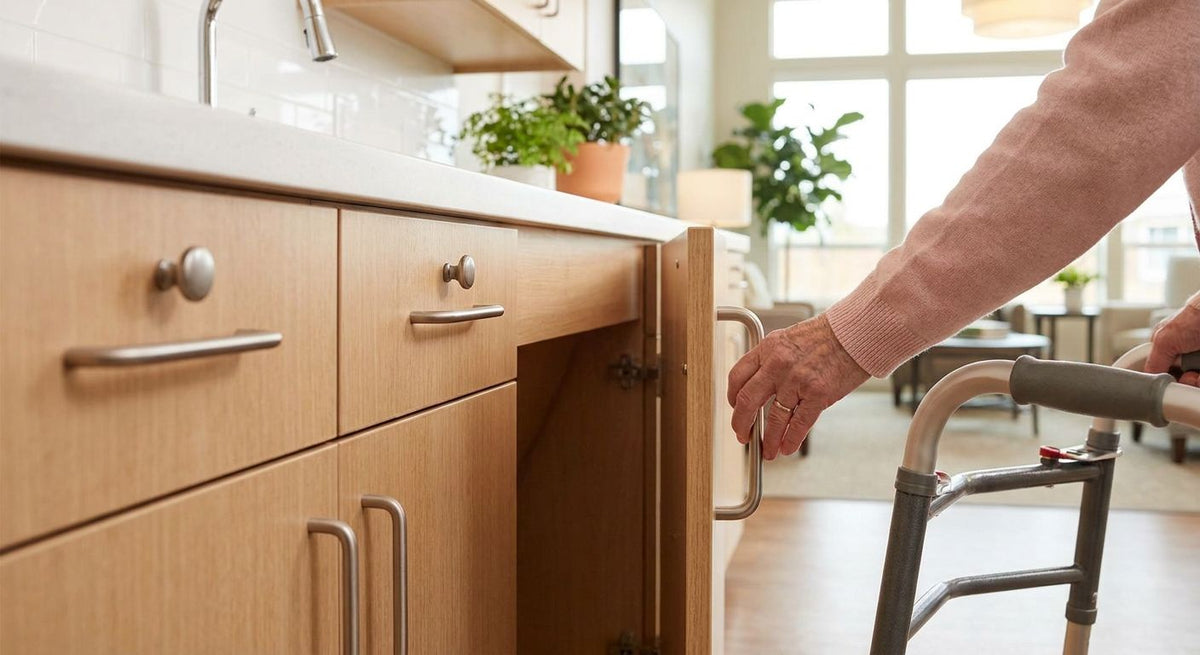
Assisted living facility cabinet hardware is the knob, pull, hinge, and grab-bar selection built around ADA operable-parts rules, cleanable finishes, and grip-friendly design, with the goal of cutting resident injury risk while passing state licensing inspection in 2026. A homeowner picks hardware for style. A facility director or contractor is buying hardware that dozens of residents with arthritis, tremor, or limited hand strength will touch daily, and that housekeeping will scrub with commercial disinfectant every week without the finish flaking or the pull loosening.
Shop the finish
Every stainless steel knob and pull we carry, in one place — filter by size, style, and brand.
Browse Stainless Steel Cabinet Hardware →- Cabinet hardware for assisted living should use bar pulls or lever styles, never twist knobs, under ADA operable-parts rules.
- ADA 2010 standards cap operating force at 5 lbf and mounting height at 48 inches for controls residents use.
- Soft-close hinges and pull-out organizers cut slamming injuries and back strain in facility kitchens and common areas.
- Knobs Co stocks lever-style pulls, ADA grab bars, and bulk finish-matched hardware for facility-wide 2026 renovations.
Why cabinet hardware matters for assisted living facilities
The ADA 2010 Standards for Accessible Design require that operable parts — including cabinet hardware in resident-accessible areas — not require tight grasping, pinching, or twisting of the wrist, and that the force needed to operate them stay at or below 5 lbf. A round knob fails that test for anyone with reduced grip strength or arthritis, which is most of the resident population in memory care and assisted living wings.
That's a different buying problem than a kitchen remodel. Facility hardware gets specified once and installed across 40, 80, or 200 units, so a single wrong SKU choice multiplies into a maintenance headache and a potential inspection flag. Lever-style cabinet pulls and bar pulls solve the grip problem that twist knobs create, and they're the first thing an inspector or occupational therapist checks in a resident kitchenette.
Audit your current hardware against ADA operable-parts rules
Start with what's already installed before ordering anything new. Most facilities built or renovated before 2010 still have round knobs throughout resident units.
- Walk every resident-accessible cabinet and note knob vs. pull hardware
- Measure mounting height against the 48-inch maximum reach rule
- Test each pull with a spring scale if available — anything over 5 lbf to operate fails
- Flag cabinets requiring a pinch or twist grip for replacement first
- Photograph and log finish condition for wear-based replacement budgeting
Choose pull styles over knobs for kitchens and bathrooms
Bar pulls and lever-style pulls let a resident hook fingers or even a closed fist under the hardware, which meets the ADA no-tight-grasp requirement that round knobs violate. Lever-style cabinet pulls for limited grip strength cover the sizing and mounting specifics for exactly this use case.
- Specify 4-inch to 6-inch bar pulls for standard drawer and door widths
- Avoid recessed cup pulls in high-turnover units — they collect grime and are harder to grip wet
- Standardize one pull length per cabinet category to simplify reorders
- Skip knurled or ridged textures in memory care units where texture can confuse residents
- Keep a spare-parts bin of the exact same SKU for fast replacement
Plan hardware for ADA-compliant kitchens and kitchenettes
Resident kitchenettes and shared dining prep areas carry the strictest compliance burden because they combine ADA reach rules with commercial-kitchen durability needs. How to plan cabinet hardware for an ADA-compliant kitchen walks through reach-range layout in more depth.
- Mount all operable hardware within the 15-inch to 48-inch reach zone
- Choose one-hand-operable latches over anything needing two-hand coordination
- Verify appliance pulls on wall ovens and under-counter fridges meet the same force limit
- Confirm door swing clearance doesn't conflict with wheelchair or walker turn radius
- Document compliance choices for the state licensing file
Fit soft-close hinges and slides to cut noise and injury
Slamming cabinet doors and drawers are a real hazard around residents with balance issues and a real nuisance in shared living spaces. Soft-close hardware removes both problems without changing how a cabinet looks.
- Retrofit soft-close hinges on existing face-frame or frameless doors
- Add soft-close drawer slides in kitchenette and bathroom vanity cabinets
- Prioritize soft-close in dining hall and common-area cabinetry, where traffic is heaviest
- Test hinge tension seasonally — soft-close mechanisms can stiffen or fail with age
- Budget hinge replacement on a 5-7 year cycle for high-use units
Pull-out organizers do the same accessibility work drawers can't: they bring items forward instead of making a resident or aide reach and bend into a deep cabinet.


Outfit bathrooms with grab bars, robe hooks, and towel bars rated for pull force
Bathroom hardware carries the highest liability exposure in any assisted living facility because falls happen at the sink and shower, not in the kitchen. Best ADA grab bars for accessible bathrooms covers the mounting and load specs inspectors look for.
- Mount grab bars at ADA-specified heights near toilets and in shower stalls
- Confirm wall blocking supports the rated pull load before installing any grab bar
- Choose robe hooks and towel bars with rounded, snag-free profiles
- Match vanity pull hardware to the same low-force, one-hand-operable standard as kitchens
- Re-torque all bathroom hardware annually — moisture loosens mounting screws faster than in kitchens
Standardize finishes and plan bulk procurement
A facility with 15 different finishes across units turns every maintenance ticket into a parts hunt. One or two facility-wide finishes, ordered in volume, keeps replacement fast and budgets predictable.
- Pick one primary finish for kitchens and one for bathrooms, facility-wide
- Order 10-15% extra stock per finish for future repairs
- Set a replacement cycle based on unit turnover, not calendar age alone
- Keep a written spec sheet listing exact SKUs by cabinet type for future contractors
Comparing hardware options for assisted living cabinets
| Hardware type | Best for | Key limitation |
|---|---|---|
| Bar pulls (4-6 in) | Kitchenettes and common-area cabinets, easiest one-hand operation | Needs more mounting clearance than a knob |
| Wire/cup pulls | Recessed cabinet faces, ADA one-hand use | Fewer finish options than bar pulls |
| Round knobs | Low-traffic storage only, not resident-facing cabinets | Requires pinch grip — fails ADA operable-parts test |
| Touch-latch / push-to-open | Memory care units, no graspable hardware at all | Higher unit cost, more service calls |
Verdict: bar pulls or lever-style pulls win for nearly every resident-facing cabinet in an assisted living facility; round knobs belong only in staff-only storage.
Common mistakes assisted living facilities make
- Specifying decorative twist knobs in resident kitchenettes because they look nicer in a rendering, then failing an ADA operable-parts check during inspection
- Mixing finishes across units during phased renovations, which turns a simple hardware swap into a facility-wide finish-matching project
- Skipping the door-swing clearance check against wheelchair and walker turn radius, forcing a second round of installation
- Underbudgeting replacement frequency — hardware in a facility sees far more daily cycles than a residential kitchen and wears out faster
- Buying one-off instead of bulk and paying more per unit while ending up with inconsistent SKUs across the building
“A round knob that needs a pinch grip fails the ADA test the moment a resident with arthritis tries to open the drawer.”
FAQ
What's the best cabinet hardware for assisted living facilities?
Bar pulls or lever-style pulls are the best cabinet hardware for assisted living facilities because they meet ADA operable-parts rules without requiring a pinch or twist grip. Round knobs generally fail that requirement for residents with arthritis or limited hand strength.
Is ADA-compliant hardware required in senior living kitchens and bathrooms?
Yes, resident-accessible cabinets in licensed assisted living facilities must meet ADA 2010 operable-parts standards, including the 5 lbf force limit and 48-inch maximum reach height. State licensing inspections typically check this directly.
How much force can cabinet hardware require under ADA rules?
ADA 2010 Standards Section 309 caps the force required to operate hardware at 5 lbf. Hardware that needs more force than that, or requires tight grasping or twisting, does not meet the standard.
Are knobs allowed in assisted living facility cabinets?
Round twist knobs are allowed in staff-only or non-resident storage but generally fail ADA operable-parts rules in resident-facing kitchens and bathrooms. Bar pulls or levers are the safer facility-wide choice.
What's the difference between bar pulls and touch-latch hardware for memory care?
Bar pulls require a light one-hand pull motion, while touch-latch hardware needs only a push and has no graspable part at all. Memory care units often prefer touch-latch because it removes hardware residents might tug on repeatedly.
How often should assisted living facilities replace cabinet hardware?
Facility cabinets see far more daily use cycles than a residential kitchen, so plan hardware and hinge replacement on a 5-7 year cycle rather than waiting for visible failure. High-traffic dining and common-area cabinets wear out faster than resident-unit storage.
Can you buy cabinet hardware in bulk for a multi-unit facility?
Yes, ordering one or two standardized finishes in volume keeps per-unit cost down and simplifies future repairs across a facility with dozens of identical cabinets. Bulk ordering also avoids the finish-mismatch problem that comes from buying hardware unit by unit.
What finish holds up best under institutional cleaning?
Satin nickel and matte black finishes tend to hide fingerprints and water spots better under daily commercial disinfectant use than polished brass or chrome. Whatever finish you pick, standardize it facility-wide so replacement stock is simple to match.
One last thing
The detail most facility managers miss until an inspection flags it: ADA's 5 lbf force limit and 48-inch reach maximum apply to every operable cabinet a resident might use, not just the ones in their private unit — that includes dining hall sideboards, activity room storage, and shared kitchenette cabinets. Audit those common areas with the same checklist you use for resident rooms, because inspectors do.


