

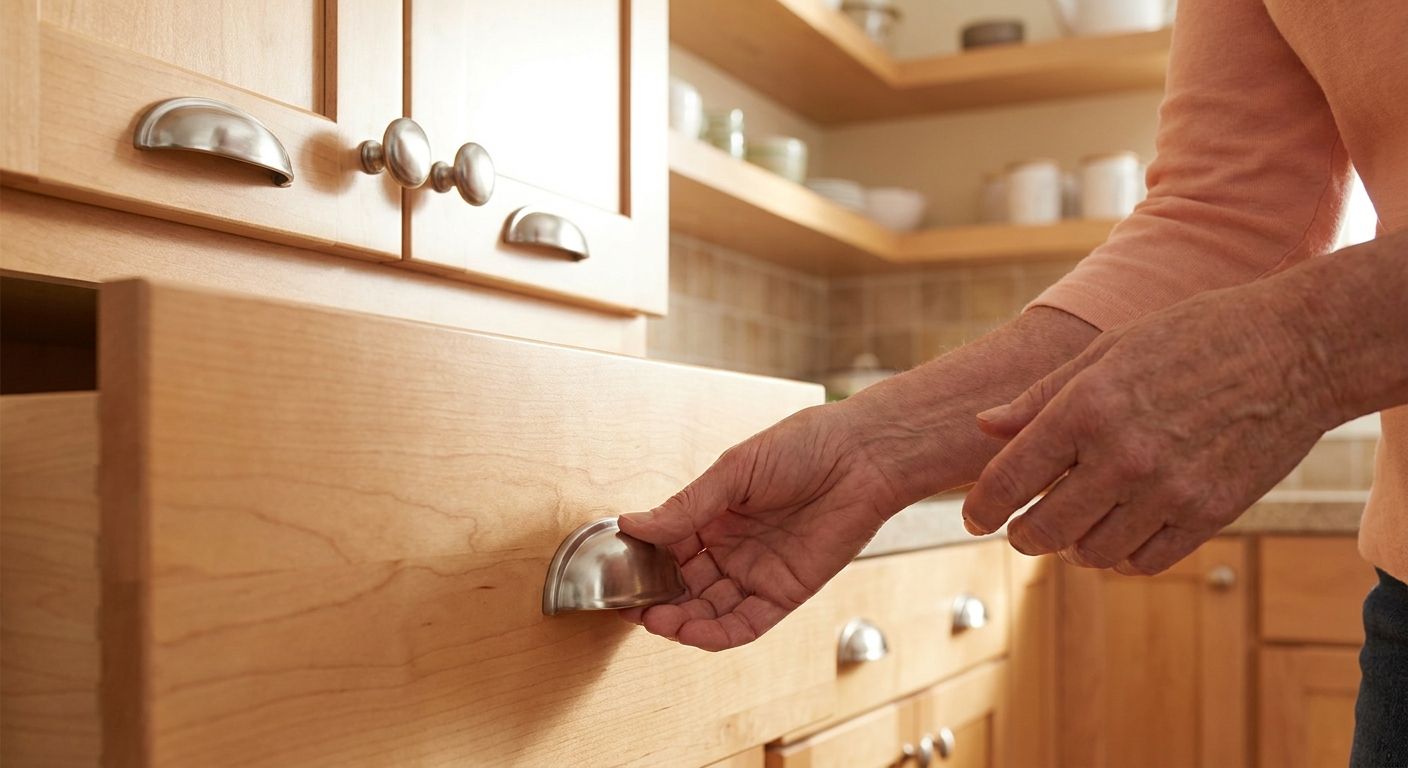
Bar pulls in the 5-inch to 12-inch range are the best overall cabinet hardware for aging-in-place kitchens because they take a full-hand grip instead of a pinch. Lever-style pulls win for anyone managing arthritis or reduced hand strength. Touch-latch hardware is the best pick for wheelchair-height base cabinets. A powered vanity drawer is the best call for bathroom vanity accessibility, and ADA grab bars handle tub-and-shower safety that no cabinet pull can cover.
- Bar pulls are the best cabinet hardware for aging in place because a full-hand grip beats a knob's pinch grip.
- Lever-style pulls and touch-latch hardware solve grip-strength and wheelchair-reach problems knobs cannot fix.
- ADA grab bars mount 33 to 36 inches above the floor per federal accessibility standards, not wherever looks best.
- Skip round knobs in 2026 aging-in-place kitchens - they demand the pinch grip that arthritis takes away first.
- A powered vanity drawer removes the pull-and-brace motion that's hardest on a bad shoulder in the bathroom.
Why this matters
Most aging-in-place kitchen advice focuses on counter height and appliance placement, and skips the cabinet hardware sitting at hand level all day. That's a mistake, because hardware is the one touchpoint used dozens of times daily - opening a drawer, closing a cabinet, steadying a hand near the sink.
A round knob needs a pinch grip: thumb and two fingers closing on a small point. That's exactly the motion arthritis, tremor, and reduced grip strength attack first. Planning a kitchen around this problem, laid out in detail in how to plan cabinet hardware for an ADA-compliant kitchen, starts with swapping grip type before anyone touches paint colors or cabinet boxes.
Getting the hardware category wrong in 2026 means a remodel that looks finished but still fails the person it was built for.
What makes the best cabinet hardware for aging-in-place kitchens
- Full-hand grip over pinch grip - bar pulls, appliance pulls, and lever pulls beat round knobs for anyone with reduced hand strength
- Lever or push action over twist-and-pull - less fine-motor coordination required per open
- Mounting height inside the ADA reach range - 33 to 48 inches covers both cabinet hardware and grab bars
- Soft-close or touch-latch mechanisms - removes the slam and the pinch-point injury risk from cabinet doors
- Finish consistency kitchen to bathroom - one grip logic across every room means less relearning after a fall risk changes
Cabinet hardware for aging in place: at a glance
| Hardware type | Best for | Standout feature | Key limitation |
|---|---|---|---|
| Bar pulls (5 to 12 inch) | Everyday cabinet doors and drawers | Full-hand grip, no pinching required | Longer sizes need wider stiles to mount cleanly |
| Appliance pulls (12 to 18 inch) | Oven, fridge, dishwasher doors | Two-hand grip surface for heavy doors | Overkill on standard drawers |
| Lever-style pulls | Limited grip strength or arthritis | Opens with a push, not a grip | Fewer finish choices than standard pulls |
| Touch-latch hardware | Wheelchair-height base cabinets | Nothing to grip - push to open | Costs more labor to retrofit |
| Powered vanity drawer | Bathroom vanity accessibility | Motorized opening at the touch of a button | Needs an outlet near the vanity |
| ADA grab bars | Bathroom safety near tub and shower | Load-rated for body weight | Must anchor into a wall stud |
1. Bar Pulls (5 to 12 Inch): Best Cabinet Hardware for Everyday Full-Hand Grip
Bar pulls run in a straight line from post to post, so the whole hand wraps around the bar instead of pinching a small knob. A pull in the Top Knobs Grace Riverside or Amerock Bronx line spreads the load across four fingers, which matters most once grip strength starts to fade.
Bar pulls pros:
- Full-hand grip works even with reduced dexterity
- Available in 5-inch to 18-inch lengths across nearly every Knobs.co finish
- A contrasting finish doubles as a visual size cue for low-vision users
Bar pulls cons:
- Longer bars need enough stile width to mount without hitting a hinge
- Thin-diameter bar profiles are harder to grip than thicker ones
Best for: everyday cabinet doors and drawers throughout the kitchen. Verdict: Buy.
2. Appliance Pulls (12 to 18 Inch): Best Cabinet Hardware for Oven, Fridge, and Dishwasher Doors
Appliance pulls are the heavy-duty cousin of the bar pull, built for panel-ready refrigerator doors and oven fronts that need two hands to open. Options like the Top Knobs Grace Riverside appliance pull run up to 18 inches, and finishes like the Acanthus 12-inch and 14-inch bars give a full grip surface at the wide drill centers panel doors need.
Appliance pulls pros:
- Longest reach of any pull category, useful for tall pantry and appliance doors
- Reinforced mounting posts handle repeated heavy-door pulls better than standard bar pulls
- Matches bar pull finish so the kitchen reads as one hardware system
Appliance pulls cons:
- Unnecessary bulk on standard cabinet drawers
- Fewer finish choices than the standard bar pull lineup
Best for: panel-ready appliances and heavy pantry doors. Verdict: Buy for appliances, Skip for drawers.
3. Lever-Style Pulls: Best Cabinet Hardware for Limited Grip Strength
Lever-style pulls extend from the door and open with a push of the palm or forearm, not a pinch or a wrap. For anyone managing arthritis, tremor, or reduced hand strength, lever-style cabinet pulls remove the fine-motor step entirely - you nudge, the door swings.
Lever pulls pros:
- Opens with a forearm or knuckle push, no grip required
- Pairs well with soft-close hinges since there's no hard stop to catch a hand on
- Reads as a design choice, not medical equipment
Lever pulls cons:
- Fewer manufacturers make this style, so matching finish across a full kitchen takes more sourcing
- Protrudes further from the door face than a knob, which changes clearance in narrow galley kitchens
Best for: households managing arthritis or reduced hand strength. Verdict: Buy.
4. Touch-Latch Hardware: Best Cabinet Hardware for Wheelchair-Height Cabinets
Touch-latch hardware removes the pull entirely - a light push on the door face releases the latch and the door springs open a few inches. For lower cabinets at wheelchair-accessible height, touch-latch hardware means there's nothing to grip, aim for, or miss.
Touch-latch pros:
- Zero hardware to grip, aim for, or catch a sleeve on
- Keeps a flat, handleless look that works with lowered wheelchair-height counters
- Removes a common snag point for walkers and wheelchair footrests
Touch-latch cons:
- Retrofitting existing doors costs more labor than swapping a knob for a pull
- Requires a firm, deliberate push - a light touch sometimes doesn't trigger the latch
Best for: wheelchair-height base cabinets and lowered counter runs. Verdict: Buy for new builds, Hold for a full retrofit.
5. Powered Vanity Drawers: Best Cabinet Hardware for Bathroom Vanity Accessibility
A motorized vanity drawer opens at the touch of a button, which matters most in the one room where wet floors and limited mobility overlap most: the bathroom. A powered organizer drawer built for a 15-inch cabinet cavity lets a seated user reach a button instead of pulling a drawer against a locked wheel.
Powered vanity drawer pros:
- Removes the pull-and-brace motion that's hardest on a bad shoulder or wrist
- Built-in organizer trays keep frequently used items within a seated reach zone
- No knob or pull to grip at all
Powered vanity drawer cons:
- Needs a nearby outlet, which isn't always already in the vanity cabinet cavity
- Fixed sizing - not a drop-in fit for every vanity cabinet width
Best for: bathroom vanities serving a seated or low-mobility user. Verdict: Buy for new vanity builds.
6. ADA Grab Bars: Best Cabinet Hardware for Bathroom Safety
Grab bars aren't cabinet hardware in the traditional sense, but they belong on the same hardware order for anyone planning an aging-in-place bathroom in 2026. ADA-compliant grab bars mount 33 to 36 inches above the floor and anchor into a wall stud or blocking - not just a drywall anchor - because they have to hold body weight during a fall, not just a towel.
ADA grab bars pros:
- Load-rated for body weight, unlike towel bars which aren't designed to bear weight
- Available in finish lines - brushed nickel, matte black, oil-rubbed bronze - that match cabinet pulls
- Mounting height is governed by a fixed standard, so there's no guessing where it goes
ADA grab bars cons:
- Requires stud-blocking during install; can't be added to finished drywall alone
- Purely functional - far fewer decorative options than pulls or knobs
Best for: tub, shower, and toilet-area safety in a bathroom remodel. Verdict: Buy.


How we ranked
Each hardware type was scored against the five criteria above: grip type, action required, ADA reach compliance, injury-risk mechanism, and finish consistency. Bar pulls topped the list because they clear all five with no retrofit cost. Touch-latch and powered drawers rank lower only because of install labor, not because they perform worse for the person using them.
Which cabinet hardware should you choose?
For most kitchens, start with 5-inch to 12-inch bar pulls across cabinets and drawers, then move to lever-style pulls in any zone used by someone with reduced grip strength. Bathrooms need their own plan: a powered vanity drawer plus ADA grab bars set at 33 to 36 inches, not decorative towel bars pressed into safety duty.
Cabinet hardware solves the reach and grip problems inside the kitchen and bathroom, but it's one line item in a larger accessibility plan. A home built around lever pulls, touch-latch cabinets, and grab bars indoors usually needs the same push-button logic at the entrance too, and for many 2026 remodels that means adding a wheelchair access ramp so a step at the front door doesn't undo everything the cabinet hardware inside was built to fix.
“If a pull requires pinching to open, it is not aging-in-place hardware.”
FAQ
What is the best cabinet hardware for aging in place?
Bar pulls in the 5-inch to 12-inch range are the best overall cabinet hardware for aging in place because they use a full-hand grip instead of a pinch. Lever-style pulls and touch-latch hardware cover specific grip-strength and wheelchair-reach needs beyond that.
Are knobs or pulls better for aging-in-place kitchens?
Pulls are better than knobs for aging-in-place kitchens because they don't require a pinch grip. A round knob demands thumb-and-finger precision that arthritis and reduced dexterity attack first.
What height should ADA grab bars be mounted?
ADA grab bars mount 33 to 36 inches above the floor per federal accessibility standards. They also need to anchor into a wall stud or blocking, not just a drywall anchor, since they're load-rated for body weight.
Is touch-latch hardware better than pulls for wheelchair users?
Touch-latch hardware works better than pulls for wheelchair-height base cabinets because there's nothing to grip or aim for - a push on the door face opens it. Standard pulls still work fine on upper cabinets outside wheelchair reach.
Do lever-style pulls cost more than standard pulls?
Lever-style pulls typically cost more than standard bar pulls because fewer manufacturers produce the style. Finish matching across a full kitchen also takes more sourcing time as a result.
Can I mix bar pulls and touch-latch hardware in the same kitchen?
Yes - many aging-in-place kitchens use bar pulls on upper cabinets and touch-latch hardware on lower, wheelchair-height cabinets. Matching the finish across both keeps the kitchen looking like one system.
What's the difference between appliance pulls and bar pulls?
Appliance pulls run 12 to 18 inches and are reinforced for heavy panel-ready doors, while bar pulls run 5 to 12 inches and suit standard cabinet doors and drawers. Both use the same full-hand grip logic.
How much reach clearance does ADA-compliant hardware need?
ADA guidelines cap the accessible side-reach range at 48 inches from the floor. Cabinet hardware and grab bars both need to sit inside that window to count as accessible.
One last thing
The hardware swap most 2026 aging-in-place renovations skip is the dishwasher door. People budget for cabinet pulls throughout the kitchen and grab bars in the bathroom, then leave the stock dishwasher handle in place - and it still needs the same two-finger pinch grip the rest of the remodel was built to avoid.