

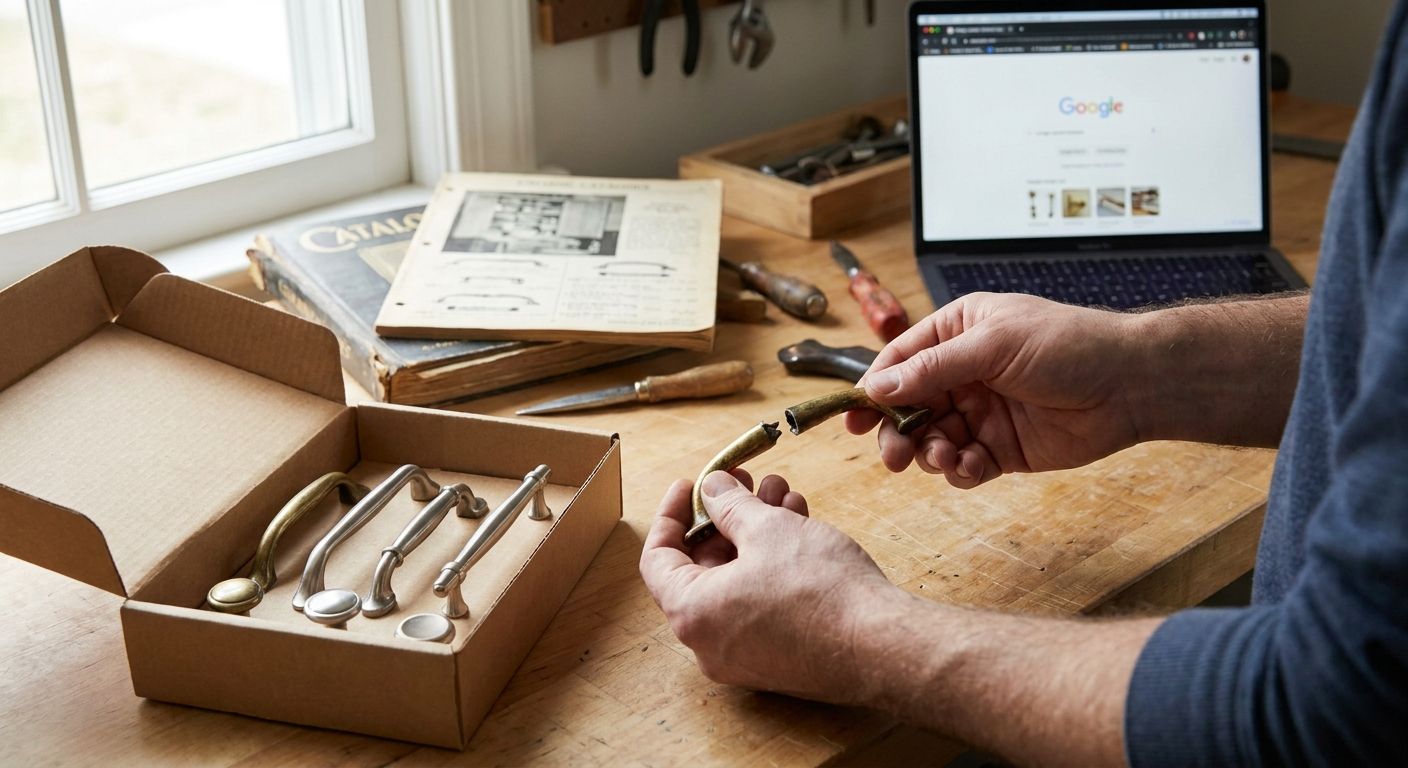
Discontinued cabinet hardware doesn't mean a dead end — it means you stop shopping by brand name and start shopping by spec. This guide walks through the exact process for tracking down cabinet hardware replacement parts, from measuring what's on your cabinet now to sourcing a cross-reference part that fits without redrilling.
Shop the finish
Every oil-rubbed bronze knob and pull we carry, in one place — filter by size, style, and brand.
Browse Oil-Rubbed Bronze Cabinet Hardware →- Match cabinet hardware replacement parts by spec — center-to-center, hole diameter, finish — not by brand name.
- Drawer slide brackets and sockets run $4 to $28 in 2026 and cross-reference across dozens of discontinued slide systems.
- Backplates solve mismatched screw holes when an exact replacement doesn't exist — buy one before you drill anything new.
- Knobs.co stocks 50,000+ SKUs across brands, so cross-shopping specs beats chasing a dead product line.
Shop the picks from this guide
In stock at Knobs.co · Free shipping on hardware orders $99+ · 110% price match
-
 Amerock
Edona 1-1/4'' diam Cabinet Knob BP53005Polished Chrome
Amerock
Edona 1-1/4'' diam Cabinet Knob BP53005Polished Chrome
$3.21
$3.77 -
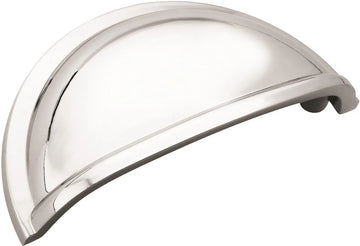 Amerock
Cup Pulls 3'' cc Cabinet Cup Pull BP53010Polished Chrome
Amerock
Cup Pulls 3'' cc Cabinet Cup Pull BP53010Polished Chrome
$4.61
$5.42 -
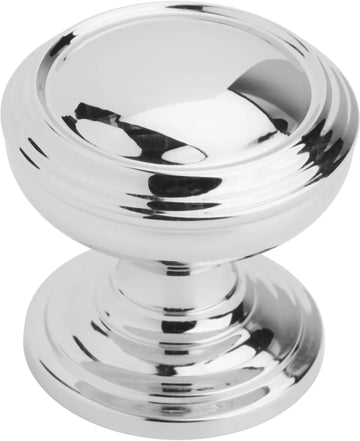 Amerock
Revitalize 1-1/4'' diam Cabinet Knob BP55342Polished Chrome
Amerock
Revitalize 1-1/4'' diam Cabinet Knob BP55342Polished Chrome
$6.42
$7.55 -
 Amerock
Edge Pull 5-1/16'' cc Cabinet Pull BP36575Polished Chrome
Amerock
Edge Pull 5-1/16'' cc Cabinet Pull BP36575Polished Chrome
$5.83
$6.85 -
 Amerock
Ravino 1-1/4'' diam Cabinet Knob BP53012Polished Chrome
Amerock
Ravino 1-1/4'' diam Cabinet Knob BP53012Polished Chrome
$2.79
$3.28 -
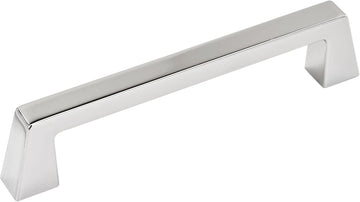 Amerock
Blackrock 5-1/16'' cc Cabinet Pull BP55277Polished Chrome
Amerock
Blackrock 5-1/16'' cc Cabinet Pull BP55277Polished Chrome
$9.63
$11.32


Why this matters
Cabinet hardware brands get bought, merged, and dropped constantly. A slide bracket, a hinge cup, or a knob backplate that shipped with your cabinets in 2016 can be gone from the manufacturer's line by 2026 with zero warning. That's not a defect in your cabinets — it's normal turnover in a fragmented hardware industry with dozens of manufacturers making functionally identical parts under different names.
The mistake most homeowners and even some contractors make is searching for the exact brand and model number, hitting a dead page, and assuming the part is unobtainable. It almost never is. Drawer slide brackets, hinge cups, and mounting plates are built to shared industry dimensions far more often than not. Once you know the measurements, Knobs.co and similar suppliers can usually cross-reference a working replacement even when the original SKU is long gone.
What you'll need
- A digital caliper or a tape measure accurate to 1/16 inch
- The old part removed or at least fully visible (don't force anything loose yet — see Step 1)
- A phone camera for close-up reference photos
- Any manufacturer markings, stamped numbers, or leftover packaging
- A finish sample or the part itself, for color matching under natural light
- 15 to 30 minutes per hardware type you're replacing
The steps
1. Identify what you actually have before you touch anything
Don't remove the failing part first — document it first. Manufacturer stamps are often on the underside of hinges, the back of drawer slide brackets, or molded into plastic sockets, and once a bracket snaps or a hinge cup gets pried out, that stamp can go with it.
Photograph the part from three angles: face-on, from the side to show depth, and a close-up of any stamped text or numbers. If you have the original cabinet paperwork or a builder's spec sheet, that's often faster than reverse-engineering from the hardware itself.
Common mistake: tossing the broken part before measuring it. Keep it until the replacement is confirmed to fit.
2. Measure the four numbers that actually matter
For knobs and pulls, you need center-to-center distance (the screw hole spacing) and hole diameter. For hinges, you need the cup diameter, the boring depth, and the overlay type (full, half, or inset). For drawer slides, you need the slide length and the mounting bracket's hole pattern.
Write these down in inches to the nearest 1/16. A pull with 3-inch centers and a pull with 3-1/8-inch centers are not interchangeable — you'll be redrilling holes if you guess wrong. Guides that walk through this properly, like measuring hole spacing before you buy, save a return shipment.
Expected outcome: four to six clean numbers you can hand to any hardware retailer and get a real answer, not a guess.
3. Search by specification, not by brand
Once you have measurements, stop searching "[Brand Name] model 4471 replacement" and start searching by spec: "3 inch center to center pull," "1-3/8 inch hinge cup," "P1700 style drawer slide bracket." Manufacturers frequently license or copy each other's mounting patterns, especially for drawer slides and concealed hinges, so a part from a different brand entirely can be a drop-in fit.
This is where cross-referencing pays off. Hickory Hardware, for example, made mounting brackets and sockets for slide systems used across multiple builder-grade cabinet lines — the P1700-W bracket and the P1056 bracket both fit specific Hickory undermount and side-mount slide families even when the original cabinet brand no longer exists.
4. Check universal brackets and sockets before assuming total replacement
Most drawer slide failures aren't the slide itself — they're the small plastic or metal bracket connecting the slide to the drawer box. Replacing a $4 to $6 bracket is a five-minute fix; replacing an entire slide system because one clip broke is overkill.
Sockets and brackets like the Hickory Hardware rear-mount socket or the P1700/BKT-W bracket are sold individually for exactly this reason — they keep a functioning slide system alive without a full teardown.


5. Order a sample before committing to a finish match
Finish is the number one reason replacement hardware gets returned. A part labeled "oil-rubbed bronze" from one manufacturer can run noticeably darker or lighter than another brand's version of the same name, and lighting in a photo never tells the whole story.
Order a physical sample and hold it against the existing hardware in the same room, same time of day. Verdict: order the sample every time — it's the cheapest insurance in this whole process.
6. Cover mismatched holes instead of forcing an exact match
If the closest cross-reference part has a slightly different hole spacing, don't force it or fill and redrill immediately. A backplate can bridge the gap between your existing screw holes and a new knob or pull, buying you access to a much wider selection of in-stock replacements. Coverage plates typically run a few inches wider than the hardware itself, which is enough to hide a 1/4-inch to 1/2-inch spacing mismatch.
7. Buy two or three extra when you find the right cross-reference
Once you've confirmed a working replacement, buy enough for every cabinet that uses that hardware plus one or two spares. The part that's in stock in 2026 might not be in stock in 2028, and reordering later means repeating this entire process from scratch.
Troubleshooting
Problem: the new bracket doesn't line up with the old screw holes. Check whether the issue is the bracket or the slide track itself — brackets often have slotted holes with a half-inch of adjustment built in. If it's genuinely off, a hinge repair plate designed for stripped or shifted holes solves this without redrilling the cabinet face.
Problem: no manufacturer stamp exists anywhere on the part. Measure and search by dimension only. Concealed hinges in particular are dimensionally standardized around 35mm cup diameters industry-wide, so an unmarked hinge almost always has a modern equivalent.
Problem: the finish looks close in photos but wrong in person. Always request a free sample before ordering the full set — comparing metal in your own kitchen light is the only reliable test.
Problem: the slide track is fine but the mounting bracket is cracked. Replace the bracket alone. Full slide replacement is rarely necessary when the failure is isolated to a $4 to $6 mounting component.
Problem: you can't find center-to-center specs anywhere for the old pull. Measure screw-to-screw distance directly with a caliper rather than relying on a model number search — it's faster and it's the number that actually matters for fit.
Tools and resources
- Digital caliper for hole diameter and spacing
- A hardware jig if you're replacing hardware across many drawers at once
- Reference photos taken before removing the old part
- A finish sample ordered ahead of full purchase
- Backplates on hand in case spacing doesn't match exactly
What to do next
If the old screw holes won't work with any available replacement, don't panic — filling and refinishing old cabinet hardware holes is a standard fix that lets you redrill in a new location without visible history on the cabinet face.
FAQ
How do I find replacement parts for discontinued cabinet hardware?
Measure the existing part's center-to-center spacing, hole diameter, and finish, then search by those specifications rather than the original brand name. Most drawer slide brackets and hinge cups are built to shared industry dimensions, so a cross-reference part from a different manufacturer often fits without modification.
Can I replace just the drawer slide bracket instead of the whole slide?
Yes, in most cases the bracket or socket is the failure point, not the slide track itself. Individual brackets cost $4 to $6 in 2026 and swap in without removing the entire slide system.
What if my cabinet hardware has no manufacturer markings?
Measure the part directly with a caliper and search by dimension. Concealed hinges are largely standardized around common cup diameters, so an unmarked hinge usually still has a current equivalent in stock.
How much do cabinet hardware replacement parts cost?
Small components like drawer slide brackets and sockets run $4 to $6, while hinge mounting kits with drill templates run around $27 as of 2026. Full knobs and pulls vary more widely depending on finish and size.
Will a backplate hide mismatched screw holes?
Yes, a backplate covers a spacing mismatch of a quarter inch to a half inch between your existing holes and a new knob or pull. It's the fastest fix when an exact replacement isn't available.
Should I order a hardware sample before buying replacements in bulk?
Always order a sample first. Finish names like "oil-rubbed bronze" vary noticeably between manufacturers, and comparing the physical part in your own lighting is the only reliable way to confirm a match.
Is it cheaper to replace all cabinet hardware or just the broken pieces?
Replacing only the failed component is almost always cheaper — a cracked bracket or worn hinge cup costs a fraction of a full hardware set. Full replacement only makes sense when you're changing the look of the kitchen anyway.
Where can I buy cabinet hardware replacement parts individually?
Retailers that stock hardware by the piece rather than only in matched sets, such as Knobs.co with 50,000+ SKUs across dozens of brands, let you buy a single bracket, socket, or hinge without purchasing an entire new set.
One last thing
The part that fails first is rarely the expensive one — it's almost always a $4 bracket or a plastic socket that never had a model number stamped on it in the first place. Measure before you order, request the free sample before you commit to a finish, and keep the old broken part in a drawer until the replacement is confirmed to fit. That habit alone eliminates most of the frustration people associate with "discontinued" cabinet hardware in 2026.


