

Cabinet Hardware for Dark Cabinets: 2026 Guide
Pick the right cabinet hardware for dark cabinets in 2026. Finish pairings, sizing rules, and what to avoid — covering brass, matte black, and brushed nickel.

Dark cabinets make one of the most unforgiving backdrops for hardware decisions — the wrong finish or scale disappears, clashes, or cheapens an expensive paint or stain job. This guide walks you through the exact decisions to make before you buy, from finish selection to sizing to common traps that catch even experienced designers.
Shop the finish
Every brass knob and pull we carry, in one place — filter by size, style, and brand.
Browse Brass Cabinet Hardware →TL;DR: Cabinet hardware for dark cabinets works best when you choose high-contrast or tone-on-tone finishes with deliberate intention, size pulls to the door height (not habit), and avoid over-polished finishes that pick up every fingerprint. In 2026, the strongest combinations on dark cabinetry are warm brass, matte black, brushed nickel, and unlacquered brass — each for different cabinet tones and kitchen styles. Knobs.co carries 50,000+ SKUs across all of these finishes, so availability is not the constraint. The right decision-making process is.
Shop the picks from this guide
In stock at Knobs.co · Free shipping on hardware orders $99+ · 110% price match
-
 Amerock
Edona 1-1/4'' diam Cabinet Knob BP53005Polished Chrome
Amerock
Edona 1-1/4'' diam Cabinet Knob BP53005Polished Chrome
$3.21
$3.77 -
 Alno
Alno A1032 1'' Brass Cabinet KnobPolished Brass
Alno
Alno A1032 1'' Brass Cabinet KnobPolished Brass
$13.46
$14.95 -
 Notting Hill Hardware
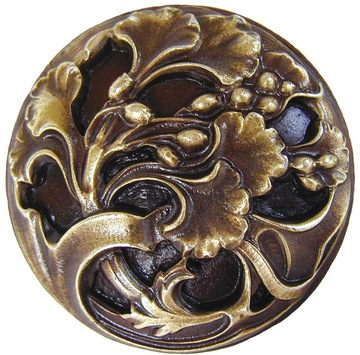
 Florid Leaves Pewter Cabinet KnobAntique Brass
Notting Hill Hardware
Notting Hill Hardware Florid Leaves Pewter Cabinet KnobAntique Brass
$38.40
$48.00 -
 Alno
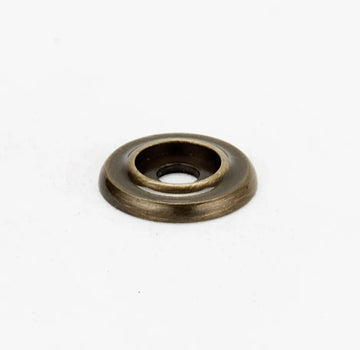
Alno A615 Brass Cabinet BackplateAntique English / 1''
Alno
Alno A615 Brass Cabinet BackplateAntique English / 1''
$8.06
$8.95 -
 Alno
Alno A726 Charlie's 3 1/2'' CC Cabinet PullAntique English / 3''
Alno
Alno A726 Charlie's 3 1/2'' CC Cabinet PullAntique English / 3''
$24.26
$26.95 -
 Alno
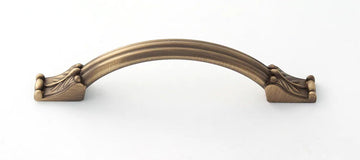
Alno A1476 Fiore 3 1/2'' CC Brass Cabinet PullAntique English Matte / 3''
Alno
Alno A1476 Fiore 3 1/2'' CC Brass Cabinet PullAntique English Matte / 3''
$24.26
$26.95


Why hardware decisions are harder on dark cabinets
Light cabinets are forgiving — almost any metal reads well against white or off-white. Dark cabinets are not. Forest green, navy, charcoal, espresso, and deep walnut all have undertones that clash with the wrong metal. A hardware choice that looks neutral on a sample chip can look greenish, orange-cast, or flat once it's mounted on 30 cabinet doors under kitchen lighting.
The 2026 design market has also shifted: dark cabinetry now represents a meaningful share of new kitchen installs and full renovations, which means there are more bad hardware choices in circulation — and more useful data on what actually works.
What you'll need
- Your cabinet color or stain name (and undertone — cool, warm, or neutral)
- The cabinet style (shaker, flat-front, raised panel, inset)
- Door height measurements for at least one upper and one lower cabinet
- A finish sample or photo under your kitchen's actual lighting
- A drill template or existing hole spacing if replacing hardware
The steps
Step 1: Identify your cabinet's undertone before choosing any finish
Every dark cabinet color has a dominant undertone that governs which metals look intentional versus accidental.
- Cool undertones (blue-grays, true charcoal, blue-black): pair with brushed nickel, polished nickel, chrome, or matte black. Warm brass or aged bronze will fight the coolness and read muddy.
- Warm undertones (navy with green, espresso brown, dark olive, deep walnut): pair with unlacquered brass, aged bronze, warm brass, or champagne bronze. Brushed nickel on warm-toned dark cabinets tends to look clinical.
- Neutral dark tones (true black, very dark gray without blue): the most flexible base — matte black for a tone-on-tone effect, or brushed nickel and warm brass both work depending on whether you want contrast or drama.
Hold a finish sample against your actual cabinet door under overhead lighting for at least 60 seconds before deciding. Lighting shifts the apparent warmth or coolness of both the cabinet and the hardware.
Common mistake: Choosing a finish from a vendor photo on a white background. The finish reads completely differently once it's on a dark surface.
Step 2: Decide between contrast and tone-on-tone
Two strategies work on dark cabinets — everything between them tends to look unresolved.
High contrast means a bright or light finish on a dark cabinet: brushed nickel, polished nickel, or warm brass on navy, forest green, or charcoal. The hardware becomes a visual feature. This works especially well on shaker-style doors where the profile already adds dimension.
Tone-on-tone means a dark finish on a dark cabinet: matte black on near-black or very dark gray cabinetry, or aged bronze on espresso or dark walnut. The hardware recedes and the cabinet becomes the statement. This reads more refined when executed correctly — but the finish still needs to be distinguishable, so pay attention to sheen level (flat vs. low-sheen) and the shape of the hardware.
In 2026, tone-on-tone is the more current approach for flat-front and integrated-style cabinetry, while contrast finishes remain dominant for shaker and transitional styles.
Common mistake: Choosing a medium-tone finish — oil-rubbed bronze that isn't quite warm enough, or a chrome that isn't quite bright enough — that neither contrasts nor blends.
Step 3: Size pulls and knobs to your door and drawer dimensions
Dark cabinets visually absorb hardware. A pull that looks proportionate on a white cabinet will look undersized on the same door in charcoal. The general rule: go one size larger than your instinct on dark cabinetry.
- Upper cabinet doors (typically 30–42" tall): pulls with a 3" to 5" center-to-center are the minimum. On taller doors, a 5" or longer pull reads correctly.
- Base cabinet drawers (typically 6"–30" wide): match pull length to roughly 1/3 of the drawer width. A 15" drawer takes a 5"–6" pull; a 30" drawer takes a 10"–12" pull.
- Knobs work best on dark cabinets when they're at least 1.25" in diameter — smaller knobs disappear against dark paint.
The Alaire Pull 8" center-to-center in matte black is a useful reference point for scale: an 8" bar pull on a standard upper cabinet door creates a deliberately modern proportion that reads well against dark finishes. Compare it against the door dimensions before ordering.
Common mistake: Ordering hardware based on the door or drawer count without measuring. Scale errors are visible from across the room.
Step 4: Match hardware finish to your other metal elements in the space
Dark kitchens concentrate the eye on every metallic surface simultaneously — faucet, lighting, appliance handles, and cabinet hardware all read as a group. They don't need to be identical, but they need to be in the same family.
- If your faucet is brushed nickel, your cabinet hardware should be brushed nickel or matte black — not warm brass.
- If your pendant lights are aged brass, warm brass or unlacquered brass hardware connects the room. Brushed nickel will create a split that reads as an error, not an intentional mix.
- Matte black is the most versatile dark-cabinet finish because it coordinates with both warm and cool metal accents without matching either directly.
Common mistake: Matching cabinet hardware to appliance trim colors. Appliance finishes (fingerprint-resistant stainless, black stainless) are not standard hardware finishes and will not match.
Step 5: Test finish durability and maintenance requirements before committing
Dark cabinets make fingerprints and water spots on hardware more visible, not less — especially on high-contrast combinations. A polished brass or polished chrome pull on dark charcoal cabinets will show every touch.
- Matte and brushed finishes (brushed nickel, matte black, satin brass) hide daily use better than polished finishes on dark cabinetry.
- Unlacquered brass develops a natural patina over time — this is intentional and appropriate on warm-toned dark cabinets, but confirm the homeowner or client understands the aging process before specifying.
- Oil-rubbed bronze and aged bronze are living finishes that also evolve slightly with use — appropriate on rustic or transitional dark kitchens, less appropriate on modern or contemporary installations.
Step 6: Order samples before committing to a full kitchen quantity
Dark cabinetry amplifies finish decisions. Before ordering hardware for 20, 30, or 50 doors, order 2–3 sample pulls or knobs in your shortlisted finishes and mount them on actual cabinet doors for 48–72 hours under real lighting conditions — morning light, overhead LED, and evening ambient light.
The finish that looked best at 10am under natural light may read differently under warm LED pendants at 7pm. This step prevents a complete re-order, which is the most common and most expensive mistake in cabinet hardware selection.
Troubleshooting
The hardware looks smaller than expected once installed. This is the most common dark-cabinet hardware complaint. Dark surfaces absorb visual weight. Order the next size up and compare — a 5" pull where you ordered 3" is almost always the correct fix.
The finish looks greenish or orange-cast on the door. Undertone conflict. The cabinet has a warm undertone and you've installed a cool-toned finish, or vice versa. Hold a finish sample under multiple light sources to identify the mismatch, then try the opposing temperature.
Hardware looks cheap even though it's from a quality brand. Usually a sheen problem. High-gloss finishes on dark cabinetry can look plastic. Switch to a matte or satin version of the same finish and the perceived quality improves immediately.
Existing hole spacing doesn't match the new pull's center-to-center. Do not fill and re-drill without a plan. Measure the existing spacing first. If the new pull is longer, you can often cover old holes with the pull's base plate. If the center-to-center is genuinely wrong, use a backplate — Knobs.co carries backplates in multiple sizes that solve this without patching.
Matte black hardware shows dust more than expected on dark cabinets. This is a flat-finish characteristic, not a defect. Wipe with a dry microfiber cloth weekly. Do not use polish or oil-based cleaners on matte black — they will create uneven sheen patches that are visible against dark cabinets.
Two-tone cabinets (dark lowers, light uppers) — which finish to use? Use one finish throughout. The hardware finish should coordinate with the darker, more dominant cabinet color. Switching finishes between upper and lower runs makes the space feel chaotic. See matte black pulls for dark green cabinets for a worked example of a two-tone scenario.
Tools and resources
- Drill template or hole-spacing jig (required if drilling new holes)
- Microfiber cloth for test-mounting without permanent installation
- Finish samples from Knobs.co (available across Atlas Homewares line)
- Measuring tape and door height log before ordering
- How to measure cabinet pull hole spacing — use this before any new-hole installation to avoid placement errors
What to do next
Once you've confirmed finish and scale, the next decision is whether to use knobs, pulls, or a combination — and where each belongs on the cabinet layout. For dark vanity cabinetry specifically, the sizing and finish rules shift slightly because bathroom lighting is different from kitchen lighting. See the detailed guidance on brushed nickel cabinet hardware for bathrooms as a starting point for that environment.
FAQ
What finish looks best on dark cabinets in 2026? Warm brass, matte black, and brushed nickel are the three most versatile finishes for dark cabinets in 2026. Warm brass works best on cabinets with warm undertones (navy, forest green, espresso). Matte black works across nearly all dark cabinet colors. Brushed nickel is strongest on cool-toned dark grays and charcoals.
Should cabinet hardware be lighter or darker than dark cabinets? Either approach works — the critical thing is to commit to one direction. High-contrast (light hardware on dark cabinet) reads as a design statement. Tone-on-tone (dark hardware on dark cabinet) reads as sophisticated restraint. A finish that is merely slightly different from the cabinet color looks like an error.
How do I choose between knobs and pulls for dark cabinets? Pulls generally read better on dark cabinetry because they have more visual surface area and are less likely to disappear against a dark background. Knobs work on dark cabinets when they are sized at 1.25" diameter or larger and have a distinct shape. Many designers use pulls on drawers and knobs on doors throughout the same dark kitchen.
Is matte black hardware too dark for dark cabinets? No — tone-on-tone is a deliberate design strategy, not a mistake. Matte black on very dark gray or black cabinetry creates depth and sophistication. The key is that the hardware's shape remains distinguishable from the door profile. Avoid matte black on dark cabinets when the door style is also very flat and has no detail, as the hardware can disappear entirely.
What size pulls should I use on dark base cabinet drawers? As a general rule in 2026, size pulls to approximately one-third of the drawer width. A 24" drawer takes an 8" pull; a 30" drawer takes a 10" to 12" pull. On dark cabinets, err toward the longer end of any sizing range — dark backgrounds make hardware read smaller than it measures.
Can I mix warm brass and matte black hardware on dark cabinets? Yes, but only in a structured way — not randomly across the kitchen. A common approach is matte black on upper cabinets and warm brass on lower cabinets in a two-tone kitchen. Mixing the two finishes on the same run of cabinets reads as inconsistency rather than intentional design.
Do polished finishes work on dark cabinets? Polished nickel and polished chrome can work on dark cabinets as a high-contrast choice, but they show fingerprints significantly more than matte or brushed alternatives. In a high-use kitchen, a brushed version of the same metal finish is almost always the better practical choice on dark cabinetry.
How many hardware samples should I order before committing to a full kitchen? Order at least 2–3 pulls or knobs in your top finishes before placing a full order. Mount them on actual doors and evaluate under kitchen lighting — morning, overhead, and evening. One $15–$30 sample investment prevents a complete re-order on a 30-door kitchen.
One last thing
The single most useful thing a hardware salesperson or designer can tell you — and rarely does — is this: the render lied. Digital renderings of dark kitchens almost always show hardware at artificially high contrast because the rendering engine can't replicate how kitchen lighting flattens finishes against dark surfaces. In 2026, with more photorealistic kitchen planning tools than ever, this is still the most common reason clients are surprised by hardware that looks different than expected. Order samples. Mount them on the actual door. Look at them at 7pm under the lights that will be on every night.
Related guides
- Matte black pulls for dark green cabinets
- Mid-century modern hardware for walnut cabinets
- Brushed nickel pulls for navy blue cabinets
Shop Brass Cabinet Hardware
-
 Belcastel 1-3/8'' diam Mushroom Knob MO6303ABM-D
$8.43
Belcastel 1-3/8'' diam Mushroom Knob MO6303ABM-D
$8.43
-
 Lafayette 96 mm cc Bar Pull 317-96ABSB
$17.90
Lafayette 96 mm cc Bar Pull 317-96ABSB
$17.90
-
 Lafayette 128 mm cc Bar Pull 317-128ABSB
$19.91
Lafayette 128 mm cc Bar Pull 317-128ABSB
$19.91
-
 Lafayette 1-3/8'' diam Mushroom Knob 218ABSB
$13.61
Lafayette 1-3/8'' diam Mushroom Knob 218ABSB
$13.61
-
 Milan 96 mm cc Bar Pull 1092AEM
$11.69
Milan 96 mm cc Bar Pull 1092AEM
$11.69
-
 Belcastel 18'' cc Appliance Pull MO6373-18ABM-D
$189.18
Belcastel 18'' cc Appliance Pull MO6373-18ABM-D
$189.18
-
 Belcastel 160 mm cc Bar Pull MO6373-160ABM-D
$16.67
Belcastel 160 mm cc Bar Pull MO6373-160ABM-D
$16.67
-
 Belcastel 128 mm cc Bar Pull MO6373-128ABM-D
$13.86
Belcastel 128 mm cc Bar Pull MO6373-128ABM-D
$13.86


Browse all 3349 in Brass Cabinet Hardware → Cabinet knobs Cabinet pulls & handles