

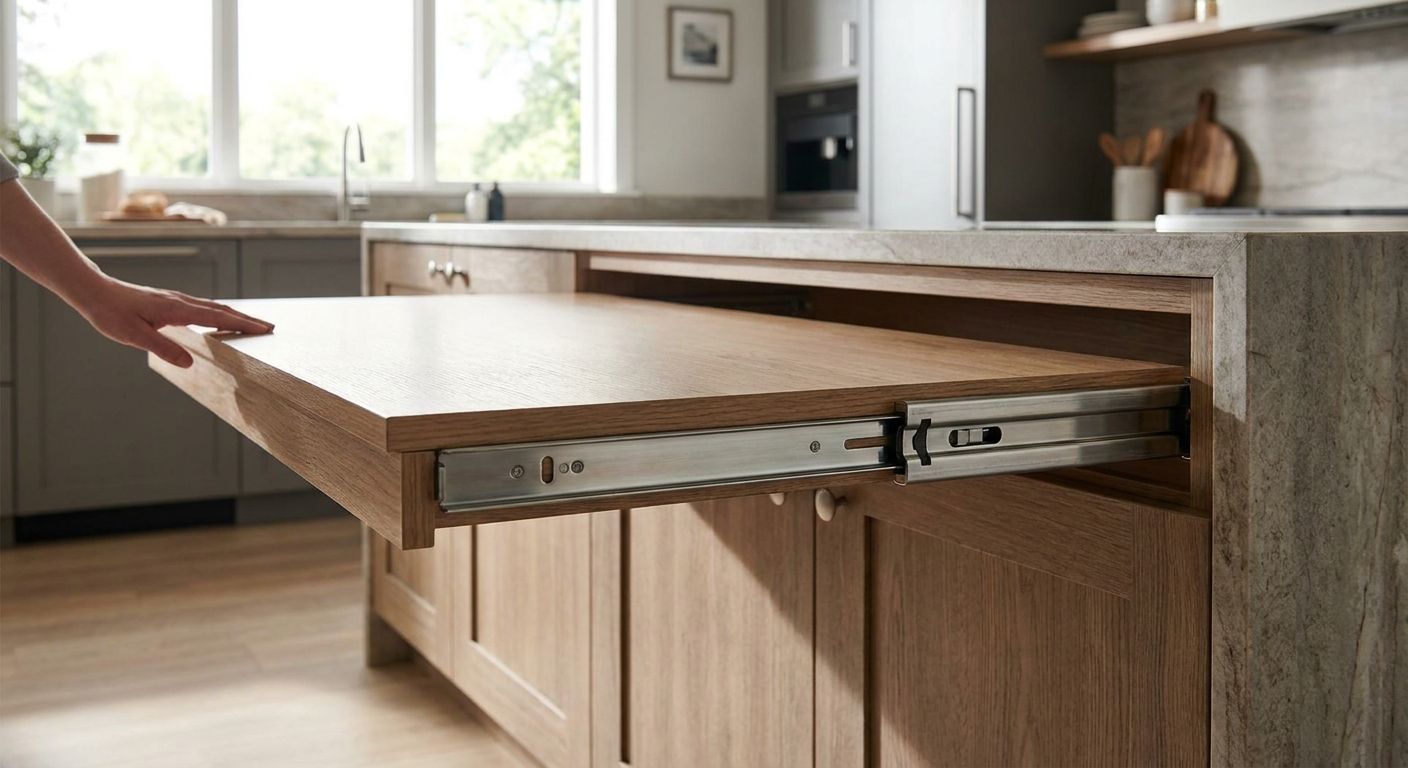
Pull-out table hardware for kitchen islands is the slide, bracket, and pull system that lets a hidden or fold-away table extend from an island's end panel, turning a fixed island into flexible seating without adding a permanent dining table. Homeowners shopping this category in 2026 aren't furniture builders — they need hardware that's strong enough for a person's forearms and dinner plates, not just a drawer of spoons, and simple enough to retrofit into an island that already exists.
- Pull-out table hardware for kitchen islands needs full-extension slides rated for body weight, not light-duty drawer slides.
- Knobs.co stocks the bracket and slide-socket hardware that reinforces a DIY pull-out table build in 2026 — buy the reinforcement pieces, not a kit.
- Match the tabletop pull finish to your island's existing cabinet hardware for visual continuity at the one spot guests touch.
- Bar pulls in the 8 to 16 inch range read best on wide table fronts; anything shorter looks undersized on a full table edge.
Why this matters for kitchen island owners
A fixed island overhang gives you two stools and a countertop. A pull-out table for a kitchen island gives you overflow seating, a homework surface, or a folding prep extension you tuck away when the kitchen goes back to normal. That flexibility only works if the hardware underneath is built for repeated, weight-bearing extension — not the same slide you'd put under a silverware drawer.
This segment cares about two things a generic cabinet-hardware buyer doesn't: load capacity under real body weight, and finish continuity, because a pull-out table sits at eye level next to the rest of the island's pulls and knobs. Get either wrong and the fix means re-drilling holes in a table nobody wants to redo twice.
How to get pull-out table hardware right
Measure your island depth and clearance
Before you shop hardware, confirm the island has room to give up. A full-extension slide travels the entire length of its own track, so a 20-inch tabletop needs roughly 20 inches of clear cavity behind the panel it emerges from.
- Measure island depth from the panel face to any interior obstruction (plumbing, outlets, drawer boxes)
- Confirm counter height — 36 inches is the standard kitchen counter height, so your table should land close to that for seated comfort
- Check for 15 to 18 inches of knee clearance once the table is extended, the standard seating overhang guideline
- Note whether the panel is structural (attached to the island frame) or decorative (removable end cap) — structural panels need reinforced brackets
Choose the right slide mechanism
This is the step where most DIY pull-out tables fail. Full-extension ball-bearing slides carry weight ratings that commonly run 75 to 100 pounds per pair in the cabinet hardware world — a light-duty slide rated for a utensil drawer will bow under a table loaded with plates and elbows.
- Pick full-extension (not 3/4-extension) slides so the entire tabletop clears the cabinet opening
- Confirm the weight rating covers a seated adult leaning on the table's edge, not just the tabletop's own weight
- Buy slides in matched pairs from the same production run — mismatched slides bind and drag
- Add a rear-mount socket where the manufacturer specifies one; skipping it is the single most common cause of a wobbly extension
Reinforce the substructure before you mount anything
A table gets more downward stress at full extension than any drawer ever will, so the substructure needs backup, not just a stronger slide.
- Add a center support bracket if the tabletop spans more than 24 inches
- Check the island's own legs and levelers — a wobbly island frame transfers straight into a wobbly table
- Use screws sized for the tabletop's actual thickness, not the screws that ship with a standard 3/4-inch cabinet door
- Reinforce the panel the slide mounts to with a cleat if it's thinner than 3/4 inch
Decide between a full pull-out table and a pop-up mechanism
Not every island needs the same hardware. A full slide-out table works when there's floor clearance for the tabletop to swing or extend flat; a pop-up or lift mechanism works better when floor space is tight. For anyone renovating a small galley kitchen, the same logic that governs space-saving tools for small kitchens applies here — the goal is maximum function in minimum footprint, whether that's a slide-out table or a compact appliance that tucks away.
| Option | Best For | Key Limitation |
|---|---|---|
| Full-extension slide-out table | Occasional overflow seating or a folding craft/homework surface | Needs clear cavity equal to the tabletop's full depth |
| Pop-up or lift mechanism | Small islands with limited floor clearance for a swung table | More moving parts, more maintenance than a straight slide |
| Fixed pull-out shelf (non-table) | Quick prep surface, not seating | Won't support a full dining top or sustained weight |
Verdict: full-extension slides paired with a reinforced bracket win for anyone seating more than one person; a pop-up mechanism only earns its added complexity when floor space genuinely won't allow a swing-out table.
Select the pull hardware for the tabletop front
The pull on a pull-out table gets more daily grip pressure than any other pull in the kitchen — it's how the whole assembly gets opened and closed. A Top Knobs Amwell bar pull or similar bar-style pull in the 8 to 16 inch range gives you enough leverage across a wide table edge, unlike a small knob that concentrates all the pulling force on one point.
- Choose a bar pull over a knob for anything wider than 18 inches — leverage matters more than style here
- Match the pull's finish to the rest of the island's hardware so the table doesn't read as an afterthought
- Confirm the pull's screw length against the tabletop's actual thickness before ordering
- Avoid oversized, heavily textured pulls that snag clothing during frequent daily use
Install and test under real load, not just an empty slide
A slide that glides smoothly with nothing on it can still bind once a table's worth of weight is added.
- Test the full extension with a few place settings and two people leaning on the edge, not just an empty pass
- Check for sag at full extension after 24 hours under load, not just immediately after install
- Re-torque all bracket screws after the first week of use — wood substrates settle
- Confirm the slide returns fully flush when retracted; a gap invites dust and snagging
Once the mechanism is installed and tested, the reinforcement hardware behind the scenes — the sockets, brackets, and mounting guides — does more to prevent a sagging table in 2026 than any decorative choice up front.


Common mistakes homeowners make with pull-out table hardware
- Using decorative-only slides rated for a utensil drawer on a table meant to hold plates and a person's forearms — the slide sags within months, not years.
- Skipping the center support bracket on anything spanning more than 24 inches, which is exactly where sag shows up first.
- Mismatching the pull finish against the rest of the island's hardware, breaking continuity at the one detail every guest touches.
- Ignoring knee clearance math and ending up with a table that lands a few inches off standard 36-inch counter height, which makes seated use awkward.
- Ordering a single slide instead of a matched pair from the same production run, which causes binding and uneven extension.
FAQ
What is pull-out table hardware for a kitchen island?
It's the slide, bracket, and pull assembly that lets a hidden tabletop extend from an island's end panel for extra seating or workspace. The core component is a full-extension drawer slide rated for weight-bearing use, not a light-duty slide.
How much weight can pull-out table slides hold?
Full-extension ball-bearing slides commonly used in cabinet hardware carry ratings around 75 to 100 pounds per pair. Confirm the rating covers a seated adult leaning on the edge, not just the tabletop's own weight.
Is a pull-out table better than a fixed island overhang for seating?
A pull-out table adds flexible, occasional seating without permanently reducing counter space, while a fixed overhang is simpler but static. Choose the pull-out route when the kitchen needs to flex between prep space and dining space.
What size bar pull works best on a pull-out table front?
Bar pulls in the 8 to 16 inch range give enough leverage across a wide table edge without concentrating force on one point. A small knob works against you on anything wider than about 18 inches.
Can I retrofit pull-out table hardware into an existing island?
Yes, as long as the panel the slide mounts to is structural or can be reinforced with a cleat. Measure the interior cavity depth first — the slide needs clear space equal to the tabletop's full length.
How much clearance do I need for a pull-out table mechanism?
Plan for clear cavity depth equal to the tabletop's length behind the panel, plus 15 to 18 inches of knee clearance once extended. That knee clearance figure is the standard seating overhang guideline used across kitchen design.
Do pull-out tables need soft-close hardware?
Soft-close isn't required but reduces wear on a mechanism that gets opened and closed daily. A soft-close slide is worth the small added cost on any table used for regular seating.
What finish should I choose for pull-out table pulls?
Match whatever finish already runs across the rest of the island's cabinet hardware. A table pull in a different finish reads as an afterthought since it sits at eye level next to everything else.
One last thing
The screw length that ships with most decorative pulls is sized for a standard 3/4-inch cabinet door, not a full-thickness pull-out tabletop. Measure the tabletop material before ordering hardware in 2026, or you'll be making a second trip for longer screws once the first ones bottom out short of the pull's post.