

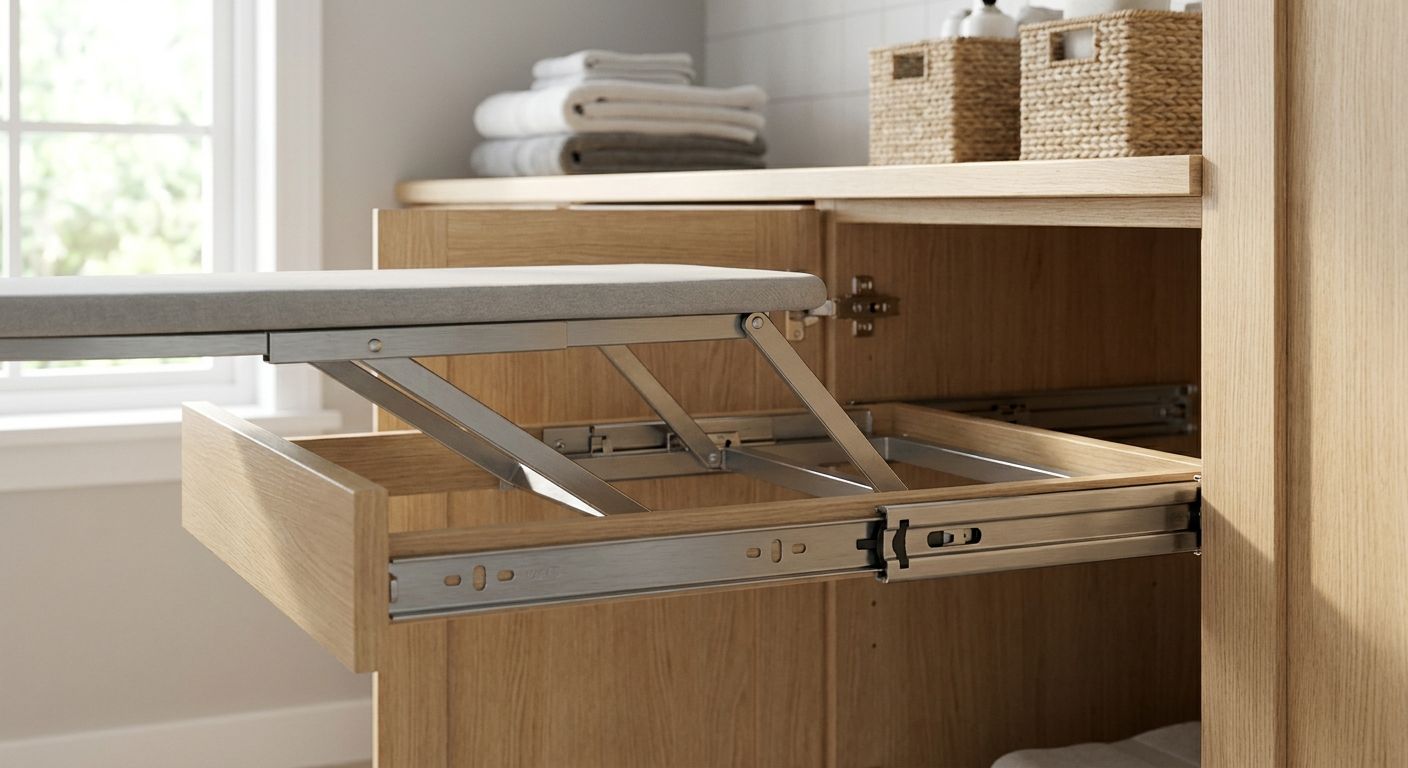
Pull-out ironing board hardware for laundry cabinet renovators is a pivot bracket and slide assembly that stores a wall- or cabinet-mounted ironing board flat when not in use, built to survive tight utility-room clearances and moisture near the washer. Laundry cabinets run narrower and sit closer to plumbing and appliance doors than kitchen cabinets, so the slide-and-bracket combination has to clear water lines, dryer vents, and washer doors that a kitchen pull-out never has to deal with.
- A face-frame pivot bracket with a wire-mounted board fits shallow wall cabinets; skip it if the board carries a steam station.
- Full-extension ball-bearing slides on a plywood subframe carry a mounted board and iron without sagging over years of daily use.
- Knobs.co stocks the drawer slide hardware and mounting brackets that make a laundry cabinet ironing board pull-out possible in 2026.
- Repurposing a 45-inch pantry door pull-out unit works in narrow wall cabinets, not base cabinets deeper than the unit's rated depth.
Why pull-out ironing board hardware matters for laundry cabinet renovators
Laundry rooms shrink every remodel cycle in 2026 as builders push square footage toward kitchens and primary suites, which means a fixed ironing station eats space most households can't spare. A pull-out or fold-down board solves that by living inside a cabinet cavity until you need it, then locking flat against a wall or drawer front when you're done.
The segment building these isn't buying a single SKU off a shelf. They're assembling a pivot bracket, a load-rated slide, and a mounted board, usually inside cabinetry that already exists. That means the hardware has to match cabinet depth, door swing, and wall clearance exactly, not just "fit a standard opening." Get the laundry room cabinet hardware picks wrong and the board either won't clear the washer door or won't hold its own weight after a year of daily folding.
Build a pull-out ironing board into a laundry cabinet
Measure your cabinet cavity
Before ordering anything, measure the space you're building into. Laundry cabinets typically run 12 inches deep for wall units and 24 inches deep for base units, and those standard depths dictate which slide length and bracket reach will actually work.
- Interior cavity depth and width, not the face-frame opening
- Distance from the cavity to the nearest appliance door swing
- Height of the mounting point relative to the ironing surface you want
- Wall or stud clearance behind the cabinet for a pivot bracket
- Board length when folded out, measured against the room's walkway width
Choose your slide hardware
A full-extension, ball-bearing drawer slide carries the load better than a friction-fit rail, and it's the difference between a board that glides out clean and one that binds after six months of steam and lint.
- Rate the slide for the combined weight of the board, the padded cover, and the iron itself, not the board alone
- Pick full-extension over three-quarter extension so the board clears the cabinet face completely
- Match slide length to cavity depth; most laundry base cabinets take a 20- or 22-inch slide
- Mount the slide to a 3/4-inch plywood subframe, not directly to thin cabinet sides, for a stable pivot point
- Check that the slide's finish tolerates the humidity near a washer and dryer
Mount the pivot bracket
The pivot bracket lets the board swing out from vertical storage into a horizontal working position. Get the pivot point wrong and the board either won't lock flat or swings past 90 degrees and hits the adjacent cabinet.
- Center the bracket on the board's balance point, not its geometric center
- Use a positive-stop catch so the board can't swing past your intended angle
- Reinforce mounting screws into a stud or plywood backer, never drywall alone
- Test the swing arc empty before mounting the board permanently
- Add a rubber or felt bumper where the board contacts the cabinet frame to cut noise and wear
Add or repurpose a pull-out carrier
If you'd rather skip building a custom bracket, a pull-out pantry-door unit gives you a ready-made carrier frame that a board mounts to directly. The Rev-A-Shelf 45-inch pantry door pull-out unit is built for narrow wall cabinets and works as a carrier frame for a board of similar length, provided the board's finished weight stays within what the unit's shelving is rated to hold.
- Confirm the unit's rated depth matches your cabinet before ordering
- Check clearance for the pull-out arm's full swing radius
- Verify the board's finished weight against what the carrier is designed to hold, including any padded cover
- Skip this route if your cavity runs deeper than 12 inches; a straight slide-and-bracket build fits better
Finish and hardware-match the front
- Pick a pull or knob finish that matches the rest of the laundry cabinetry so the ironing board door doesn't read as a retrofit
- Use a pull with enough projection to open the board one-handed, since the other hand is usually full of laundry
- Match screw-hole spacing to the door thickness so the pull doesn't bind against the fold-out mechanism
- Consider a touch-latch if you want a handle-free front for a flush laundry wall
Test the full cycle before you close the wall
- Extend and retract the slide fully at least ten times before finishing trim
- Load the board with a standard iron and check for sag at full extension
- Confirm the door or drawer front closes flush with neighboring cabinets
- Check that nothing rubs, squeaks, or binds through the full swing
“Size the slide for a padded board plus a steam iron, not the board alone, or it sags within months.”
Comparison: pull-out ironing board hardware options for laundry cabinets
| Option | Best for | Key limitation |
|---|---|---|
| Face-frame pivot bracket + wire-mounted board | Shallow wall cabinets under 12 inches deep | Manual pivot only, no soft-close or slide assist |
| Full-extension ball-bearing slide + plywood subframe | Base cabinets 20-24 inches deep carrying a padded board | Needs a custom subframe; won't drop into a stock cabinet as-is |
| Repurposed pantry-door pull-out unit | Narrow wall cabinets where a ready-made carrier saves build time | Rated for the unit's shelving load, not a full station with a steam iron |
| Wall-mounted fold-down bracket, no slide | Laundry rooms with no spare cabinet cavity | Board stays visible against the wall when stowed; no concealed storage |
For most laundry cabinet retrofits in 2026, the full-extension slide on a plywood subframe is the build that survives daily use. The face-frame bracket works fine for light, occasional ironing, and the pantry-door carrier is the fastest install when your cabinet matches its rated depth.
Common mistakes laundry cabinet renovators make with ironing board hardware
- Undersizing the slide's weight rating. A padded board plus a steam iron adds up fast, and a slide sized for a normal drawer sags within months under that combined load.
- Ignoring appliance door swing. A washer or dryer door opening into the same footprint as the board's pull-out arc turns a convenience feature into a daily obstruction.
- Mounting hardware into drywall alone. The pivot point takes repeated stress every time the board folds out; without a stud or plywood backer, screws work loose within a year.
- Skipping a positive-stop catch. Without one, the board swings past its intended angle and slams into the adjacent cabinet or wall trim.
- Treating finish as an afterthought. A mismatched pull or hinge finish on the ironing board door in an otherwise coordinated 2026 remodel is the fastest way to make a custom build look bolted-on.
FAQ
What is pull-out ironing board hardware?
It's a pivot bracket and slide assembly that lets a mounted ironing board fold flat into a cabinet cavity and pull out flush for use. The mechanism combines a load-rated drawer slide with a swing bracket, not a single off-the-shelf part.
Can I add a pull-out ironing board to an existing laundry cabinet?
Yes, as long as the cavity depth and wall clearance can fit a slide and pivot bracket. Base cabinets around 24 inches deep handle a full slide-and-subframe build; wall cabinets around 12 inches deep usually need a lighter bracket-only setup.
What slide length works best for a laundry cabinet ironing board?
Most laundry base cabinets take a 20- or 22-inch full-extension slide, matched to the cavity depth measured to the interior wall. Always size the slide's weight rating for the board plus a steam iron, not the board alone.
Is a pantry-door pull-out unit strong enough for an ironing board?
Only if the board's finished weight, including any padded cover, stays within what the unit's shelving is rated to hold. The Rev-A-Shelf 45-inch pantry door pull-out unit works as a carrier frame in narrow wall cabinets, not deep base cabinets.
How deep does a laundry cabinet need to be for a pull-out ironing board?
A base cabinet around 24 inches deep gives room for a full slide-and-bracket build with a padded board. Anything shallower than 12 inches limits you to a wall-mounted fold-down bracket without a slide.
What finish should I match on the ironing board cabinet hardware?
Match whatever finish runs through the rest of the laundry cabinetry so the retrofit door doesn't stand out. Knobs.co carries pulls and knobs across dozens of finishes to match an existing laundry room build.
Do I need soft-close hardware on an ironing board pull-out?
It's not required, but a soft-close slide or a positive-stop catch prevents the board from swinging past its intended angle and slamming into the cabinet frame. That matters more here than on a standard drawer since the board travels farther.
How much weight does ironing board pull-out hardware need to hold?
Size the slide for the combined weight of the board, any padded cover, and the iron itself, since that combination exceeds a bare board's weight quickly. A slide rated only for the board alone is the most common failure point in these builds.
One last thing
Most laundry cabinet ironing board failures trace back to one decision: sizing hardware for the board alone instead of the board plus a loaded iron and cover. If you remember one thing from this guide, size the slide and bracket for the full working load, not the empty board, and match the cabinet depth to the mechanism instead of forcing wall-cabinet hardware into a base cabinet or the reverse. That single check saves more laundry cabinet retrofits in 2026 than any finish or pull choice ever will.