

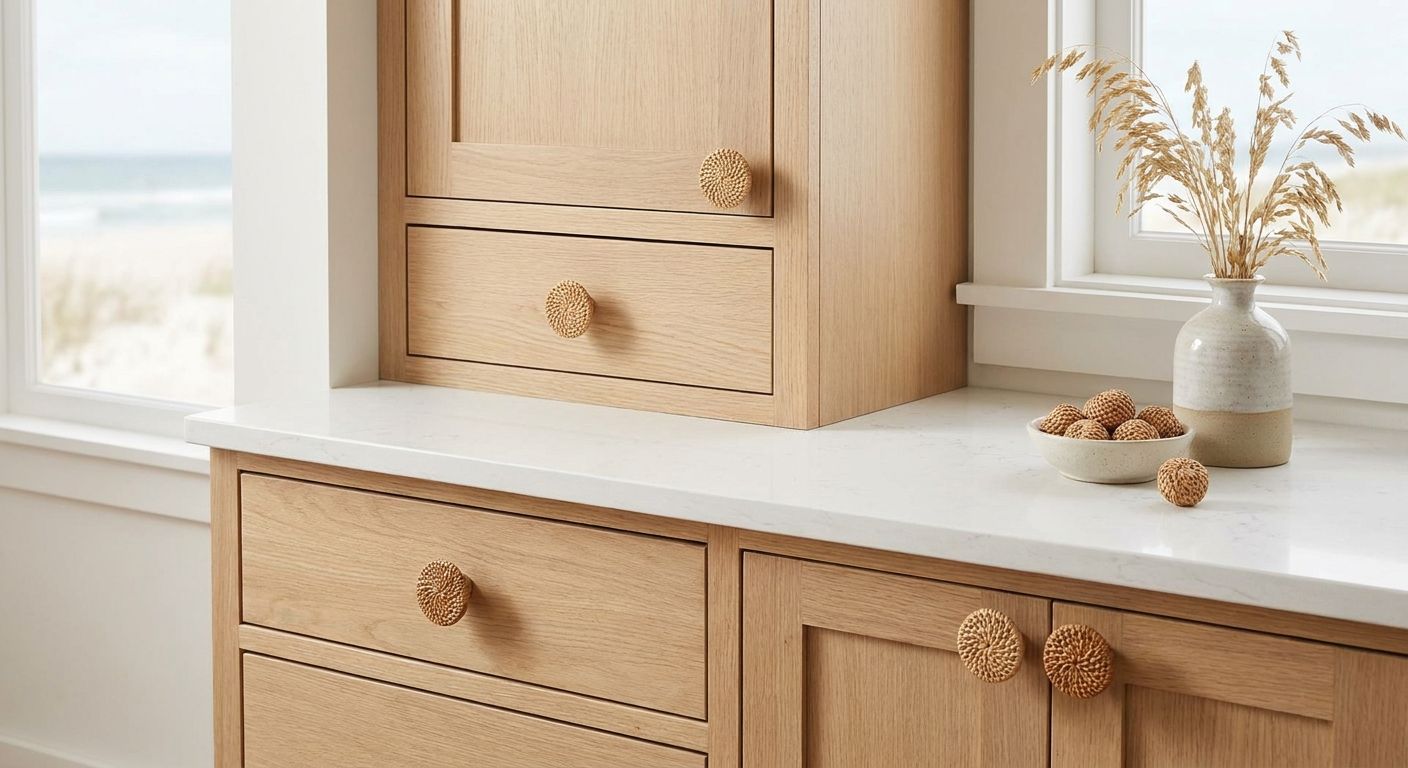
Rattan cabinet knobs are woven or rattan-textured cabinet hardware designed to bring a natural, hand-crafted look to coastal, cottage, and beach-house kitchens without replacing the cabinet boxes. Homeowners in this segment are usually pairing them with light oak, whitewashed, or Shaker-style cabinets and want the texture to read as natural fiber, not as another metal finish.
- Rattan cabinet knobs work best on low-splash zones like islands and pantry doors, not sink-adjacent cabinets.
- Real rattan wicks moisture; resin or wire-look metal pulls hold up better near a kitchen sink in 2026.
- Standard cabinet knob diameter runs 1-1/4 to 1-3/8 inches — order a sample before buying a full set.
- Pair warm wicker tones with satin brass or aluminum finishes, not cool matte black, for a cohesive coastal kitchen.
Why rattan cabinet knobs matter for coastal kitchens
Coastal kitchen buyers aren't shopping for hardware the way a modern-kitchen renovator does. They're chasing texture and warmth over shine, which is why woven and natural-fiber-look hardware keeps showing up in beach-house and cottage kitchen mood boards alongside light wood tones and linen finishes. That preference for texture over polish is exactly what makes rattan cabinet knobs a distinct category from standard brushed or matte hardware.
The trade-off this segment runs into is durability. A kitchen has grease, steam, and constant hand contact — three things natural rattan doesn't love. Knobs Co stocks 50,000+ SKUs across dozens of brands, which means the coastal-kitchen buyer usually has more than one route to the woven look: true rattan for low-contact spots, and rattan-textured resin or metal for everything that touches water and grease daily.
How to choose and install rattan cabinet knobs
Define the coastal palette before you shop hardware
Hardware should match the room's undertone, not fight it. Pull your palette together first so you're not guessing at knob color against a swatch board later.
- Note your cabinet finish (whitewashed oak, painted linen, driftwood gray)
- Pick one dominant metal accent — warm brass, aluminum, or aged bronze
- Decide if the woven texture is the star or a supporting detail
- Pull 2-3 reference photos of finished coastal kitchens for comparison
- Check how your countertop and backsplash read next to a warm tan tone
Match the material to where the knob actually lives
Not every cabinet door sees the same wear. A pantry door gets touched dry; a sink-base cabinet gets touched wet, greasy, and often.
- Real rattan or rope-wrap knobs: pantry doors, islands, low-traffic uppers
- Resin or faux-rattan knobs: anywhere near the sink, stove, or dishwasher
- Wire-look metal pulls (like a satin aluminum advantage wire pull) for full kitchen durability with a woven silhouette
- Ceramic cottage-style knobs as a non-fiber alternative that still reads coastal
- Skip natural fiber entirely in high-humidity coastal homes without air conditioning
Size the knob to the door, not just the style
Rattan cabinet knobs come in the same standard sizing as any other cabinet knob, and sizing mistakes are the fastest way to make a coastal kitchen look off-balance.
- Standard cabinet knob diameter runs 1-1/4 to 1-3/8 inches
- Drawer fronts under 24 inches wide generally read better with a single centered knob
- Wider drawers (30+ inches) usually call for a bar pull instead of a knob
- Confirm screw length against your door and drawer front thickness before ordering in bulk
- Check projection (how far the knob sits off the door) against how the cabinet opens against an island or wall
Coordinate the finish across the whole kitchen
A woven knob on its own reads as an accent. A woven knob next to five different metal tones reads as clutter. Choosing the right hardware finish before you buy is the step most coastal remodels skip.
- Pick one metal accent for the whole kitchen — hinges, faucet, and pulls included
- Warm wicker tones pair naturally with satin brass, aged gold, or aluminum
- Avoid cool matte black next to warm rattan; the contrast reads harsh, not coastal
- Use a single wire or bar pull style on appliance panels to break up an all-knob kitchen
- Test the pairing under your actual kitchen lighting, not showroom light
Order samples before committing to a full kitchen
A rattan-style knob photographs differently than it feels in hand, and color varies more between dye lots on natural fiber than on powder-coated metal. Buying 30-40 knobs sight unseen from a photo is the single most common regret in this category.
- Order 2-3 finish samples before buying the full quantity
- Hold the sample against your actual cabinet door in daylight
- Check the knob's undertone against your countertop, not just the cabinet
- Confirm the backplate size if the knob comes with one
- Compare weight and grip feel, not just look, if kids or elderly household members use the kitchen daily
Install with the right screw length and spacing
Rattan and rattan-look knobs mount the same way standard cabinet knobs do, but the wrap or resin coating can hide a loose fit if the screw is even slightly off.
- Measure door and drawer thickness before selecting screw length
- Center knobs on drawer fronts under 24 inches
- Use a jig for repeat placement across more than 10 doors
- Snug the screw by hand first to avoid cracking resin or splitting a rattan wrap
- Re-check alignment after the first week; natural fiber can shift slightly as it settles
Comparing hardware options for a coastal kitchen
| Option | Best for | Key limitation |
|---|---|---|
| Natural rattan or rope-wrap knobs | An authentic, hand-crafted coastal-cottage look | Wicks moisture and frays with heavy daily kitchen contact |
| Resin or faux-rattan knobs | Kitchens needing daily wipe-downs near water and grease | Texture reads flatter up close than real fiber |
| Wire-look metal pulls (satin aluminum, brass) | Buyers who want the woven silhouette with full metal durability | Missing the warm, natural-fiber feel purists want |
| Ceramic cottage-style knobs | Coastal-cottage or farmhouse-adjacent kitchens | Heavier and more prone to chipping if dropped |
| Ring or drop-bail pulls in aged finishes | Vintage or beach-house-grandmother styling | Less common fit on modern flat-front cabinet doors |
Verdict: real rattan belongs on low-contact doors, everything within reach of the sink or stove should be resin, metal, or ceramic.
Common mistakes coastal kitchen buyers make
- Installing real rattan directly behind the sink or next to the range, where steam and grease shorten its life fast
- Mixing warm wicker tones with cool matte black hardware and expecting the contrast to look intentional
- Skipping the sample step and ordering 30+ knobs before confirming the undertone in person
- Choosing an oversized knob for a narrow Shaker rail because it looked right in a product photo, not on the actual door
- Forgetting screw length varies by door thickness, leading to a wobbly knob after the first month of use
FAQ
What are rattan cabinet knobs made of?
Rattan cabinet knobs are made from woven natural rattan, rope-wrapped hardware, or resin and metal cast to mimic a woven texture. The resin and metal versions hold up better in a kitchen environment than true natural fiber.
Are rattan cabinet knobs durable in a kitchen?
Real rattan is not the most durable choice near a sink, stove, or dishwasher because it wicks moisture and can fray. Resin or metal wire-look pulls give the same woven look with far better daily durability in 2026 kitchens.
What's the best alternative to real rattan for a coastal kitchen?
A satin aluminum wire-look pull or a resin knob styled to mimic woven texture is the best alternative. Both hold up to grease and water while keeping the coastal, natural-fiber look intact.
Do rattan-style knobs work with brushed nickel or matte black hardware?
Rattan knobs pair better with warm finishes like satin brass, aged gold, or aluminum than with cool-toned brushed nickel or matte black. The warm-cool contrast tends to read as mismatched rather than coastal.
Can I mix rattan knobs with metal bar pulls in the same kitchen?
Yes, and it's a common coastal-kitchen pairing — rattan or rattan-look knobs on doors and drawer fronts, with a matching-tone metal bar pull on appliance panels or wider drawers.
How do I clean woven or rattan-style cabinet hardware?
Wipe resin and metal rattan-look knobs with a damp cloth as needed. Real rattan should stay dry and get spot-cleaned only, since standing water or heavy scrubbing breaks down the fiber over time.
What size cabinet knob should I buy for a coastal kitchen?
Standard cabinet knob diameter runs 1-1/4 to 1-3/8 inches, which fits most Shaker and flat-front coastal cabinet doors. Confirm screw length against your door thickness before ordering a full set.
One last thing
Bathroom vanities are the easiest place to run real rattan in a coastal home — far less grease and steam exposure than a kitchen, and the woven texture still reads against a light vanity top. Save the natural fiber for the room that won't punish it, and let resin or metal carry the look everywhere the kitchen actually gets used.


