

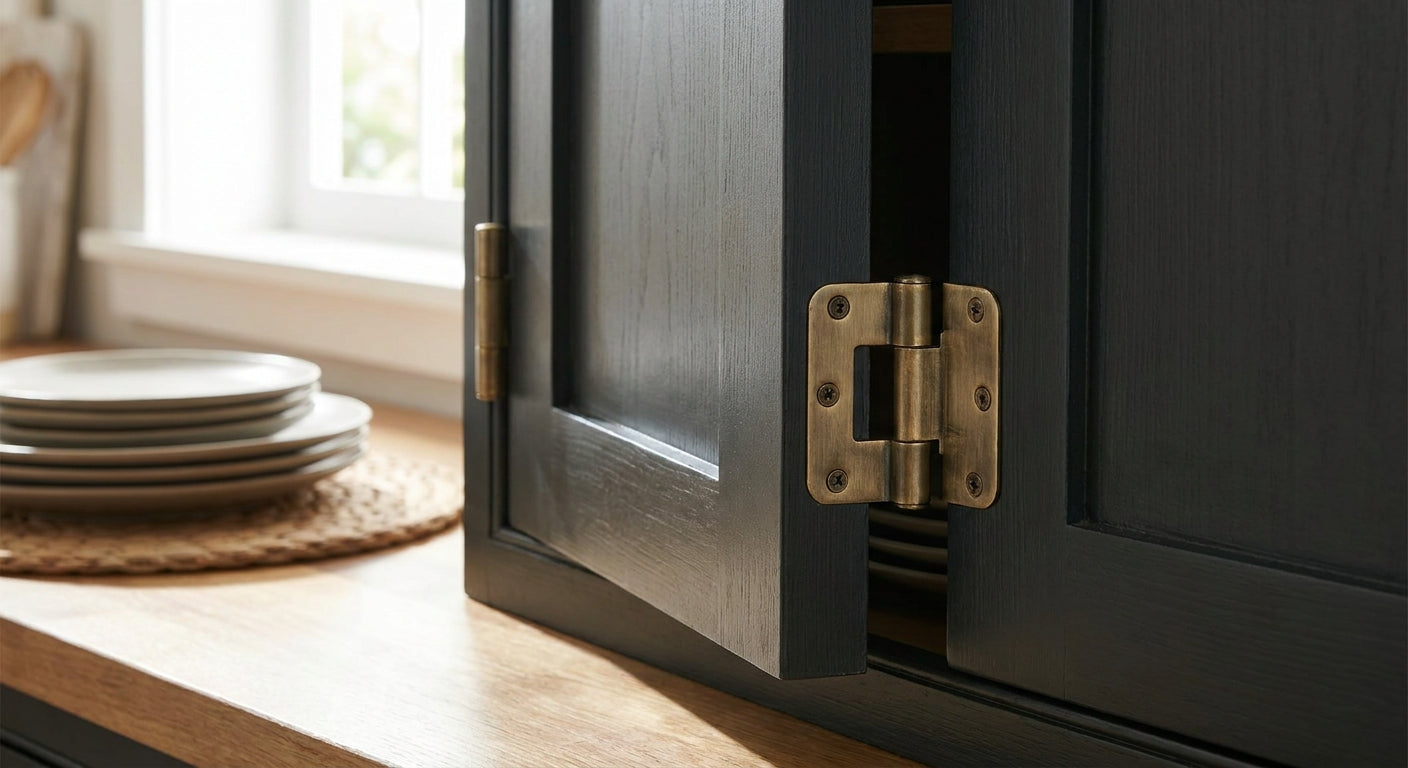
Inset cabinet doors sit flush inside the face frame, and that flush fit only holds up if the hinge underneath is built for zero overlay — not borrowed from an overlay door setup. This guide breaks down which inset cabinet hinges actually hold that reveal, which ones only look right in the box, and which specific products earn a Buy for 2026 installs.
Shop cabinet hinges
Every cabinet hinge we carry, in one place — filter by overlay, mount type, and brand.
Browse Cabinet Hinges →- Exposed brass butt hinges remain the standard inset cabinet hinges for flush-fit doors — no overlay measurement needed, unlike wrap-style hinges.
- Amerock's Antique Brass minaret-tip butt hinge at $9.40 a pair is the traditional inset pick for 2026 kitchens and vanities.
- Hinges labeled with an overlay spec, like a 1/2 inch overlay wrap hinge, are built for face-frame doors, not true inset — skip them on flush installs.
- Semi-concealed soft-close inset hinges exist and are worth the upgrade if slamming doors bother you daily.
- A mounting template kit under $30 prevents the single most common inset hinge mistake: uneven reveal gaps.
Shop the picks from this guide
In stock at Knobs.co · Free shipping on hardware orders $99+ · 110% price match
-
 Amerock
Functional Hardware 3/8'' Offset Non-Self Closing Face Mount Cabinet Hinge - 1 Pair BPR3406Antique Copper
Amerock
Functional Hardware 3/8'' Offset Non-Self Closing Face Mount Cabinet Hinge - 1 Pair BPR3406Antique Copper
$6.99
$8.22 -
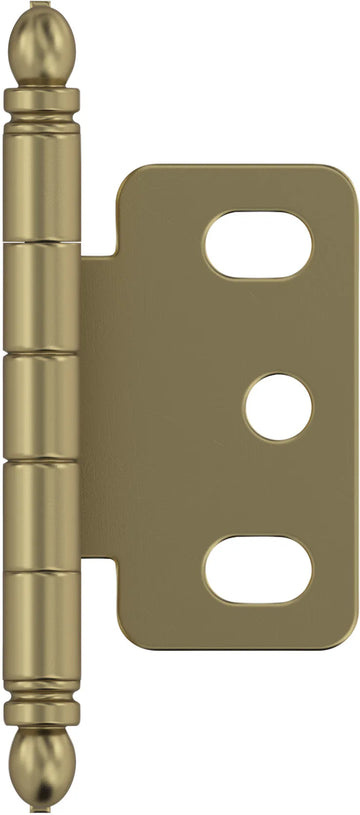 Amerock
Functional Hardware 3/4'' Door Thickness Full Inset Partial Wrap Ball Tip Cabinet Hinge - Single Hinge PK3180Golden Champagne
Amerock
Functional Hardware 3/4'' Door Thickness Full Inset Partial Wrap Ball Tip Cabinet Hinge - Single Hinge PK3180Golden Champagne
$5.90
$6.93 -
 Amerock
Functional Hardware 1/2'' Overlay Double Demountable Cabinet Hinge - 1 Pair BPR8704Burnished Brass
Amerock
Functional Hardware 1/2'' Overlay Double Demountable Cabinet Hinge - 1 Pair BPR8704Burnished Brass
$12.95
$15.23 -
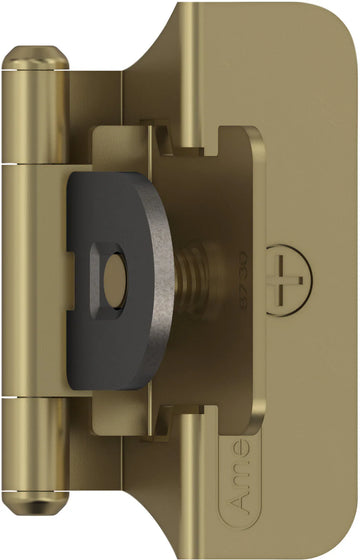 Amerock
Functional Hardware 1/4'' Overlay Double Demountable Cabinet Hinge - 1 Pair BPR8701Golden Champagne
Amerock
Functional Hardware 1/4'' Overlay Double Demountable Cabinet Hinge - 1 Pair BPR8701Golden Champagne
$12.95
$15.23 -
 Amerock
Functional Hardware Variable Overlay Self Closing Face Mount Cabinet Hinge - 1 Pair BPR3429Polished Chrome
Amerock
Functional Hardware Variable Overlay Self Closing Face Mount Cabinet Hinge - 1 Pair BPR3429Polished Chrome
$5.32
$6.25 -
 Amerock
Functional Hardware 3/4'' Door Thickness Full Inset Full Wrap Ball Tip Cabinet Hinge - Single Hinge PK3175Antique Brass
Amerock
Functional Hardware 3/4'' Door Thickness Full Inset Full Wrap Ball Tip Cabinet Hinge - Single Hinge PK3175Antique Brass
$5.56
$6.54


Why this matters
Inset doors have zero margin for error. On an overlay cabinet, a hinge that's slightly off still hides the mistake behind the door lip. On an inset door, every gap is visible from across the room, and the wrong hinge type is the number one reason those gaps show up crooked. Before you order anything, it pays to understand how to choose the right cabinet hinge for your cabinets for your specific door style, because inset, face-frame overlay, and frameless European doors all need different hardware families.
The confusion mostly comes from marketing language. A hinge box that says "self-closing" or "soft-close" tells you nothing about whether it's rated for inset use — you have to check the overlay spec, or lack of one, to know for sure.
Who this is for
This guide is for homeowners finishing a custom or semi-custom inset kitchen, cabinet makers building face-frame furniture with flush doors, and interior designers specifying hardware for clients who chose the inset look precisely because it reads as higher-end than standard overlay cabinetry. If your cabinets are frameless with doors sitting on top of the box, this isn't your hinge category — you want a standard European concealed hinge instead.
What to look for in inset cabinet hinges
Overlay spec (or the absence of one)
True inset hinges either have no overlay listed at all — like a butt hinge, which mounts on the door edge rather than over it — or they explicitly say "0mm" or "inset." A hinge labeled with a 1/2 inch overlay or a variable overlay is built for face-frame doors that sit on top of the cabinet opening, not flush inside it. Mixing these up is the fastest way to end up with a door that won't close square.
Exposed versus semi-concealed construction
Butt hinges show on the face of the cabinet by design, which is part of the traditional inset look — think farmhouse, colonial, or craftsman kitchens where visible brass or bronze hardware is a feature, not a flaw. Semi-concealed hinges hide most of the hardware but still show a small leaf on the face frame. Pick based on the finish story of the kitchen, not just what's cheapest.
Self-closing spring action
Standard butt hinges are non-self-closing by default, which some traditional builds want because it lets the door sit exactly where you leave it. If you want doors to swing shut on their own, you need a spring-loaded semi-concealed hinge rated for inset use — check best soft-close hinges for inset cabinet doors before assuming any soft-close hinge will fit your frame.
Leaf gauge and door weight
A 2 inch joint hinge holds up fine on a light overhead cabinet door but will sag under a full-height pantry door within a year or two. Heavier solid-wood inset doors need a hinge with a longer leaf, more screw holes, or a second hinge added to the run — three hinges per door instead of two on anything over roughly 40 inches tall.
Finish match to the rest of the room
Inset butt hinges are visible, so the finish has to match your knobs and pulls, not just coordinate loosely. Antique brass, burnished brass, and polished chrome all read differently in daylight than they do under warm kitchen lighting — order a sample before committing to a full kitchen's worth.
Top picks for inset cabinet hinges
The traditional pick: Amerock Minaret Tip Butt Hinge, Antique Brass. This is a 2 inch joint, non-self-closing exposed hinge sold as a pair for $9.40. It's the closest thing to a default inset cabinet hinge for traditional and farmhouse builds where visible hardware is intentional. No overlay spec to worry about — it mounts directly on the door edge. Verdict: Buy for classic inset doors that want visible, decorative hardware.
The soft-close pick: semi-concealed inset hinges. If slamming cabinet doors is the actual complaint in the house, a semi-concealed spring hinge built for inset use solves it without changing the flush-door look. The shortlist of options that are actually rated for inset, rather than overlay, doors is worth a full read before ordering. Verdict: Buy if quiet closing matters more than a fully exposed hinge look.
The install-insurance pick: Hickory Hardware mounting template kit. A precision jig with a matching drill bit costs under $30 and removes the guesswork from hinge placement — the single biggest source of uneven reveals on inset doors is a hand-marked hinge mortise that's off by a sixteenth of an inch. Verdict: Buy for anyone installing more than a handful of hinges in one project.


What to avoid
- Any hinge with an overlay measurement printed on the box. A 1/2 inch overlay or variable overlay hinge is engineered for a door that sits on top of the cabinet opening. Put it on an inset door and the door either won't sit flush or won't close at all.
- European concealed cup hinges sized for frameless cabinets. These are excellent hardware — just not for this door style. If your cabinets are frameless rather than face-frame inset, read European concealed hinges for frameless cabinets instead of forcing a cup hinge into a face-frame mortise.
- Unbranded butt hinges with no leaf gauge listed. On a lightweight cabinet it won't matter. On a 40-plus inch pantry door, a thin, unrated leaf is how you end up with a door that sags an eighth of an inch within a year.
If the hinge listing mentions an overlay measurement, it's not built for a true inset door.
Verdict comparison
| Hinge type | Best for | Self-closing | Exposed or concealed | Verdict |
|---|---|---|---|---|
| Butt hinge (2 in. joint, antique brass) | Traditional inset doors, visible hardware | No | Exposed | Buy |
| Semi-concealed inset spring hinge | Inset doors that need quiet closing | Yes | Semi-concealed | Buy |
| 1/2 in. overlay full-wrap hinge | Face-frame overlay doors only | Yes | Semi-concealed | Skip for inset |
| Variable-overlay face-mount hinge | Face-frame overlay doors only | Yes | Exposed | Skip for inset |
| European concealed cup hinge | Frameless cabinets | Varies | Concealed | Skip for inset |
FAQ
What are inset cabinet hinges?
Inset cabinet hinges are hardware built for doors that sit flush inside the face frame, with no overlap over the cabinet opening. Butt hinges and semi-concealed inset spring hinges are the two most common types used on this door style in 2026.
Are inset cabinet hinges different from overlay hinges?
Yes, overlay hinges are built for doors that sit on top of the cabinet opening and list a specific overlay measurement, like 1/2 inch. Inset hinges either have no overlay spec at all, as with a butt hinge, or are explicitly labeled for zero overlay.
Do inset cabinet doors need self-closing hinges?
No, self-closing action is optional on inset doors. Traditional butt hinges are non-self-closing by design and hold the door exactly where it's left, while semi-concealed spring hinges add soft-close if that's the preference.
Can I use European concealed hinges on inset cabinet doors?
Standard European concealed cup hinges are built for frameless overlay cabinets, not face-frame inset doors. Forcing one into an inset mortise leads to a door that won't sit flush or close correctly.
How much do inset cabinet hinges cost in 2026?
A pair of exposed butt hinges runs around $9.40 in 2026, with self-closing wrap and face-mount styles landing between $8.25 and $8.75 a pair. Mounting template kits for precise placement add roughly $17 to $27.
What size hinge do I need for a heavy inset door?
A 2 inch joint hinge works for lightweight upper cabinet doors, but full-height pantry or heavy solid-wood inset doors need a longer leaf or a third hinge added to the run. Doors over roughly 40 inches tall are the usual cutoff for adding hardware.
What finish should I choose for inset cabinet hinges?
Match the hinge finish to your knobs and pulls exactly, since butt hinges stay visible on inset doors. Antique brass, burnished brass, and polished chrome all shift under different lighting, so ordering a sample before a full kitchen order is worth the few extra days.
How many hinges does one inset cabinet door need?
Most inset doors under 40 inches tall use two hinges. Taller doors, or doors carrying extra weight from glass or solid wood panels, need a third hinge added to the run to prevent sagging over time.
One last thing
The detail that trips up the most first-time inset installs isn't the hinge finish or the price — it's ordering a self-closing hinge without checking whether it lists an overlay spec at all. Two hinges can look nearly identical in a photo and cost within a dollar of each other, and one will sit your door flush while the other leaves a visible gap on day one. Check the overlay field before you check the finish.


