

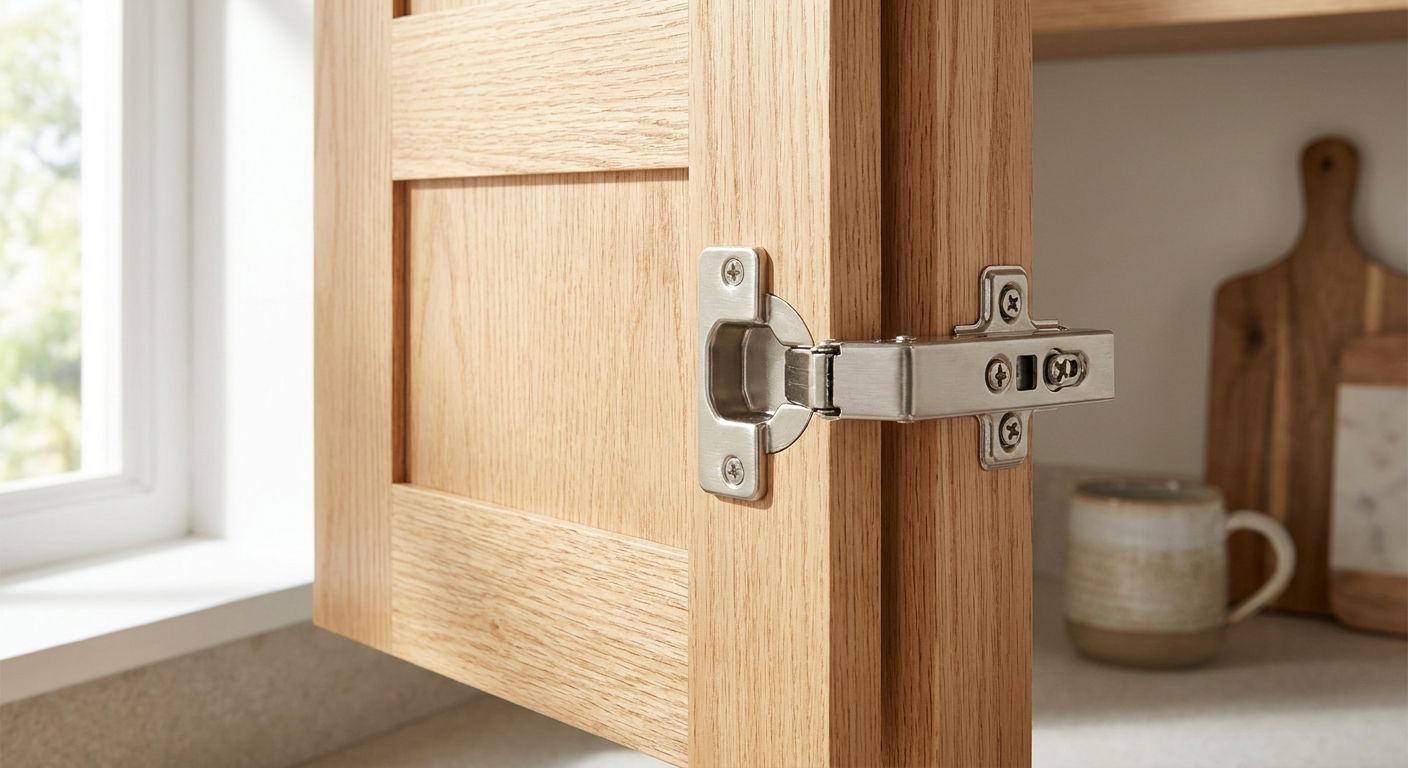
Partial overlay cabinet hinges are the connector piece most face-frame remodels get wrong first — buy the wrong reveal spec and every door in the kitchen hangs crooked. This guide breaks down what separates a true partial overlay hinge from an inset or full-overlay hinge, and which styles hold up on real face-frame cabinets in 2026.
- Partial overlay cabinet hinges for face-frame cabinets need a 3/8-inch to 1/2-inch door reveal spec, not a full-overlay or inset hinge design.
- Amerock's BPR2355AE non-self-closing butt hinge ($9.40 a pair) is the safe pick for exposed-hinge face-frame doors in 2026 -- Buy.
- Skip inset-labeled hinges like Amerock's PK3175 and BPR7628AE on partial overlay doors -- they're built for flush inset geometry, not overlay reveals.
- Self-closing semi-concealed cup hinges cost more but stop slammed doors on daily-use cabinets -- Consider for kitchens and baths.
Why this matters
Face-frame cabinets have a solid wood frame across the front of the box, and the door can sit three ways against it: fully covering the frame (full overlay), partially covering it with a visible reveal (partial overlay), or sitting flush inside the frame opening (inset). Each geometry needs a different hinge. Mount a full-overlay hinge on a partial overlay door and the door either won't close or sits proud of the frame by a quarter inch.
Partial overlay is the most common face-frame setup in production cabinetry built before 2015, and it's still standard on a lot of stock and semi-custom lines sold in 2026. Get the hinge type wrong and you're drilling new holes, patching the old ones, or shipping the wrong part back. Reading up on choosing the right cabinet hinge before you order saves a return trip.
Who this is for
This guide is for homeowners refacing or replacing doors on face-frame cabinets built with a visible wood frame, and for contractors and cabinet shops matching hinges to existing partial overlay door specs on a renovation. If your cabinets are frameless (edge-banded plywood boxes with no visible frame), you want European concealed hinges instead, not this guide.
What to look for in partial overlay cabinet hinges for face-frame cabinets
Door reveal measurement
Partial overlay hinges are built around a specific reveal -- the strip of face frame still visible between two closed doors, typically 3/8 to 1/2 inch. Measure your existing reveal before ordering, because a hinge cut for a 1/2-inch reveal won't sit flush on a 3/8-inch setup, and the mismatch shows up as a gap or a door that won't latch.
Self-closing vs non-self-closing action
Self-closing hinges use a spring to pull the door the last few degrees shut, which matters on high-traffic kitchen cabinets where doors get bumped open and left ajar. Non-self-closing hinges hold whatever position you leave them in, which some homeowners actually prefer on glass-front or display cabinets where they want to prop a door open.
Exposed vs semi-concealed construction
On partial overlay face-frame doors, hinges are either fully visible on the face of the door (butt hinges, ball-tip hinges) or semi-concealed with just the pin showing (cup-style hinges). Exposed hinges read as a design detail on traditional and cottage-style kitchens; semi-concealed hinges disappear when the door is shut, which suits transitional and modern face-frame builds.
Finish match to existing hardware
A mismatched hinge finish is the fastest way to make an otherwise good remodel look unfinished. Match the hinge to your pulls and knobs, or run a controlled contrast on purpose -- but don't land in between by accident. Knobs.co stocks hinges and pulls across the same finish families, so cross-checking a antique brass hinge against a antique brass pull takes one browser tab, not three vendor catalogs.
Screw pattern and mounting plate compatibility
Partial overlay hinges mount either as a single face-plate screwed directly to the frame and door, or as a two-piece hinge with a separate mounting plate. Two-piece designs let you adjust the door later without redrilling, which matters if the cabinet box settles or the door warps slightly over a few seasons.
Door weight and hinge count per door
Heavier doors -- solid wood, glass-front with lead came, or anything over roughly 30 inches tall -- need three hinges instead of two to keep the door from sagging. Skimping to two hinges on a tall door is the single most common reason partial overlay doors drop out of alignment within the first year.


Top picks for partial overlay face-frame doors
The safe pick -- exposed decorative hinge. Amerock's BPR2355AE is a 2-inch minaret tip butt hinge in antique brass, non-self-closing, sold as a pair at $9.40. It mounts on the face of the frame and door, which works cleanly on partial overlay doors where you want the hinge to read as part of the design. Buy for traditional or cottage-style face-frame kitchens where the reveal is meant to be seen.
The daily-use upgrade -- self-closing semi-concealed hinge. If doors get bumped open twenty times a day, a self-closing cup-style hinge earns its keep by pulling the door shut instead of leaving it ajar. For a full rundown of options rated specifically for face-frame reveal geometry, check the soft-close face-frame hinge guide before ordering. Consider this route for kitchens and bathroom vanities with heavy daily traffic.
The wildcard -- mixed finish accent. Running a contrasting hinge finish against your pull hardware is a deliberate design move, not a mistake, on partial overlay doors with a visible frame. It only works if the contrast is intentional and repeated across every door in the run -- one odd hinge out reads as an error. Consider on statement or two-tone kitchens; Skip if you're not ready to commit to the look on every cabinet.
What to avoid
- Inset-labeled hinges on overlay doors. Amerock's PK3175 is built as a full inset, full wrap hinge, and the BPR7628AE above is a 3/8-inch inset self-closing face mount hinge -- both are engineered for a door that sits flush inside the frame opening, not one that overlays it. Mounted on a partial overlay door, the geometry is wrong and the door won't sit right no matter how you shim it.
- European concealed hinges. These are built for frameless cabinet construction with no visible face frame. Cabinet shops working both frameless and face-frame lines should keep the two hinge families separate; a quick read on inset door hinges shows how different the mounting geometry actually is.
- Two-hinge setups on tall or heavy doors. It looks like a cost saving until the door starts sagging six months in. Three hinges on anything over roughly 30 inches tall is standard practice, not an upsell.
Verdict comparison table
| Hinge type | Reveal spec | Self-close available | Visible when closed | Face-frame partial overlay fit |
|---|---|---|---|---|
| Exposed butt/ball-tip hinge | 3/8-1/2 in | Limited | Yes | Buy |
| Semi-concealed cup hinge | 3/8-1/2 in | Yes | Pin only | Buy |
| European concealed hinge | N/A (frameless) | Yes | No | Skip |
| Full inset hinge | 0 in (flush) | Yes | Varies | Skip |
FAQ
What's the best partial overlay cabinet hinge for face-frame cabinets in 2026?
A semi-concealed self-closing cup hinge rated for a 3/8 to 1/2-inch reveal is the best all-around choice for daily-use partial overlay face-frame cabinets in 2026. Exposed butt or ball-tip hinges, like Amerock's BPR2355AE, work well when you want the hardware visible as part of the design.
Is partial overlay better than full overlay for face-frame cabinets?
Neither is objectively better -- they're different door geometries, and the choice depends on your existing cabinet boxes. Partial overlay shows more of the face frame between doors, while full overlay nearly covers it; retrofitting one to the other usually means new doors, not just new hinges.
How much does a partial overlay cabinet hinge cost?
Functional hardware hinges for face-frame cabinets run roughly $5.55 to $9.40 per pair as of 2026, depending on finish and self-closing action. Decorative or designer finishes push the price higher.
Can I use inset hinges on a partial overlay door?
No -- inset hinges like Amerock's PK3175 are built for a door that sits flush inside the frame opening, not one that overlays it. Using an inset hinge on a partial overlay door leaves the door sitting proud of the frame or unable to close fully.
How do I measure for a partial overlay hinge?
Measure the reveal -- the gap of visible face frame between two closed doors -- which typically falls between 3/8 and 1/2 inch on partial overlay cabinets. Match that number to the hinge's rated reveal spec before ordering.
Do partial overlay cabinet doors need self-closing hinges?
They don't need them, but self-closing hinges reduce wear on high-traffic kitchen and bath cabinets by pulling the door shut instead of letting it hang open. Display or glass-front cabinets are the common exception where non-self-closing is preferred.
Can I mix hinge and pull finishes on face-frame cabinets?
Yes, mixed finishes work as a deliberate design choice, but the contrast needs to repeat consistently across every door and drawer in the run. An accidental one-off mismatch reads as an error, not a style decision.
How many hinges does a partial overlay cabinet door need?
Standard-height doors typically use two hinges, but doors taller than roughly 30 inches or made of solid wood need three to prevent sagging over time. Glass-front doors with heavier panels also benefit from the third hinge.
One last thing
The hinge reveal is easier to get wrong than the finish. Homeowners spend hours matching antique brass to antique brass and then grab whatever hinge is on the shelf without checking whether it's rated for inset or overlay geometry -- and that's the mismatch that actually causes returns. Measure the reveal first, pick the finish second.