

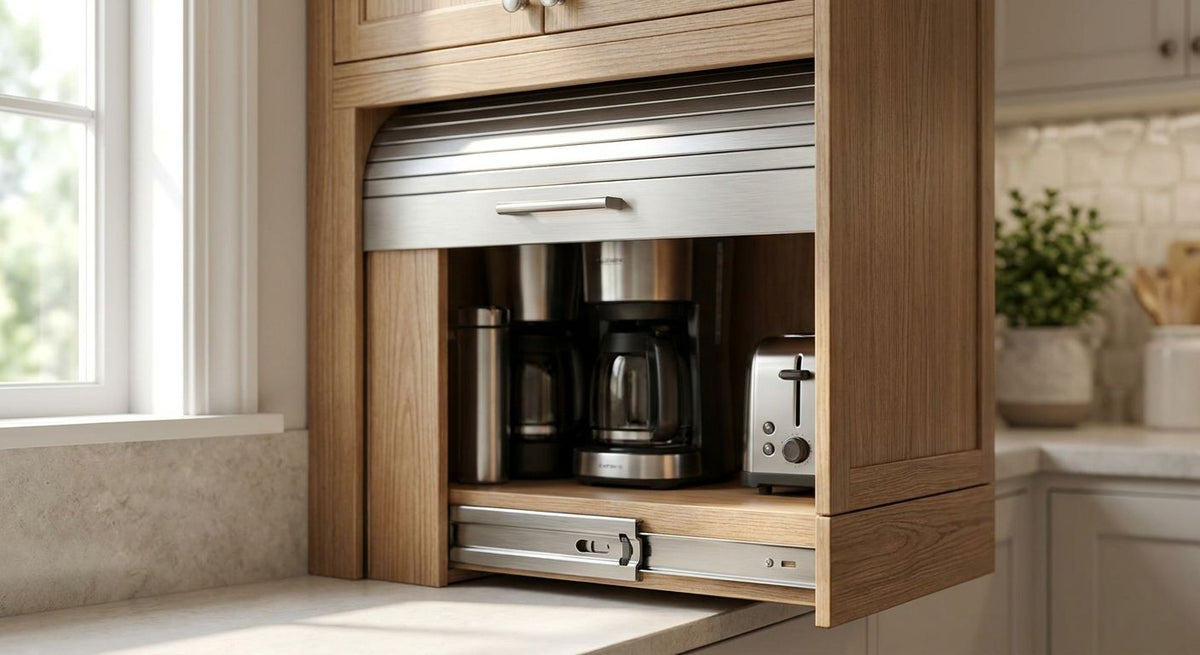
Tambour door hardware for appliance garages is the track, roller, corner piece, and pull system that lets a curved or flat panel roll up out of sight over a countertop appliance, freeing the counter while keeping the mixer or coffee maker one motion away. Appliance garages carry different demands than a standard cabinet door: the panel is lighter than solid wood, it curves through a radius corner in most installs, and the pull has to clear a coiled track instead of a flat door face.
- Tambour door hardware appliance garage kits need radius track, ball-bearing rollers, and a low-profile pull bought as separate pieces.
- Knobs.co stocks the appliance pulls, hinges, and jigs that finish a tambour install, not full track kits.
- A 12-inch appliance pull clears most curved track without binding — a safer default than an oversized bar.
- Freehand hole marking is the top cause of crooked tambour hardware; a jig fixes it in 2026 the same way it did a decade ago.
Why tambour door hardware matters for appliance garage owners
An appliance garage exists to hide countertop clutter without burying the appliance in a lower cabinet you have to bend for. The tambour panel does that job only if the hardware behind it works without binding, sagging, or catching on the pull.
Knobs.co's hardware catalog carries the finishing pieces most appliance garage builds need — pulls sized for a coiled panel, hinges for hybrid designs, and jigs for clean drilling — even though full tambour track systems are a specialty item you'll source from a millwork or cabinet-track supplier. Knowing which part of the job belongs to which supplier saves a return trip to the hardware store mid-install.
How to choose tambour door hardware for an appliance garage
Measure your appliance garage opening and the panel's curve radius
Before ordering anything, get the exact width, height, and corner radius of the opening. Tambour track is sold to match a radius, and a mismatch means the panel binds halfway through its roll.
- Measure the opening at three points (top, middle, bottom) — cabinets settle unevenly
- Note whether the corner is a true quarter-round or a shallower custom radius
- Check clearance behind the panel for the coiled slats when fully open
- Confirm the appliance's height clears the door track when the panel is stowed
Choose the track and roller system
Track comes in two families: friction track, which relies on the slat tension to hold position, and ball-bearing roller track, which glides with less resistance and less wear over repeated use. Vinyl-backed wood slats are lighter and quieter than aluminum slat systems, which matters in a small appliance garage where the door is opened multiple times a day.
- Match track radius to your measured corner, not a nominal size
- Pick ball-bearing rollers for a door that gets daily use
- Choose vinyl-backed slats for quieter operation near a coffee station
- Confirm the track kit includes end caps and corner connectors, not just rail
Pick a pull that clears the coiled track
The pull is where most tambour appliance garage installs go wrong. A bar pull mounted too high catches the coiled slats when the panel rolls fully open, and a pull that's too long overhangs the track housing.
A 12-inch appliance pull bar, like the Acanthus appliance pull bar with a 12-inch drill center in 24K satin gold, sits low enough on most tambour panels to clear standard track housing. Buy the pull after you've confirmed track clearance, not before.
“If the pull doesn't clear the coiled track, the door won't close — measure clearance before you order hardware.”
Decide between a full tambour panel and a hinged alternative
Not every appliance garage needs to roll. A hinged panel door that swings open like the rest of the kitchen skips track hardware entirely and matches the cabinetry finish more easily, at the cost of the roll-up storage motion tambour is known for.
- Full tambour: best when counter space above the appliance garage matters most
- Hinged panel: best when finish-matching to adjacent cabinets is the priority
- Retrofit conversion: best for an existing hinged appliance garage getting upgraded
- Skip a retrofit kit if the original hinge spacing doesn't match the new track's mounting holes
Install with a jig for consistent hole spacing
Freehand marking is the single biggest reason tambour hardware ends up crooked. A drilling jig holds the bit at the same angle and depth across every hole, whether you're mounting a pull, a hinge plate, or a track bracket.


- Center the jig on the marked reference line before drilling
- Drill a test hole in scrap material matching your panel thickness
- Keep screw length short enough to avoid punching through a thin tambour slat
- Vacuum drill dust from the track channel before the panel goes in
Match finish across the appliance garage and surrounding cabinets
An appliance garage sits at eye level more often than a base cabinet, so a mismatched pull finish stands out. Pull the same finish family used on the rest of the kitchen's pulls and knobs onto the appliance garage door, even when the pull size is smaller.
Test the roll-up action before final trim
Run the panel through a full open-and-close cycle before installing trim or a fascia. A door that catches during testing will only get harder to access once the surrounding trim is nailed in.
Tambour hardware options for appliance garages compared
| Option | Best for | Key limitation |
|---|---|---|
| Curved radius track kit | Corner appliance garages with a rounded opening | Needs a routed or pre-curved cabinet frame to seat correctly |
| Straight vertical track kit | Flat-front appliance garages under a wall cabinet | Panel stacks visibly above the opening — needs headroom |
| Retrofit tambour conversion kit | Older cabinets swapping a hinged door for tambour | Rarely matches original hinge spacing; new holes are usually required |
| Hinged panel door (non-tambour) | Kitchens prioritizing a finish match over roll-up storage | No roll-up motion — the door swings like the rest of the kitchen |
Verdict: a curved radius track kit paired with a 12-inch appliance pull is the standard build for a corner appliance garage in 2026 — the hinged panel alternative only wins when finish-matching outranks the roll-up motion.
Common mistakes appliance garage owners make with tambour hardware
- Ordering track before measuring the exact corner radius — a generic radius kit often doesn't seat flush against a custom cabinet corner
- Mounting the pull too high on the panel — it catches the coiled slats mid-roll and stops the door short
- Skipping the drilling jig — freehand holes drift enough to bind a light tambour panel that a solid door would tolerate
- Mixing finishes between the appliance garage pull and the rest of the kitchen — the appliance garage sits at eye level, so the mismatch is more visible than on a base cabinet
- Choosing aluminum slats in a tight kitchen corner without checking clearance — aluminum track housing is often deeper than a vinyl-backed wood slat system
FAQ
What is tambour door hardware for an appliance garage?
It's the track, roller, corner connector, and pull system that lets a curved or flat panel roll up and disappear above a countertop appliance. The track carries the weight; the pull and finish hardware are chosen separately to match the rest of the kitchen.
Is tambour door hardware hard to install in an appliance garage?
It's more measurement-dependent than difficult. Getting the corner radius and track alignment right up front matters more than any single tool, and a drilling jig removes most of the risk of crooked hardware.
What size pull works best for a tambour appliance garage door?
A 12-inch bar pull mounted low on the panel clears most standard coiled track without binding. Longer pulls or pulls mounted too high are the most common cause of a tambour door catching mid-roll.
Can you convert a hinged appliance garage door to tambour?
Yes, with a retrofit conversion kit, but the original hinge holes rarely line up with the new track's mounting points. Plan for new drilling rather than reusing existing holes.
Do tambour appliance garage doors need soft-close hinges?
No — tambour panels roll on track and rollers, not hinges, so soft-close hinge hardware doesn't apply. Soft-close only comes into play if you choose a hinged panel alternative instead of true tambour.
What's the alternative to tambour hardware for an appliance garage?
A hinged panel door that swings open like a standard cabinet door skips track hardware entirely and matches adjacent cabinetry more easily, though it gives up the roll-up storage motion tambour is chosen for.
Does Knobs.co sell tambour track kits?
Knobs.co carries the appliance pulls, hinges, and drilling jigs that finish a tambour appliance garage install. Full tambour track systems are typically sourced from a cabinet-track or millwork supplier and paired with hardware from a separate catalog.
How do you stop a tambour appliance garage door from binding?
Confirm the track radius matches your cabinet's actual corner measurement and mount the pull low enough to clear the coiled slats. Most binding issues trace back to one of those two mismatches.
One last thing
The detail that gets skipped most often on a tambour appliance garage build isn't the track — it's the finish match between the small pull on that one door and every other pull in the kitchen. Order a sample of your chosen finish against the appliance garage panel color before committing to a full set; a 12-inch pull in the wrong undertone is the fastest way to make an otherwise clean install look like an afterthought.