

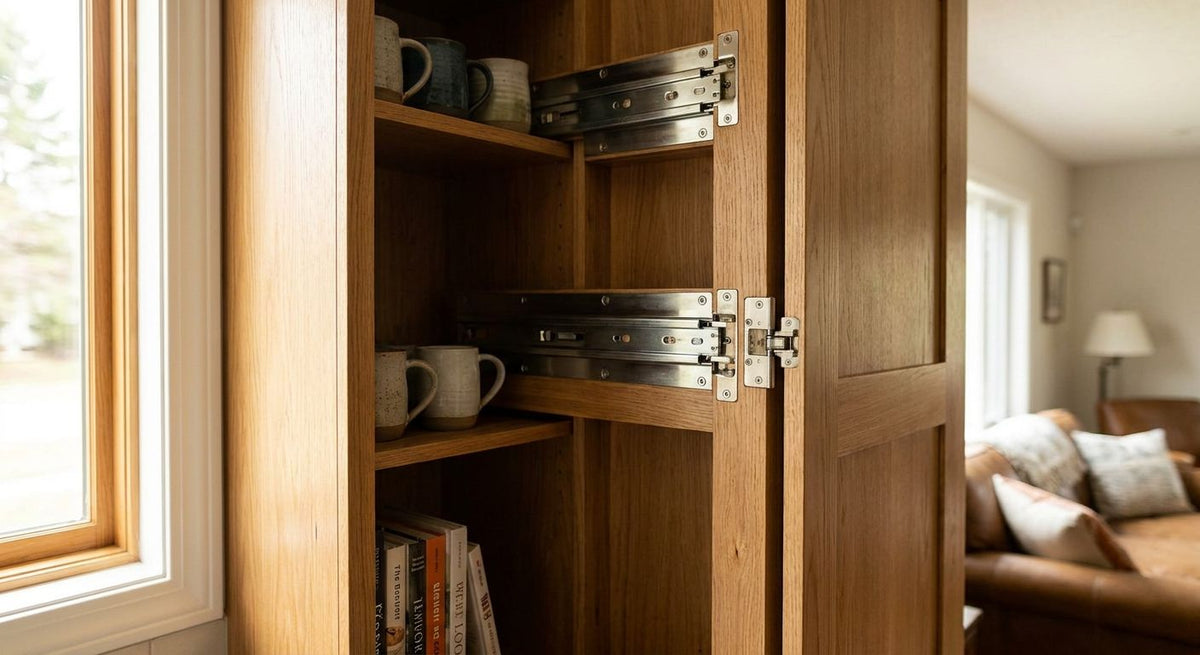
Cabinetmakers and DIY renovators use pocket door hardware to let a cabinet door swing open, then slide flat into the cabinet body, clearing the opening completely for appliances, TVs, or pull-out storage. Cabinetmakers need hardware that installs the same way across a dozen units without redrilling; DIY renovators need hardware that tolerates a slightly off-center hole and still closes flush.
- Pocket door hardware cabinets need swing-and-slide hinges, not standard overlay hinges — the door must clear the face frame before it retracts.
- European-style concealed hinges with a 170-176 degree opening angle are the baseline for a true pocket action in 2026.
- Flush pulls beat knobs or bar pulls on pocket doors since the door sits flush against the cabinet side wall when open.
- Budget DIY conversions with touch latches skip the true pocket mechanism and only remove the visible pull.
- Test swing clearance on one door before ordering hardware for a full media console or appliance garage run.
Why pocket door hardware matters for cabinetmakers and DIY renovators
Pocket doors show up most on built-in media consoles, appliance garages, and any cabinet where a door in the open position can't block a TV screen, a mixer, or a pull-out shelf. That's a different job than a standard overlay hinge, which only swings the door out of the way — it never tucks it inside the cabinet.
Cabinetmakers running multiples of the same cabinet need a hinge that bores to a repeatable template every time, because a hole that's off by even 2mm changes the door's rest position against the side panel. DIY renovators converting one existing cabinet in 2026 are usually working with a face frame that was never built for a pocket mechanism, so the hardware has to forgive some imprecision or the retrofit fails on install day.
Knobs.co stocks concealed hinges built for this kind of swing-and-slide install, along with the flush pulls made for sliding cabinet doors that keep the door's face clean once it's tucked away.
Confirm your cabinet is a pocket-door candidate
Not every cabinet can take pocket hardware without modification. Before you order anything, check these:
- Interior depth behind the face frame — the door needs somewhere to retract to
- Side panel clearance equal to or greater than the door's width
- No fixed shelf or divider sitting where the door would slide
- Face frame lip depth, since the door has to clear it on the swing-out stage
Choose swing-and-slide hinges over standard overlay hinges
A standard cabinet hinge swings the door out and stops — it was never built to let the door glide sideways afterward. Pocket door installs need a hinge engineered for the two-stage motion:
- European-style concealed hinges rated for a 170-176 degree open angle
- Hinges with a pivot arm that disengages once the door clears the opening
- Frameless-cabinet hinge cups sized to your door's material thickness
- Soft-close options if the door will get daily use near appliances
The European concealed hinges built for frameless cabinets are the starting point for most pocket conversions in 2026 — they're the same hinge family used on standard overlay doors, just specified for the wider swing angle a pocket mechanism needs.
Bore and template every hinge location
Skipping a template is the single fastest way to ruin a pocket door install. Use a jig every time:
- Mark hinge cup centerlines before drilling, never eyeball them
- Use a Forstner bit sized exactly to your hinge cup, not a close substitute
- Drill test holes on scrap ply matching your door's thickness first
- Check the step-by-step process for installing European concealed hinges before you touch the real door
Add a flush pull instead of a knob or bar pull
A pocket door needs a pull the reader's hand can grab without a protruding knob catching on the cabinet interior as the door slides in. Flush pulls solve that:
- Recessed cup pulls that sit level with the door face when closed
- Finger pulls routed into the door edge for a handleless look
- Matte black or brushed nickel finishes to match the rest of the run
- Avoid anything with a projecting knob shank over 1 inch — it will hit the side panel
Install a latch or catch for the retracted position
Once the door is inside the cabinet, it needs something holding it there so it doesn't slide back out on its own:
- Magnetic touch catches mounted on the interior side panel
- Ball-tip catches for lighter doors
- Friction latches rated for the door's actual weight, not a generic spec
Test the full cycle before final assembly
Run the door through open, swing, slide, and close at least a handful of times before you commit to a full production run:
- Confirm the door clears the face frame lip on the swing stage
- Confirm the door seats flat against the side panel with no gap
- Confirm the pull doesn't catch on adjacent hardware or trim
- Recheck hinge screws for stripping after repeated cycles
Comparing pocket door hardware options for cabinets
| Option | Best for | Key limitation |
|---|---|---|
| European concealed swing-and-slide hinges | New-build cabinets and full media console runs | Requires precise boring; not forgiving on retrofit |
| Touch-latch conversion on existing hinges | Budget DIY, single-cabinet upgrades | Removes the knob but doesn't create a true pocket action |
| Flush pull + track retrofit kit | Appliance garages and TV cabinets with side clearance | Needs interior depth equal to full door width |
| Bi-fold pocket hinge pairs | Two-door media consoles and built-ins | More moving parts, more points that can loosen over time |
For a from-scratch media console or appliance garage build in 2026, European concealed swing-and-slide hinges are the buy — they're the only option built specifically for the two-stage motion. A touch-latch retrofit is a reasonable hold for a single cabinet on a tight budget, but skip it if you actually need the door out of sight rather than just handle-free.
“If the door doesn't clear the face frame lip before it starts sliding, you have the wrong hinge, not the wrong door.”
Common mistakes cabinetmakers and DIY renovators make
- Ordering standard overlay hinges because they look similar to swing-and-slide hinges in a catalog photo, then finding the door still blocks the opening.
- Skipping the template step on a retrofit, which leaves hinge cups misaligned by a few millimeters and the door sitting crooked against the side panel.
- Forgetting to measure interior depth before ordering, so the door has nowhere to retract to once it swings open.
- Mixing finishes on the flush pull and the hinge, which shows once the door is tucked inside and the interior hardware becomes visible.
- Never testing the full cycle on one door before ordering hardware for an entire run of cabinets, then discovering a clearance problem after every hinge is already bored.
FAQ
What is pocket door hardware for cabinets?
Pocket door hardware is a hinge system that lets a cabinet door swing open and then slide sideways into the cabinet body, clearing the opening entirely. It differs from a standard overlay hinge, which only swings the door out of the way.
Can I convert a standard cabinet door to a pocket door?
Yes, if the cabinet has enough interior depth and side clearance for the door to retract into. You'll need to replace standard hinges with a swing-and-slide hinge rated for the wider open angle, and add a flush pull.
Do pocket door hinges need a special drill template?
A template or jig is strongly recommended because hinge cup placement has to be precise for the door to clear the face frame and seat flat once retracted. A misaligned bore is the most common install failure in 2026 retrofits.
What angle do pocket door hinges open to?
Most European-style concealed hinges used for pocket door installs open to 170-176 degrees, which is wide enough for the door to clear the opening before it slides.
Is a knob or a flush pull better for a pocket door?
A flush pull is better because it sits level with the door face and won't catch on the cabinet interior as the door slides in. A protruding knob or bar pull can hit the side panel.
How much clearance does a pocket door cabinet need?
The cabinet interior needs depth and side clearance roughly equal to the door's width so it has somewhere to retract to. Measure this before ordering any hardware.
What holds a pocket door in place once it's retracted?
A magnetic touch catch or friction latch mounted on the interior side panel keeps the door from sliding back out. Choose one rated for the actual weight of your door.
Are pocket door hinges more expensive than standard hinges?
Pricing varies by brand and finish, so check current listings for the specific hinge you're specifying rather than assuming a flat premium over standard overlay hinges.
One last thing
Test one door on one cabinet before you commit hardware to an entire media console or appliance garage run — a clearance problem caught on door one costs a returned hinge pair, the same problem caught on door twelve costs a full redo. Order a single hinge and flush pull, cycle it a dozen times, and only then buy for the rest of the run.