

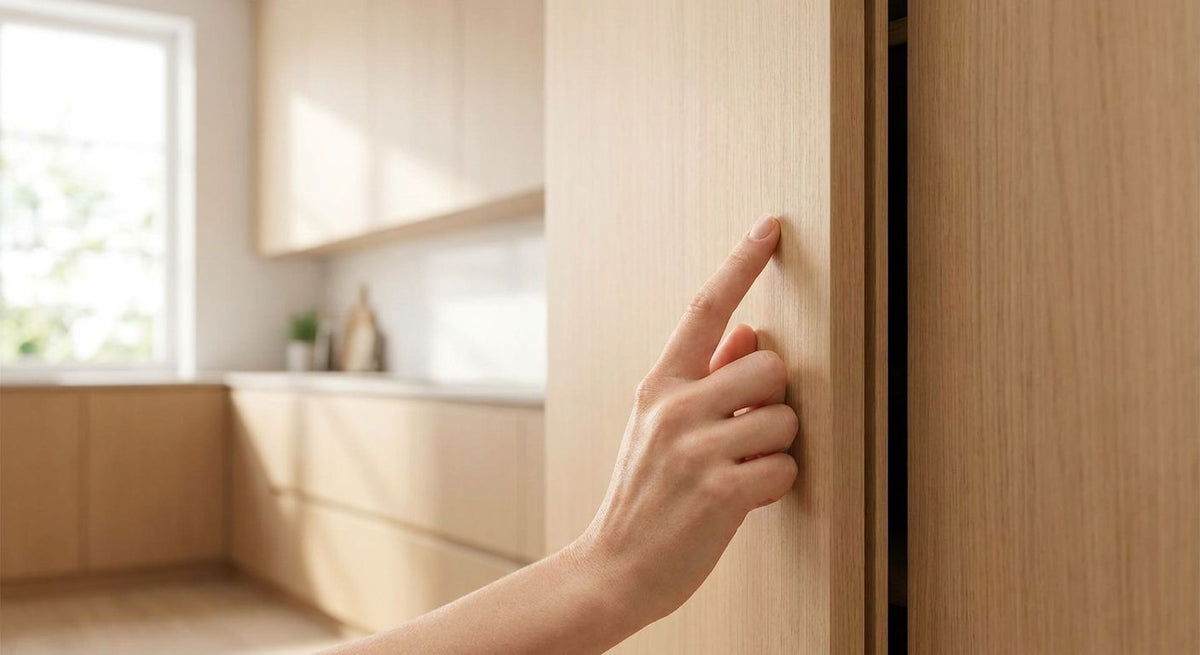
Touch-latch cabinet hardware for handleless kitchens is a push-to-open or touch-sensitive catch system that lets a flat-front door or drawer open with light pressure instead of a knob or pull, keeping the cabinet face grip-free. Handleless kitchens push this hardware harder than a standard kitchen does — every door and drawer gets opened by hand pressure alone, hundreds of times a week, with no pull to share the load.
- Mechanical push-to-open catches are the safest touch latch cabinet hardware pick for most handleless kitchens in 2026 — buy them for light-to-mid weight MDF doors.
- Magnetic touch latches run quieter but lose holding force on heavy slab doors — pair two per door over 30 inches tall.
- Motorized push-open systems cost more and need wiring — reserve them for high-end handleless kitchen remodels, not budget conversions.
- Finger pulls are the honest fallback when a push catch fails a grip test on heavy doors.
Why touch-latch hardware matters for handleless cabinets
A handleless kitchen only works if the opening mechanism is reliable, because there's no pull to fall back on when a catch sticks. That's the core difference between shopping for touch-latch hardware and shopping for a knob or pull: you're choosing a mechanism, not a finish.
Two failure points show up constantly in handleless conversions: doors too heavy for the catch rated to hold them, and catches installed without a matching concealed hinge. Get either wrong and the door either won't stay latched or won't open with a light push, which defeats the entire point of going handleless. Cabinet catches and latches for overlay doors covers the overlay-specific version of this same problem if your doors sit proud of the frame rather than flush.
Test your door weight and material first
Before buying any touch latch cabinet hardware, figure out what you're actually asking the catch to hold.
- Weigh or estimate the door: thin MDF slab doors are lighter than solid wood or quartz-faced panels
- Note the door height — doors over 30 inches typically need two catches, not one
- Check whether the door is inset or overlay, since catch placement differs
- Confirm the cabinet box material can take screws for the catch plate without stripping
Choose the catch mechanism
This is the decision that determines everything downstream — feel, sound, and how the hardware ages.
- Mechanical push-to-open catches: a physical spring latch, no batteries, works immediately
- Magnetic touch latches: quieter close, softer feel, weaker holding force
- Motorized push-open systems: one-touch electric opening, needs low-voltage wiring
- Tip-out or tilt catches for narrow drawers where a full catch won't fit
A mechanical push-to-open catch is the right first move for most handleless kitchens — it's the cheapest to test, the easiest to replace if a door proves too heavy, and it doesn't depend on power. If a design calls for something quieter or electric, move to magnetic or motorized only after the mechanical version has proven the door weight works.
“If a push catch needs more than a light fingertip push, the mechanism is wrong for that door's weight.”
Pair the latch with the right hinge
Touch-latch hardware doesn't work in isolation — it depends on the hinge holding the door true.
- Frameless cabinets need concealed European hinges with the correct cup bore
- Face-frame cabinets need a hinge rated for the frame's inset or overlay depth
- Soft-close hinges reduce the slam that a push-catch door produces on close
- Mismatched hinge tension makes a push catch feel inconsistent door to door
European concealed hinges for frameless cabinets walks through cup sizing and mounting plate selection if you're building the handleless conversion from the hinge up rather than retrofitting.
Position and install the catches
Placement is where most DIY handleless conversions go wrong.
- Set catches roughly 2 to 3 inches from the top and bottom door edges as a general installer practice
- Use a drill template or jig rather than eyeballing hole spacing
- Test the catch on one door before drilling the full kitchen run
- Mark and drill on a scrap panel first if this is your first touch-latch install
Test the push force before committing the whole kitchen
Don't install 20 doors of hardware before confirming the mechanism holds up.
- Push and release each test door at least 15-20 times to check for consistent latch
- Listen for rattling, which signals a loose catch plate or an undersized screw
- Check that the door sits flush when closed, not proud or recessed
- Confirm the catch releases with one hand, since that's the entire point of going handleless
Decide on a finger-pull backup
Some handleless kitchens aren't fully committed to touch latches on every door — a finger pull along the top rail gives a manual backup without breaking the flat-front look.
Finger pulls for handleless flat-front cabinets is worth reading if you want that hybrid option for heavier doors or drawers that see daily heavy use, like a trash pull-out or a pot drawer.
Order samples before you commit to a full run
Once the mechanism and hinge pairing are decided, ordering the actual catches for one door before buying for the whole kitchen catches a bad fit before it's expensive. Knobs.co stocks touch-latch and catch hardware across multiple brands, which makes it faster to test one mechanism against your actual door weight before ordering 30 units.
Comparing touch latch cabinet hardware options
| Option | Best for | Key limitation |
|---|---|---|
| Mechanical push-to-open catch | Budget handleless conversions on light-to-mid weight MDF doors | Needs a firm push; can loosen after years of heavy daily use |
| Magnetic touch latch | Quiet close on frameless cabinets | Weaker holding force on heavy slab or quartz-faced doors |
| Motorized push-open system | High-end handleless kitchens wanting one-touch electric opening | Needs wiring and power; more parts that can fail |
| Finger pull (hybrid, not a true latch) | Anyone unsure about committing to a full push mechanism | Not truly grip-free — a visible groove remains |
Verdict: mechanical push-to-open catches win on reliability and cost for the average handleless kitchen in 2026, and magnetic touch latches win only when quiet close matters more than holding force.
Common mistakes handleless-kitchen buyers make
- Skipping the door-weight test. Installing one catch per door on a heavy solid-wood slab, then wondering why it won't stay shut.
- Ignoring hinge compatibility. Buying touch latches before confirming the cabinet's existing hinges can handle a handleless door's tension.
- Ordering the full kitchen run before testing one door. A catch that feels fine in a showroom can feel wrong on your actual cabinet material.
- Pairing a push catch with a standard hinge instead of a soft-close hinge. The door slams shut every time, which wears the catch faster than normal use.
- Assuming every drawer needs the same catch as the doors. Narrow drawers often need a tip-out or tilt catch instead of a full-size push mechanism.
FAQ
What is touch latch cabinet hardware?
Touch latch cabinet hardware is a push-to-open or magnetic catch mechanism that lets a cabinet door or drawer open with light pressure instead of a knob or pull. It's the standard hardware choice for handleless kitchens in 2026.
Is touch latch hardware better than knobs and pulls for handleless cabinets?
For a flat-front handleless design, yes — touch latches keep the cabinet face grip-free, which knobs and pulls can't do. For any other cabinet style, knobs and pulls remain simpler to install and more reliable long-term.
Do touch latches work on heavy cabinet doors?
Mechanical push catches hold lighter MDF doors reliably but struggle on heavy solid-wood or quartz-faced doors. Pair two catches per door on anything over 30 inches tall, or move to a motorized push-open system.
How many touch latches does one cabinet door need?
Most doors under 30 inches tall need one catch; taller doors typically need two, positioned near the top and bottom edges. Drawers usually need a different tip-out or tilt catch rather than a full-size door catch.
Can I install touch latch hardware myself?
Yes, with a drill template or jig to keep hole spacing consistent across doors. Test one door first before drilling a full kitchen run of catches.
Do touch latches need special hinges?
They need hinges rated for the door's weight and mounting style — concealed European hinges for frameless cabinets, frame-rated hinges for face-frame cabinets. A mismatched hinge makes the catch feel inconsistent from door to door.
Why does my push-to-open catch feel loose after a few months?
A loose catch usually means an undersized screw, a stripped cabinet panel, or a catch rated below the door's actual weight. Re-drill with a properly sized screw or move to a heavier-rated catch.
Are magnetic touch latches quieter than mechanical push catches?
Yes, magnetic touch latches close more quietly than mechanical spring catches, but they hold less weight. They work best on lighter frameless doors, not heavy slab panels.
One last thing
The detail buyers skip most in 2026 handleless conversions isn't the catch itself — it's the soft-close hinge that has to pair with it. A push-to-open catch without a soft-close hinge slams the door shut every time, and that repeated impact is what wears a catch out early, not the daily push-and-release cycle it was actually designed for.