

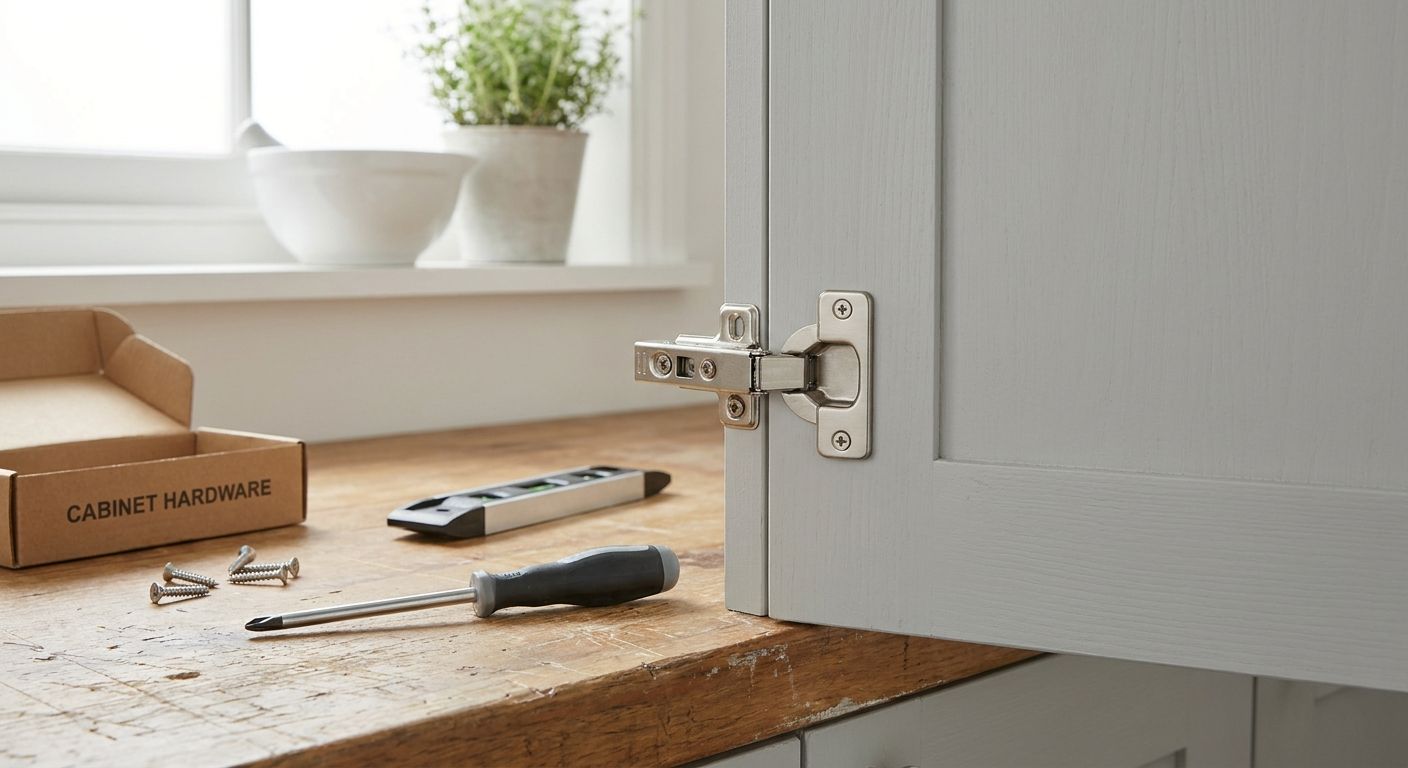
Self-closing cabinet hinges are the cheapest line item in a budget kitchen update that changes how the kitchen feels every single day — no slammed doors, no sagging half-open cabinets, and a swap that costs a fraction of new cabinet boxes. This guide ranks the hinge types worth buying for a 2026 budget kitchen update and flags the ones that look like a bargain but aren't.
- European concealed self-closing cabinet hinges with a 35mm cup bore are the safest buy for a 2026 budget kitchen update — verdict: Buy.
- Face-frame soft-close hinges retrofit standard framed cabinets without replacing the cabinet box.
- Skip unbranded clip-on dampers with plastic soft-close inserts — they're the first part to fail.
- Inset soft-close hinges cost more per pair but solve the classic inset-door slam problem.
- Bolt-on soft-close dampers are the cheapest fix when your existing hinges still open and close cleanly.
Why this matters
Most budget kitchen updates spend the whole hardware line on new pulls and knobs, because that's what shows up in the before-and-after photo. Hinges get ignored because once the door is closed, nobody sees them.
That's exactly why they're worth fixing first. A door that slams every time someone closes it wears the cabinet box, the finish, and everyone's patience — and it's usually the loudest thing in the room. Before you shop, it helps to know the difference between soft-close cabinet hinges and true self-closing hinges, because the two terms get used interchangeably and they're not the same mechanism.
Self-closing hinges use spring tension to pull the door shut on their own past a set point. Soft-close hinges add a hydraulic or dashpot damper that slows the final few inches so the door settles instead of slamming. Most of what's sold as "self-closing cabinet hinges" in 2026 combines both — spring-driven closing with a damped final approach — and that combination is what this list ranks.
How we ranked
Each hinge category on this list is scored on four things that matter more than brand name: compatibility span (framed vs. frameless, overlay vs. inset), retrofit difficulty (does it use existing holes or require new mortises), opening angle range, and price relative to replacing the cabinet door or box outright. The rankings pull from aggregated cabinet hardware category standards, not a single manufacturer's spec sheet, so a hinge that only fits one door style automatically scores lower than one that fits most kitchens built in the last two decades.
The ranked list
1. European concealed self-close hinge (35mm cup) — the workhorse pick
The 35mm cup bore is the standard mortise size used across most frameless cabinets and a large share of framed kitchens built since the 1990s. It mortises into the door, bolts to a mounting plate on the cabinet side, and closes the door under spring tension with a damped final approach. Standard opening angle runs 110°, and wide-opening or lazy susan versions reach up to 165°.
For a 2026 budget kitchen update, this is the single easiest hinge to source because nearly every major hardware brand makes a version that drops into an existing 35mm bore without new drilling. Check the European concealed hinge options if your kitchen is frameless before you order — cup depth varies slightly between brands.
Verdict: Buy.
2. Face-frame soft-close hinge — the retrofit fix for framed cabinets
Framed, or face-frame, cabinets mount the hinge to a face-frame stile instead of a full cabinet side panel. The overlay — how much of the door covers the frame — determines which hinge you need, and most stock and semi-custom framed kitchens use a standard overlay rather than a custom one.
Because face-frame construction dominates kitchens built through the 2010s, this is the most common category for anyone updating an older kitchen in 2026 instead of replacing boxes. Confirm your overlay measurement before you buy — see soft-close hinges for face-frame cabinets for how to check it without removing a door.
Verdict: Buy.
3. Inset soft-close hinge — the flush-door fix
Inset doors sit flush with the cabinet frame instead of covering it, so the hinge mortises into both the door and the frame with almost no margin for error. Self-close matters more here because an inset door out of alignment by even a couple millimeters shows a visible, uneven reveal around every edge.
These hinges cost more per pair than concealed cup hinges and take longer to install correctly. They're worth it if your kitchen already has inset doors — not worth converting overlay doors to inset just to use them.
Verdict: Consider.
4. No-drill clip-on soft-close damper — the shortcut, handle with care
Some manufacturers sell a soft-close insert that clips onto an existing 35mm cup hinge without drilling anything new. It's the cheapest fix on this list and the fastest — a few minutes per door with no cabinet disassembly.
The catch is fit consistency. Cup depth and hinge geometry vary by brand, and low-cost dampers built with plastic internals wear out faster than a hinge with an integrated soft-close cam. Test one door before committing a whole kitchen's budget to it.
Verdict: Hold.
5. Heavy-duty soft-close hinge — the pick for pantry and tall doors
Pantry doors, tall pull-out cabinets, and any door well over standard base-cabinet height put more leverage on a hinge than a typical 12 to 18 inch door does. A light-duty self-close hinge rated for standard doors will sag or lose closing tension faster under that extra weight and swing.
Buying a heavy-duty rated hinge for just those specific doors — and a standard hinge everywhere else — keeps a 2026 budget kitchen update from over-spending on hardware the rest of the kitchen doesn't need.
Verdict: Buy for pantry and tall doors, Skip for standard base cabinets.
6. Bolt-on soft-close damper — the budget move for undamaged hinges
If your existing hinges still open and close cleanly and the only problem is the slam, a separate soft-close damper mounted to the cabinet or door frame solves the noise without replacing hardware that isn't broken. It's reversible too, which matters if you're updating a rental or a house you plan to sell.
This is the cheapest single item on the whole list, and it pairs well with a broader fix — see how to stop cabinet doors from slamming shut for the full walkthrough on matching dampers to hinge type.
Verdict: Consider.
Comparison table
| Hinge type | Best for | Opening angle | Install difficulty | Verdict |
|---|---|---|---|---|
| European concealed (35mm cup) | Frameless & modern cabinets | Standard 110° | Easy — matches existing bore | Buy |
| Face-frame soft-close | Framed, traditional kitchens | Standard, overlay-dependent | Moderate — overlay-specific | Buy |
| Inset soft-close | Flush inset doors | Narrower than overlay hinges | Advanced | Consider |
| No-drill clip-on damper | Existing 35mm hinges | Depends on host hinge | Easiest | Hold |
| Heavy-duty soft-close | Pantry & tall doors | Wide, up to 165° | Moderate | Buy for tall doors |
| Bolt-on soft-close damper | Undamaged hinges, rentals | N/A | Easiest | Consider |
Where to buy
- Match the hinge and mounting plate from the same product line. Mixing brands on cup-and-plate systems is the most common cause of a door that sags a few weeks after install, even when both parts look identical.
- Confirm the overlay measurement before ordering, not the door style. Overlay — the amount of door covering the face frame — is the number that determines fit; two doors that look the same can need different hinges.
- Order one hinge before you order a full set on an unfamiliar brand. Confirm it seats cleanly in the existing 35mm bore and closes without binding, then buy enough for the rest of the kitchen.
FAQ
What's the best self-closing cabinet hinge for a budget kitchen update in 2026?
A European concealed self-closing hinge with a standard 35mm cup bore is the best pick for most budget kitchen updates in 2026, since it fits both frameless and many framed cabinet boxes without new drilling. Face-frame soft-close hinges are the right call instead if your kitchen has traditional framed cabinet construction.
Is a soft-close hinge the same as a self-closing hinge?
No — a self-closing hinge uses spring tension to pull the door shut on its own, while a soft-close hinge adds a damper that slows the final approach so it doesn't slam. Most hinges sold in 2026 combine both mechanisms in one unit.
Can I replace regular hinges with self-closing hinges without drilling new holes?
Yes, if your existing hinges use a standard 35mm cup bore, a like-for-like self-closing replacement usually drops into the same holes. Overlay and inset hinge styles are less forgiving and sometimes require new mortising.
Do self-closing hinges work on inset cabinet doors?
Yes, inset soft-close hinges exist specifically for flush-mounted doors, but they cost more per pair and take longer to install correctly than concealed cup hinges. They're worth it only if your cabinets are already built with inset doors.
What cup bore size do most kitchen cabinets use?
Most kitchen cabinets built since the 1990s use a 35mm cup bore for concealed European-style hinges. Older or custom-built cabinets sometimes use a different bore size, so measure before ordering.
Should I replace all my cabinet hinges at once or one at a time?
Test one hinge on one door first if you're trying an unfamiliar brand, then order the rest of the kitchen's worth once you've confirmed the fit and close action. Replacing everything at once without testing risks a full return if the cup depth doesn't match.
Are heavy-duty hinges necessary for every cabinet door?
No — heavy-duty soft-close hinges are worth the extra cost only on pantry doors and tall cabinets where the door's weight and swing put more strain on the hinge. Standard base cabinet doors do fine on a standard-rated self-close hinge.
Can a soft-close damper fix a slamming door without replacing the hinge?
Yes, a bolt-on soft-close damper mounts to the cabinet or door and slows the close without touching the existing hinge. It's the cheapest fix on the list and works as long as the hinge itself still opens and closes cleanly.
One last thing
Hinges are the only hardware in a kitchen that disappear once the door is closed, yet get used more times per day than any pull or knob in the room. If the budget only stretches to a handful of doors this year, start with the cabinets nearest the sink and stove — those get opened and closed the most, and they're the ones where a hinge failure shows up first.