

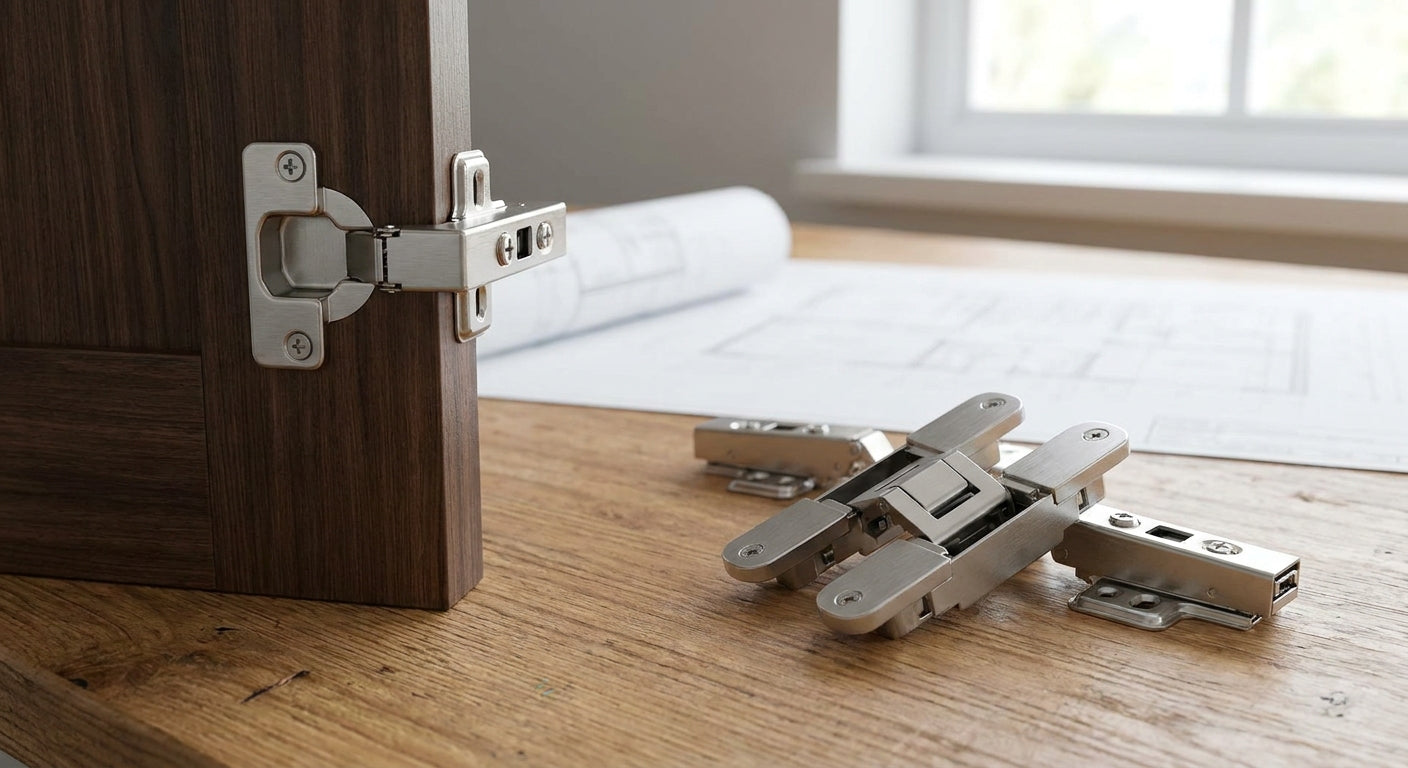
Frameless cabinet boxes need a different hinge than face-frame cabinets — get the overlay, cup size, or opening angle wrong and doors sag, bind, or won't close flush. This guide breaks down what actually matters when buying frameless cabinet hinges in 2026, who needs which type, and which specs to skip.
Shop cabinet hinges
Every cabinet hinge we carry, in one place — filter by overlay, mount type, and brand.
Browse Cabinet Hinges →- Frameless cabinet hinges use a 35mm cup bored directly into the door — face-frame butt hinges don't work here.
- European concealed hinges with a 110-degree opening angle cover most frameless kitchen and vanity builds. Buy.
- Soft-close versions add 2-4 seconds of controlled closing and cost roughly $2-4 more per hinge in 2026.
- Inset frameless doors need a specialized inset hinge, not a standard overlay hinge — check before ordering.
- Cheap cup hinges without a steel baseplate loosen within a year on heavy solid-wood doors — skip them.
Shop the picks from this guide
In stock at Knobs.co · Free shipping on hardware orders $99+ · 110% price match
-
 Amerock
Functional Hardware 3/8'' Offset Non-Self Closing Face Mount Cabinet Hinge - 1 Pair BPR3406Antique Copper
Amerock
Functional Hardware 3/8'' Offset Non-Self Closing Face Mount Cabinet Hinge - 1 Pair BPR3406Antique Copper
$6.99
$8.22 -
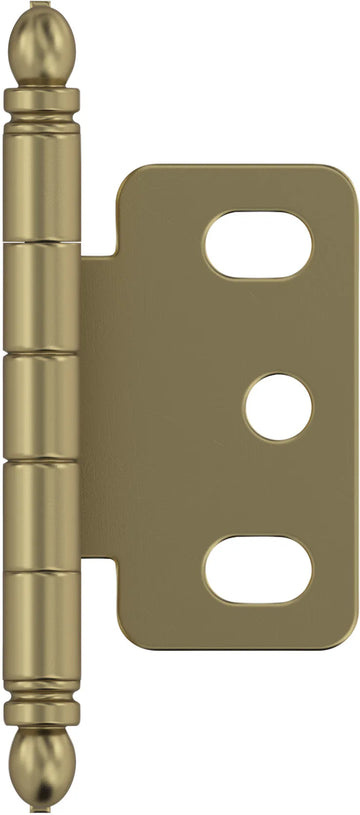 Amerock
Functional Hardware 3/4'' Door Thickness Full Inset Partial Wrap Ball Tip Cabinet Hinge - Single Hinge PK3180Golden Champagne
Amerock
Functional Hardware 3/4'' Door Thickness Full Inset Partial Wrap Ball Tip Cabinet Hinge - Single Hinge PK3180Golden Champagne
$5.90
$6.93 -
 Amerock
Functional Hardware 1/2'' Overlay Double Demountable Cabinet Hinge - 1 Pair BPR8704Burnished Brass
Amerock
Functional Hardware 1/2'' Overlay Double Demountable Cabinet Hinge - 1 Pair BPR8704Burnished Brass
$12.95
$15.23 -
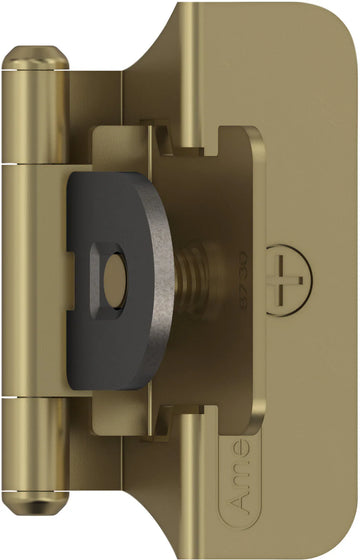 Amerock
Functional Hardware 1/4'' Overlay Double Demountable Cabinet Hinge - 1 Pair BPR8701Golden Champagne
Amerock
Functional Hardware 1/4'' Overlay Double Demountable Cabinet Hinge - 1 Pair BPR8701Golden Champagne
$12.95
$15.23 -
 Amerock
Functional Hardware Variable Overlay Self Closing Face Mount Cabinet Hinge - 1 Pair BPR3429Polished Chrome
Amerock
Functional Hardware Variable Overlay Self Closing Face Mount Cabinet Hinge - 1 Pair BPR3429Polished Chrome
$5.32
$6.25 -
 Amerock
Functional Hardware 3/4'' Door Thickness Full Inset Full Wrap Ball Tip Cabinet Hinge - Single Hinge PK3175Antique Brass
Amerock
Functional Hardware 3/4'' Door Thickness Full Inset Full Wrap Ball Tip Cabinet Hinge - Single Hinge PK3175Antique Brass
$5.56
$6.54


Why this matters
Frameless cabinets — sometimes called European-style or full-access cabinets — have no face frame to hang a hinge on. The door mounts directly to the cabinet side panel using a concealed hinge that sits inside a 35mm bored cup, with a base plate that screws (or clips) to the interior wall of the box. Order a face-frame hinge for one of these builds and it simply has nothing to attach to.
This matters more in 2026 than it did a decade ago because RTA and flat-pack cabinet lines — the boxes most contractors and DIYers now install in kitchens, closets, and laundry rooms — ship pre-bored for 35mm cup hinges as the default, not the exception. Get the hinge spec wrong and you're either redrilling a $200 cabinet door or living with a door that doesn't sit flush.
Who frameless cabinet hinges are for
This guide is for anyone building or renovating with frameless (European-style) cabinet boxes: kitchen remodelers converting from face-frame to full-overlay cabinetry, cabinet makers and millwork shops running frameless product lines, contractors installing RTA boxes for clients, and homeowners replacing a single hinge on an IKEA-style or flat-pack cabinet. If your cabinet door sits flush against the box with no visible wood frame around the opening, you're in frameless territory, and European concealed hinges for frameless cabinets are the category you're shopping.
If you're working on a face-frame cabinet — the kind with a visible wood frame around each door opening — this is the wrong guide. Those cabinets take a different hinge geometry entirely, usually a butt hinge or a face-frame-specific concealed hinge.
What to look for in frameless cabinet hinges
Overlay type: full, half, or inset
Most frameless cabinet doors use full overlay, meaning the door covers the entire cabinet edge with no gap. Half overlay shows up when two doors share a center support and each door covers roughly half the edge. Inset is rare on frameless boxes but does happen on furniture-grade builds, and it needs its own hinge geometry — an inset frameless hinge, not a standard overlay hinge with the mounting plate adjusted.
Buying the wrong overlay type is the single most common return reason on cabinet hinges. Measure your door's coverage over the cabinet edge before ordering, not after.
Cup diameter and boring depth
35mm is the standard cup diameter across nearly every European-style hinge sold in the US in 2026, whether the brand is Blum, Salice, Grass, or a generic clone. What varies is boring depth — usually 11.5mm to 13mm — and how close to the door edge the cup sits. A door that's already bored for one hinge brand will almost always accept another 35mm-cup hinge, which is why frameless hardware is easier to cross-shop than most buyers expect.
Opening angle
Standard frameless hinges open to 95 or 110 degrees, which covers the vast majority of kitchen and bathroom cabinet doors. Corner cabinets, lazy susans, and doors next to appliances often need a wide-angle hinge — 165 or even 170 degrees — so the door swings clear of an adjacent panel or handle. Check the cabinet layout before defaulting to a standard-angle hinge on every door in the run.
Soft-close vs standard
Soft-close hinges use an internal damper to slow the last few inches of the door's swing, eliminating slam noise and reducing wear on the hinge and door over time. They cost more per unit — typically a few dollars more than a standard hinge — but on a full kitchen with 20-30 doors, that adds up fast. Soft-close cabinet hinges are worth the upcharge on any cabinet a household uses daily; skip them on rarely opened storage like attic or utility cabinets if budget is tight.
Base plate and mounting style
Screw-on base plates are the most common and most secure, especially on particleboard or MDF cabinet sides where screw-in strength matters. Clip-on plates let you snap the hinge arm on and off without a screwdriver, which speeds up production runs for cabinet shops but isn't necessarily stronger. Confirm your cabinet side panel thickness — typically 5/8 inch to 3/4 inch on frameless boxes — matches the plate's screw length before ordering in bulk.
Brand cross-compatibility
Blum, Salice, and Grass dominate the frameless hinge market, and their 35mm cup hinges are largely interchangeable with each other's base plates, though exact hole spacing can shift by a millimeter or two between brands. If you're matching new hinges to an existing cabinet run, check the base plate hole pattern before assuming any 35mm hinge will drop in without redrilling.
Top picks for frameless cabinet builds
The safe pick — 110-degree soft-close full overlay hinge. Covers roughly 80% of standard frameless kitchen and vanity doors. Look for an 8mm to 9mm cup depth and a steel base plate rated for at least 20 lbs of door weight. Buy — this is the default spec for most frameless remodels in 2026, and Knobs.co's soft-close cabinet hinges guide breaks down the sizing by door weight.
The wildcard — inset frameless hinge. Furniture-grade frameless builds sometimes use an inset door for a flush, seamless look. This hinge type sits differently in the cup and needs a matched base plate depth, usually 0mm to 3mm offset. Consider it only if your doors are actually inset — read the inset cabinet hinges breakdown before ordering, since the wrong offset leaves a visible gap.
The DIY-friendly pick — pre-bored 35mm cup hinge with a printed drilling template. If you're hanging doors without a shop-grade boring machine, a hinge that ships with a paper or plastic drilling template saves you from off-center cups. Buy for any first-time frameless install — the step-by-step guide to installing European concealed hinges walks through cup placement and screw torque.
The corner-cabinet upgrade — 165-degree wide-angle hinge. Standard 110-degree hinges won't clear an adjacent door or a pull-out shelf on tight corner cabinets. A wide-angle hinge adds swing clearance at a modest cost premium, usually $3-6 more per unit than a standard hinge in 2026. Consider it for any cabinet within 6 inches of a wall, appliance, or another door — choosing the right cabinet hinge covers angle selection by cabinet position.
What to avoid
- Face-frame butt hinges marketed as "universal." Full-wrap and partial-wrap butt hinges are built for face-frame or inset doors with a visible frame to screw into — they have no cup, so they physically can't mount to a frameless box's flat side panel.
- No-name plastic cup hinges without a steel base plate. They loosen within a year under daily use, especially on heavier solid-wood or laminate doors over 20 lbs.
- Hinges with fixed, non-adjustable arms. Frameless doors need the three-way adjustment — in/out, up/down, left/right — that comes standard on branded European hinges. Without it, you can't correct a door that sits crooked after the box settles.
“If the door doesn't sit flush after three turns of the adjustment screw, the hinge is wrong for the job.”
Frameless hinge comparison
| Pick | Overlay | Opening angle | Soft-close | Verdict |
|---|---|---|---|---|
| Standard full overlay | Full | 110\u00b0 | Optional | Buy |
| Inset frameless | Inset | 95\u00b0-110\u00b0 | Optional | Consider |
| Pre-bored DIY hinge | Full | 110\u00b0 | Optional | Buy |
| Wide-angle corner hinge | Full | 165\u00b0 | Optional | Consider |
| No-name plastic cup hinge | Full | Varies | No | Skip |
FAQ
What's the best hinge for frameless cabinets?
A 110-degree soft-close European concealed hinge with a 35mm cup and steel base plate covers most frameless kitchen and vanity doors in 2026. Wide-angle 165-degree hinges are better for corner cabinets or doors next to appliances.
Are frameless cabinet hinges the same as face-frame hinges?
No. Frameless hinges use a 35mm cup bored into the door and mount to a flat base plate on the cabinet side panel, while face-frame hinges attach to a visible wood frame around the door opening. The two are not interchangeable.
Is Blum better than a generic 35mm cup hinge?
Blum hinges are built to tighter tolerances and hold adjustment longer under daily use, which matters on high-traffic kitchen cabinets. A generic 35mm hinge with a steel base plate performs fine on lower-use cabinets like laundry or utility rooms.
How much does a frameless cabinet hinge cost?
Standard 35mm concealed hinges typically run a few dollars per unit, with soft-close versions costing $2-4 more per hinge in 2026. A full kitchen with 20-30 doors can add $60-120 in soft-close upcharges alone.
Can I install frameless cabinet hinges myself?
Yes, with a 35mm Forstner bit and a drilling template or jig for accurate cup placement. Most DIYers can hang a standard overlay hinge in under 15 minutes per door once the cup is bored correctly.
What opening angle do I need for a corner cabinet?
Corner cabinets and doors next to appliances usually need a 165-degree wide-angle hinge to clear adjacent panels or pull-out hardware. Standard 95-110 degree hinges bind or stop short in tight corners.
Do all frameless cabinet doors need soft-close hinges?
No. Soft-close is worth the extra cost on daily-use cabinets like kitchen and bathroom doors, but standard hinges are fine on rarely opened storage like attic or garage cabinets.
How many hinges does a frameless cabinet door need?
Doors under 40 inches tall typically use two hinges; taller pantry or wardrobe doors over 60 inches usually need three to prevent sagging. Heavier solid-wood doors may need an extra hinge regardless of height.
One last thing
Most buyers assume matching hinge brand to cabinet brand is required — it isn't. The 35mm cup is close to a universal standard across Blum, Salice, Grass, and most house-brand hinges sold in 2026, so a cross-shop on price rarely causes a fit problem. What actually causes returns is skipping the overlay-type measurement, not the brand name.


