

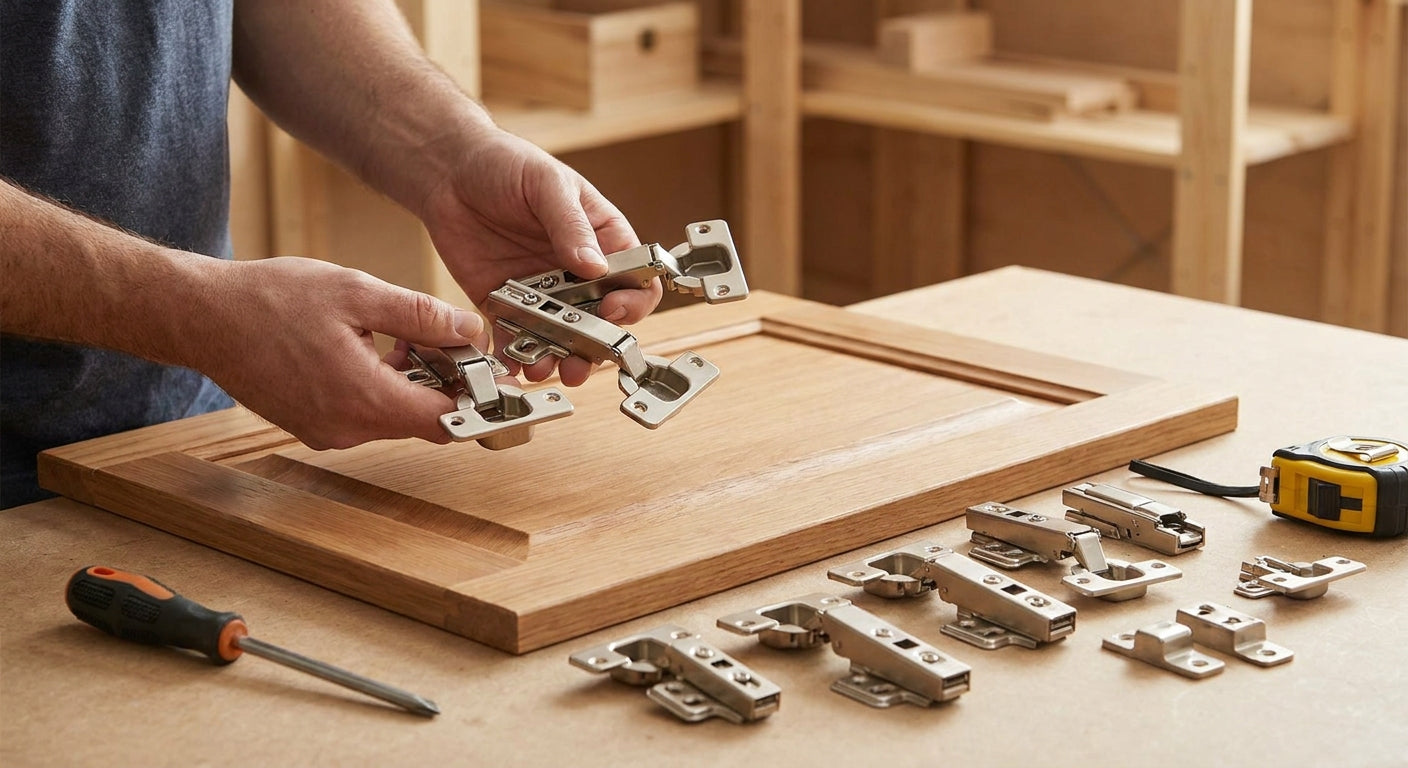
Cabinet hinges look simple until you order the wrong overlay type and your doors won't sit flush. This guide walks through picking the right hinge for your cabinet construction, overlay, and finish before you spend a dollar.
Shop cabinet hinges
Every cabinet hinge we carry, in one place — filter by overlay, mount type, and brand.
Browse Cabinet Hinges →TL;DR: Match your hinge to three things in this order: cabinet construction (face frame vs. frameless), door overlay (full, partial, or inset), and finish. For most 2026 kitchen remodels, a soft-close concealed European hinge in the finish that matches your pulls is the right call — Buy if your doors are full overlay, Consider partial-overlay hardware if you're mixing old and new cabinets, and Skip exposed decorative hinges unless your cabinets are genuinely face-frame with inset doors. Getting hinge type wrong is the single most common return reason in cabinet hardware, more common than knob or pull mismatches.
Why this matters
A hinge that's off by even 1/8 inch in overlay spec will leave your cabinet door binding, gapping, or not closing flush against the frame. Unlike a knob or pull, which is purely cosmetic, a hinge is structural — pick wrong and the door sags or the hinge cup pulls out of the wood within a year. Knobs.co sells cabinet hinges across dozens of brands specifically because construction type varies by manufacturer, decade, and region, and a hinge that fits a 2010s frameless cabinet won't fit a 1990s face-frame one.
What you'll need
- A tape measure and calipers (for cup diameter and overlay depth)
- One removed door and its existing hinge, if you're replacing rather than building new
- A drill with a Forstner bit sized to your hinge cup (typically 35mm for concealed hinges)
- A pencil and a hinge template or jig for repeat spacing
- A screwdriver matched to the hinge screw head
- Your cabinet door and box in front of you — measuring from a photo alone gets the overlay wrong more often than not
If you're replacing hardware on face-frame cabinets, check how to install cabinet hinges on face frame cabinets before you order, since face-frame hinges and frameless hinges are not interchangeable.
The steps
1. Identify your cabinet construction type
This determines almost everything else. Face-frame cabinets have a solid wood frame across the front of the box; frameless (also called full-access or European-style) cabinets have the door mounted directly to the box side with no frame lip. Run your hand along the cabinet opening — if you feel a 1.5-inch wood strip around the edge, it's face frame. Get this wrong and every hinge you order afterward will be the wrong depth.
Common mistake: assuming all modern kitchens are frameless. Plenty of 2026-built cabinetry still uses face-frame construction, especially in traditional and farmhouse styles.
2. Determine your door overlay
Measure how much of the cabinet frame or box edge your door covers when closed. Full overlay covers nearly the entire frame, leaving a small gap between doors (common on frameless cabinets). Partial overlay covers about half the frame, leaving more wood visible (common when two doors share one frame stile). Inset doors sit flush inside the frame opening, with the door edge and frame edge nearly touching.
Each overlay type needs a different hinge — a full-overlay hinge on an inset door will jam the door shut. This is the single step most DIYers skip, and it's the most expensive mistake to fix after installation.
3. Measure the hinge cup diameter and boring depth
On concealed hinges, the round cup that sits inside the door is almost always 35mm across, but boring depth varies by hinge brand and door thickness. Standard cabinet doors run 3/4 inch thick; anything thinner needs a shallower-bore hinge or you'll drill through the door face. Measure your existing door thickness with calipers before ordering replacements.
Expected outcome: you should be able to state cup diameter, door thickness, and overlay type in one sentence before moving to step four.
4. Decide between concealed and exposed hinges
Concealed (European-style) hinges hide inside the door and box, showing nothing from the front — the standard choice for shaker, flat-front, and most contemporary cabinets in 2026. Exposed hinges (butt hinges, decorative hinges) show on the outside of the door and work as a design feature on face-frame, inset-door cabinets styled traditional or farmhouse.
If your doors are inset and your kitchen leans traditional, an exposed decorative hinge does double duty as hardware and ornament. If your doors are overlay and your kitchen is anything else, go concealed.
5. Choose soft-close or standard closing action
Soft-close hinges use a built-in damper to stop the door from slamming, and by 2026 they're close to standard on new cabinet installs because they cut down on wear at the hinge cup over years of daily use. Standard hinges cost less and work fine on lower-traffic cabinets like a laundry room or a rarely-opened pantry door.
For kitchens specifically, soft-close is worth the few extra dollars per hinge — read best soft-close hinges for face frame cabinets if your cabinets fit that construction type. Buy soft-close for any door opened more than a handful of times a day.
6. Match hinge count to door height and weight
Doors under 30 inches tall typically need two hinges; anything from 30 to 48 inches needs three; tall pantry or full-height doors often need four to prevent sagging. Heavier doors — solid wood, glass-front, or oversized panels — need the higher hinge count regardless of height, since the extra hinge distributes weight and stops the top corner from drooping over time.
Common mistake: reusing a two-hinge layout on a new door that's taller or heavier than the original. If the old door sagged, that's your sign to add a hinge, not repeat the same spec.
7. Match the finish to your existing or planned hardware
Hinges in a mismatched finish next to matte black pulls or brushed nickel knobs stand out in a way that reads as unfinished. Order hinge finish alongside your knob and pull order so everything ships and installs together, rather than hunting for a finish match after the fact.
Troubleshooting
- Door doesn't sit flush after installing a new hinge: you likely used the wrong overlay hinge — recheck full vs. partial vs. inset before assuming the hinge is defective.
- Hinge cup won't seat fully in the door: the Forstner bit bored too shallow or too small; most concealed hinges need a 35mm bore at roughly 1/2-inch depth.
- Door sags at the top corner within months: you're under-hinged for the door's weight or height — add a third or fourth hinge.
- Soft-close feature stopped working: the damper inside the hinge wears out faster on doors that get slammed shut instead of pushed; this isn't a defect, it's usage pattern.
- Screws won't hold in the cabinet box: the box material is likely particleboard rather than plywood — use slightly longer screws or add a threaded insert.
- Hinge squeaks after a year: a drop of household oil on the pivot point fixes most squeaks; if it persists, the hinge itself may be worn and due for replacement.
Tools and resources
- A 35mm Forstner bit and drill for boring concealed hinge cups
- Calipers for measuring door thickness and existing hinge cup size
- Soft-close hinges for inset cabinet doors if your kitchen uses inset construction
- A hinge jig for repeat spacing across multiple identical doors
- Knobs.co stocks concealed and exposed hinges across the construction types and overlays covered above, sourced from the same major brands that supply the rest of their 50,000-plus SKU catalog
What to do next
Once your hinges are ordered and confirmed against overlay, cup size, and door weight, move on to matching pulls and knobs in the same finish so the whole cabinet reads as one cohesive hardware set rather than mismatched pieces bought at different times.
FAQ
What's the best cabinet hinge for a kitchen remodel in 2026? For full-overlay frameless kitchens, a soft-close concealed European hinge is the standard choice in 2026. For face-frame kitchens with inset doors, an exposed decorative or butt hinge fits the construction and the traditional look.
Is soft-close better than standard closing on cabinet hinges? Soft-close reduces slamming wear and noise, making it the better pick for high-traffic kitchen cabinets. Standard hinges are fine for low-traffic spots like laundry rooms or rarely-used pantry doors.
How do I know if my cabinets are face frame or frameless? Check the front edge of the cabinet box — a face-frame cabinet has a solid wood strip around 1.5 inches wide framing the opening, while frameless cabinets mount the door directly to the box side with no visible frame.
How many hinges does one cabinet door need? Doors under 30 inches typically need two hinges, doors from 30 to 48 inches need three, and taller or heavier doors need three to four to prevent sagging.
Can I mix hinge brands with my existing cabinet knobs and pulls? Yes, hinges and knobs don't need to be the same manufacturer, but matching the finish across all hardware keeps the kitchen looking intentional rather than assembled piecemeal.
What size hole do I drill for a concealed cabinet hinge? Most concealed European-style hinges use a 35mm cup that requires a 35mm Forstner bit bored to roughly 1/2-inch depth, though boring depth varies slightly by door thickness.
How much does it cost to replace cabinet hinges? Cabinet hinges typically run a few dollars to around fifteen dollars per hinge depending on brand, soft-close feature, and finish, with most kitchens needing between fourteen and thirty hinges total.
Do inset cabinet doors need special hinges? Yes, inset doors need hinges specifically rated for inset construction since standard overlay hinges will cause the door to bind against the frame when closed.
One last thing
The overlay measurement is the step people skip because it feels obvious, and it's the reason so many hinge returns happen in the first place. Measure the actual overlay on the actual door in front of you in 2026 before you place an order — don't trust a spec sheet from a cabinet installed a decade ago, because manufacturers have shifted overlay standards more than once since then.


