

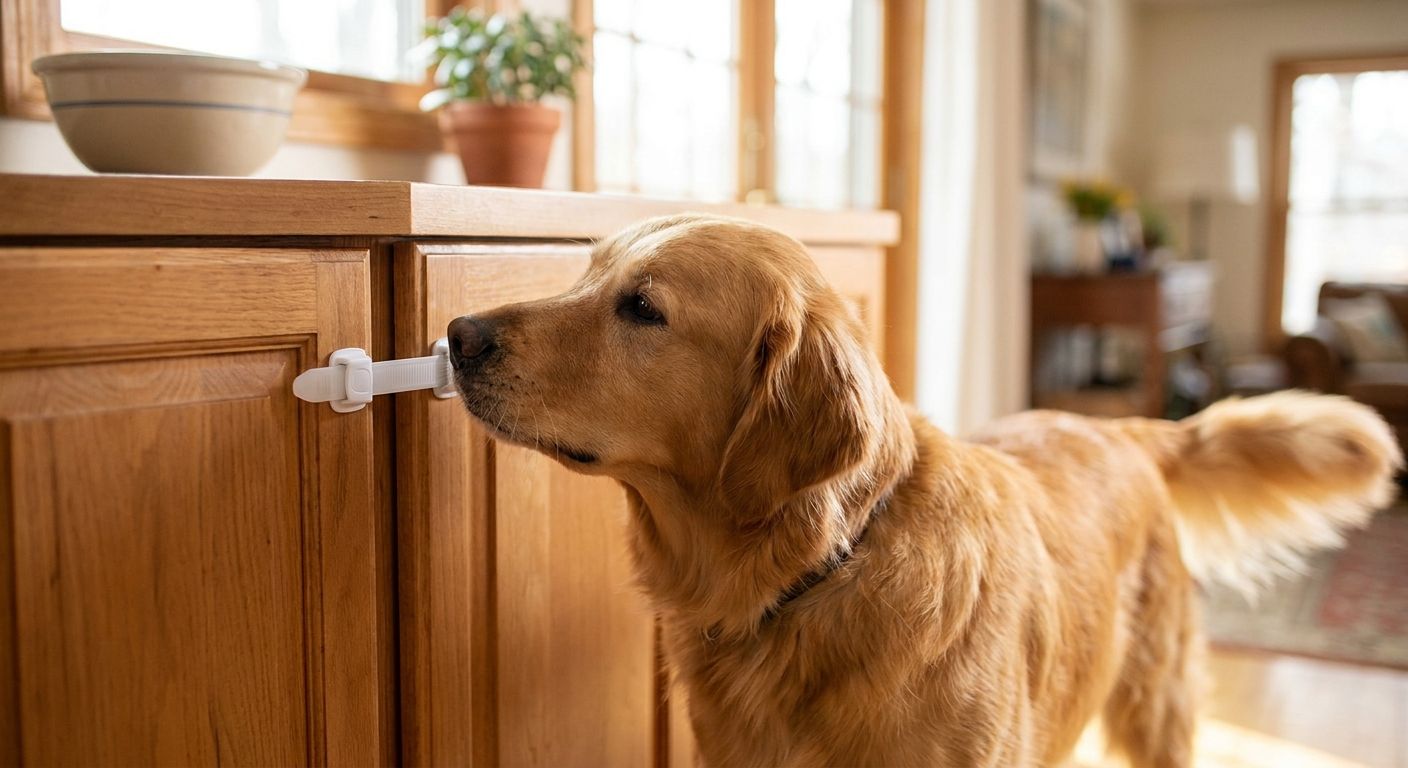
Pet-proof cabinet latches for homes with dogs are hardware upgrades — magnetic catches, childproof-rated locks, and self-closing hinges — installed on lower cabinets to stop a dog's nose or paw from prying a door open. Dogs push lower and more persistently than toddlers, so the latch has to hold against steady nose pressure over time, not just a quick tug from small fingers.
Shop the finish
Every brass knob and pull we carry, in one place — filter by size, style, and brand.
Browse Brass Cabinet Hardware →- Pet proof cabinet latches for dogs work best as magnetic catches or self-closing hinges on low cabinets, not knob locks alone.
- Childproof-rated cabinet locks built for kids also stop most medium and large dogs from nosing doors open.
- Self-closing hinges shut the door automatically after every use, removing the gap a dog needs to get a nose in.
- Skip single strap locks in kitchens with food-motivated dogs — nose pressure defeats most strap designs within weeks.
Why cabinet latches matter for homes with dogs
A dog doesn't need a hand or a thumb to open a cabinet — a nose wedged into a gap and steady, repeated pressure does the job on most standard doors. The cabinets at floor level are the ones under attack: trash, pet food, and cleaning supplies all sit right at nose height, and that's exactly where most homeowners skip hardware because "the dog's never gotten in before."
The fix isn't different in kind from childproofing, but it is different in degree. A toddler lock rated for small fingers may not survive a 24/7 routine of a dog leaning its full body weight against a pantry door. Cabinet catches and latches for overlay doors need to be matched to both the door style and the size of the dog testing them, and that match is where most pet-proofing projects go wrong in 2026.
Step 1: Audit which cabinets your dog actually targets
Walk the kitchen and mudroom before buying anything. Most dogs concentrate their efforts on two or three doors, not every cabinet in the house.
- Check the under-sink cabinet first — trash and cleaning chemicals live there and smell strongest at floor level
- Look for nose smudges, scratch marks, or loosened doors on cabinets your dog has already tried
- Note pantry and food-storage cabinets separately; food-motivated dogs try harder and more often
- Confirm door swing direction — an out-swing door is easier for a dog to nose open than an in-swing door
Step 2: Match the latch type to the door style
A magnetic catch made for a face-frame overlay door won't necessarily fit a frameless European-style cabinet, and vice versa. Measure before ordering hardware.
- Face-frame overlay doors typically take a mounted catch inside the frame
- Frameless cabinets often already run a hinge with adjustable closing tension
- Measure actual door thickness — most catches and hinges list a supported range
- Check for an existing strike plate hole from prior hardware before drilling new ones
Cabinet catches and latches for overlay doors covers fit differences between overlay styles in more detail if your cabinets are a mix of both.
Step 3: Install magnetic or roller catches on low cabinets first
Start with the cabinets your dog has already targeted, not the whole kitchen. A magnetic catch is the cheapest, least invasive first move.
- Mount magnetic catches to the case interior, not the door face, for a cleaner look
- Catches rated under roughly 5 lbs of pull force do little against sustained nose pressure
- Roller catches wear out faster in humid kitchens near a stove or dishwasher
- Push the door shut and pull the handle firmly after installing to confirm it holds
Full mounting steps are covered in how to install magnetic cabinet door catches, including screw placement for both wood and laminate doors.
Step 4: Add childproof-rated locks on food and chemical cabinets
Anything with an ingestion risk — dog food, human food, cleaning products, medication — deserves a stronger lock than a basic magnetic catch.
- Look for locks rated for both kids and pets, not just one or the other
- Sliding cabinet locks that bind two door handles together resist steady nose pressure better than single-door strap locks
- Adhesive-mount locks skip drilling but need a flat, clean door face to hold long-term
- Avoid single strap locks on the pet food cabinet specifically — it's the one a food-motivated dog works hardest to open
Best childproof cabinet locks for kitchen safety breaks down lock styles by cabinet type if you're outfitting more than one room.
Step 5: Switch to self-closing hinges for high-traffic doors
Cabinets opened dozens of times a day — the everyday dish cabinet, the pantry, the recycling bin door — benefit from a hinge that closes on its own instead of relying on someone remembering to latch it.
- Self-closing hinges pull the door shut automatically once it swings within a few inches of closed
- No separate catch to engage means no chance of a family member leaving it open
- Works well on cabinets that get opened and closed dozens of times daily
- Pair a self-closing hinge with a catch on any cabinet a dog has already broken into, since redundancy beats a single point of failure


Step 6: Test latch strength against nose and paw pressure
Don't trust new hardware on day one. Watch how your dog actually interacts with it before you consider the cabinet secure.
- Push steadily on the closed door for a full 10 seconds to simulate sustained nose pressure
- Observe the dog's behavior around the cabinet for at least a week before removing any physical barrier like a baby gate
- Re-test after summer heat in 2026 — humidity and temperature swings can loosen adhesive-mounted hardware
- Check screws on hinges and catches monthly during the first season of use
Step 7: Maintain hardware through the year
Pet-proofing isn't a one-time install. Hardware loosens, adhesive pads lose grip, and dogs learn.
- Retighten catch and hinge screws every few months, especially on high-traffic doors
- Replace adhesive pads once they show any lifting at the edges
- Swap out a worn magnetic catch before a dog figures out it no longer holds
- Keep a spare catch or two on hand for the pantry and trash cabinets specifically
If your dog can open a cabinet door with its nose, a single magnetic catch alone usually won't hold it closed for long — pair it with a self-closing hinge or a childproof-rated lock.
Comparing latch options for homes with dogs
| Option | Best for | Key limitation |
|---|---|---|
| Magnetic catch | Light cabinets a dog nudges occasionally | Weak catches fail under sustained nose pressure |
| Childproof-rated lock | Cabinets storing food, meds, or cleaning supplies | Adhesive versions can loosen on humid or textured door faces |
| Self-closing hinge | High-traffic doors opened dozens of times a day | Doesn't stop a determined push before the door fully swings shut |
| Touch latch | Handleless or flat-front cabinets | Needs firm, even pressure to engage — inconsistent with large dogs |
Common mistakes homes with dogs make
- Trusting a toddler-rated lock without testing it against nose pressure — a lock built for small fingers isn't automatically built for a 60-pound dog leaning into it daily.
- Latching the trash cabinet and ignoring the pantry — the pantry is often the higher-value target for a food-motivated dog and the one owners forget.
- Skipping the medication or cleaning cabinet catch because "the dog never goes near it" — until a new puppy or foster dog arrives in 2026 and everything changes.
- Choosing adhesive-mount locks on unlacquered or textured cabinet faces where the pad has nothing flat to grip.
- Forgetting to re-test hardware after a growth spurt — a puppy's nose reaches higher and pushes harder every few months.
FAQ
What's the best cabinet latch for dogs?
A self-closing hinge paired with a childproof-rated lock is the strongest combination for cabinets a dog actively targets. Magnetic catches alone work fine for cabinets a dog only occasionally nudges.
Are childproof cabinet locks strong enough for dogs?
Most childproof-rated locks hold up against medium and large dogs, especially sliding locks that bind two doors together. Single strap locks are the weakest option and often fail against sustained nose pressure.
Do self-closing hinges stop dogs from opening cabinets?
Self-closing hinges pull a door shut automatically once it's nearly closed, which removes the open gap a dog needs to get a nose in. They don't stop a dog mid-push before the door swings shut, so pair them with a catch on high-risk cabinets.
How much pressure can a dog's nose apply to a cabinet door?
A dog can apply steady, repeated pressure over minutes that most single-tug childproof hardware isn't designed to resist. That's why sustained-pressure testing matters more for dogs than for toddlers, who typically give up after a few quick pulls.
What cabinets need pet-proof latches most?
Trash, pet food, human food, and cleaning supply cabinets at floor level need latches first. These sit at nose height and carry the strongest scent draw for a dog.
Can I pet-proof cabinets without drilling?
Yes, adhesive-mount magnetic catches and childproof locks skip drilling entirely. They need a clean, flat door face to hold long-term, so unlacquered or heavily textured doors are a weaker fit.
How often should pet-proof cabinet hardware be checked?
Check screws and adhesive mounts monthly during the first season of use, then every few months after that. Humidity swings and a growing puppy both change how much pressure hardware needs to withstand.
Is a strap lock enough for a large dog?
A single strap lock is usually the weakest option and often fails against a large dog's sustained nose pressure within weeks. Sliding locks or self-closing hinges hold up better for dogs over roughly 40 pounds.
One last thing
The cabinet most homeowners latch last is the one dogs open first: the under-sink cabinet, because trash and cleaning sprays smell strongest right at floor level. Put your first latch there in 2026, not on the pantry — the pantry usually comes second once a dog gets bored of the sink cabinet.


